Category: Home & Kitchen

  • Where to Buy an Electric Kettle: The Complete Buying Guide

    Where to Buy an Electric Kettle: The Complete Buying Guide

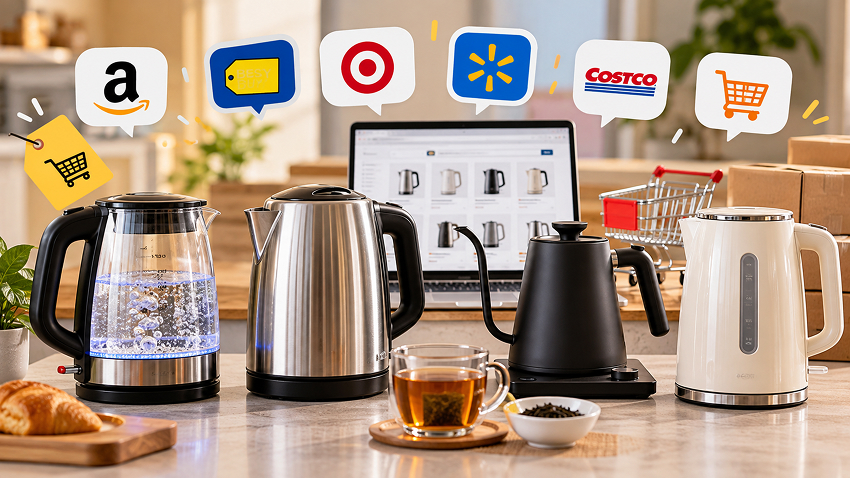
    Search “where to buy an electric kettle” and Google hands you five bare retailer category pages: product grids, filters, and zero advice. That leaves you tab-hopping between Amazon, Best Buy, Target, Walmart, and Costco trying to reverse-engineer which one is actually the best deal for the kettle you want. This guide fixes that. We’ll compare where to buy against what you’ll pay, settle the glass-vs-steel question, and hand you curated picks for every use case so you can shop with confidence in one sitting.

    Where to Buy an Electric Kettle: The Quick Answer

    If you just want the short version, here’s where each retailer wins:

    • Best overall selection and price: Amazon. Widest range, fastest shipping, the easiest returns of any online option.
    • Best for in-store pickup and easy returns: Target, Walmart, and Best Buy. Search “electric kettle near me” and these three are almost always the closest stock.
    • Best for premium and direct-from-brand: the Fellow, Cosori, and Chefman websites, where you get full warranty registration and colors the big-box stores don’t carry.
    • Best for bulk value: Costco, if you already have a membership — the return policy is famously generous.

    Now the details that decide which of those is right for you.
    What to Look for Before You Buy

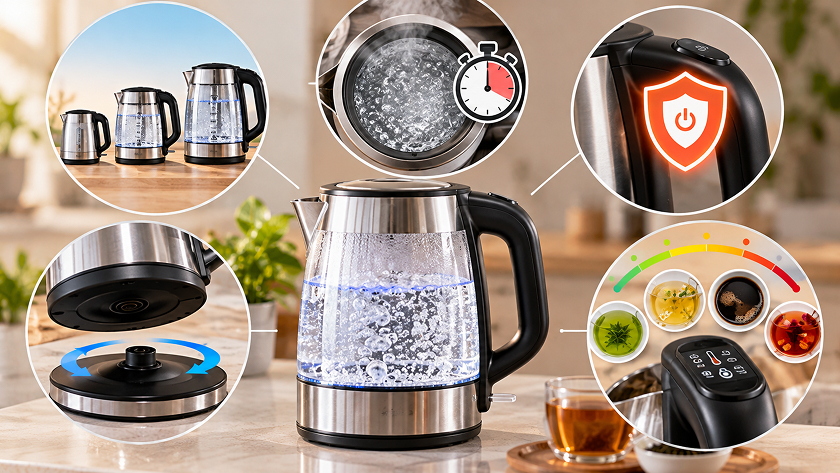
    Every kettle boils water. What separates a $15 model from a $150 one is how fast, how quietly, and how safely it does it — plus how long it lasts. Before you choose a retailer, know what you’re choosing. Here’s what to look for in an electric kettle:

    • Capacity (0.5L–1.8L): A 1.7L kettle suits a family or frequent tea drinker; a 0.5–0.8L travel size is plenty for one person or a dorm. Bigger isn’t better if you’re only boiling one mug at a time — you’ll waste energy reheating a half-empty kettle.
    • Wattage and boil speed: In the US, most kettles run 1,000–1,500 watts. A 1,500W model boils a cup in roughly 90 seconds and a full liter in about four minutes. Lower wattage means a longer wait.
    • Auto shut-off and boil-dry protection: Non-negotiable. Auto shut-off kills power the moment the water boils; boil-dry protection prevents the element from cooking itself if you forget to fill it.
    • Cordless base with 360° swivel: Lift the kettle straight off the base from any angle. Standard on almost everything now, but confirm it on ultra-budget models.
    • Temperature control: If you drink green tea (175°F) or make pour-over coffee (195–205°F), variable temperature is worth the upgrade. Boiling water scorches delicate leaves.

    If you want to understand the mechanics behind these features, our explainer on how an electric kettle works walks through the heating element and auto shut-off in plain English.

    Glass vs. Stainless Steel: Which Should You Buy?

    This is the question that stalls most buyers, so let’s settle it. Neither is universally “better” — they trade off.

    Glass lets you watch the water level and the boil, adds nothing to the taste, and looks great on a counter. The downsides: it’s more fragile, shows every water spot and mineral streak, and cheap glass models sometimes have a plastic lid or spout that touches the water.

    Stainless steel conducts heat faster, shrugs off drops, and hides limescale buildup between cleanings. The trade-off is you can’t see the water level without a side window, and a bare-metal exterior gets hot to the touch.

    So which electric kettle is better, glass or stainless steel? For pure durability and a household with kids, choose double-wall stainless steel — it stays cool outside and won’t shatter. For the healthiest electric kettle where nothing but glass and steel touches your water, pick a quality glass model or a stainless kettle with a stainless (not plastic) interior. Anyone worried about taste or plastic contact should read the spec sheet, not just the material name on the box.

    How Much Is an Electric Kettle? Price Ranges Explained

    How much does an electric kettle cost in the US? Plan on one of three tiers, and match the tier to the features you actually need:

    • Budget (under $20): Basic stainless or plastic, fast 1,500W boil, auto shut-off, and little else. Perfectly fine if you just want hot water and don’t mind a louder boil or a plastic interior.
    • Mid-range ($30–$60): Better build quality, a water-level window, all-metal or glass construction, a quieter boil, and often a keep-warm function. This is the sweet spot for most homes.
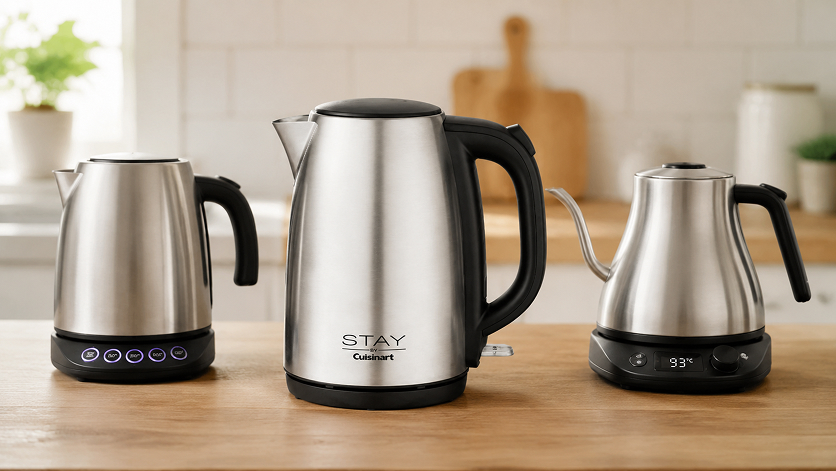
    • Premium ($70–$150+): Precise variable temperature control, gooseneck spouts for pour-over, smart-app or hold-temperature features, and materials built to last a decade. The Fellow Stagg EKG lives here.

    How much should you spend on a good electric kettle? For most people, $35–$50 buys everything you’ll use. Only go premium if you’re a serious tea or coffee drinker who wants temperature control. (Prices in Nigeria, the Philippines, and other regions vary widely with import costs and currency — we’re quoting US retail here.)

    Best Places to Buy an Electric Kettle, Compared

    Here’s the honest breakdown of the best place to buy an electric kettle, retailer by retailer:

    RetailerBest forWatch out for
    AmazonWidest selection, fast shipping, easy returns, real review volumeRead reviews carefully — some listings are unbranded rebrands
    Best BuyElectronics-grade smart and temperature-control kettles, in-store pickupSmaller basic-kettle range than the grocery-style stores
    Target / WalmartThe convenient “near me” option; strong budget-to-mid picks, same-day pickupThinner premium selection; popular colors sell out
    CostcoValue pricing on premium brands, unbeatable return policyMembership required; limited rotating selection
    Direct from brandFull warranty, exclusive colors, bundle deals (Fellow, Cosori, Chefman)Rarely the cheapest; slower shipping than Amazon

    Can you buy an electric kettle at a grocery store or pharmacy? Sometimes — larger supermarkets and drugstore chains stock a basic model or two — but selection is thin and prices aren’t competitive. Treat it as a last-minute convenience buy, not where to shop on purpose.

    Quick Picks: The Best Electric Kettle for Every Need

    Curated by use case, because “what is a good electric kettle” depends entirely on what you need it to do:

    • Quietest: Double-wall insulated models run noticeably softer. The Cosori double-wall and beep-free Fellow Corvo are the go-to for a quiet electric kettle in an open kitchen or early-morning household.
    • Smallest: A compact 0.5–0.8L travel kettle. Ideal for one person, small counters, dorms, or packing — the smallest electric kettles tuck into a cupboard easily.
    • Safest: Look for auto shut-off plus boil-dry protection plus a cool-touch double-wall exterior. That combination is the safest electric kettle setup for homes with kids or curious hands.
    • Fastest: A high-wattage (1,500W) stainless steel model. Metal conducts heat faster than glass, so the fastest-boiling electric kettles are almost always steel.
    • Most efficient: The most economical, energy-efficient electric kettle is one with precise temperature control and a keep-warm mode — you heat only to the temperature you need and skip re-boiling, which is where most wasted electricity goes. Boiling only the water you’ll use matters more than the wattage number.
    • Most reliable: Established brands with real warranties (Cuisinart, Fellow, Cosori) earn the “most reliable electric kettle” label — a stainless interior and a 2-year warranty are the signals to look for.

    Brand Origin FAQ: Where Are Popular Kettles Made?

    Buyers ask about manufacturing constantly, so here’s the transparent answer:

    • Where is the Chefman electric kettle made? Chefman is a US company based in New Jersey; its kettles are manufactured in China. Is Chefman a good brand for an electric kettle? Yes — it’s a solid, well-reviewed budget-to-mid choice.
    • Where is the Cosori electric kettle made? Cosori designs and tests in California and manufactures in China.
    • Where is the Stagg electric kettle made? Fellow’s Stagg EKG is designed in San Francisco and manufactured in China.

    The pattern is clear: nearly every mainstream kettle, budget or premium, is built in China. Country of manufacture tells you almost nothing about quality. Build materials, the warranty, and the brand’s design standards do. A well-engineered kettle made overseas outlasts a poorly-designed one made anywhere.

    Buying Online vs. In-Store: Pros and Cons

    Is it cheaper to buy an electric kettle online or in-store? Online usually wins on price and selection, but there’s a real case for buying in person:

    • Buy online for the broadest selection, the easiest price comparison, and the deepest reviews. The one risk: shipping damage, which matters most for glass kettles — inspect the box on arrival and don’t hesitate to use the return window.
    • Buy in-store if you want to feel the build quality, judge the size in person, skip the shipping wait, and carry a glass kettle home yourself instead of trusting a delivery truck. The trade-off is fewer models on the shelf.

    Our advice: research online, then buy wherever the price and return policy line up. For glass models specifically, in-store or a retailer with a no-questions return window (Amazon, Costco, Target) is the safer bet.

    Frequently Asked Questions

    What is the best place to buy an electric kettle?

    For selection, price, and easy returns, Amazon is the best overall. If you want to pick it up today or inspect it first, Target, Walmart, and Best Buy are your closest in-store options. For premium models with full warranty support, buy direct from Fellow, Cosori, or Chefman.

    How much should you spend on a good electric kettle?

    Most people are well served by a $35–$50 mid-range kettle with a water window, all-metal or glass build, and a quiet boil. Spend $70 or more only if you’re a serious tea or coffee drinker who wants variable temperature control. Under $20 gets a basic model that boils fine but skips the niceties.

    Is glass or stainless steel better for an electric kettle?

    It depends on your priority. Stainless steel heats faster, resists drops, and hides mineral buildup — best for durability and homes with kids. Glass lets you see the water, adds no taste, and looks great, but it’s more fragile. For the healthiest option, choose either a quality glass kettle or one with a fully stainless interior so no plastic touches the water.

    Are Chefman, Cosori, and Stagg kettles good quality if they’re made overseas?

    Yes. All three are American-based brands (New Jersey, California, and San Francisco respectively) that manufacture in China, like nearly every kettle on the market. Country of manufacture doesn’t determine quality — build materials, the warranty, and design standards do. All three are well-reviewed at their price points.

    Is it cheaper to buy an electric kettle online or in-store?

    Online is usually cheaper and offers far more selection, especially on Amazon. In-store shines when you want to inspect the build, avoid shipping damage on a glass kettle, or use it the same day. Research online, then buy wherever the price and return policy work best for you.

    Can I return an electric kettle if I don’t like it?

    Almost always, yes. Amazon, Target, and Walmart offer 30–90 day returns, and Costco’s return policy is among the most generous in retail. Keep the original box and receipt, and test the kettle promptly so you’re within the window if there’s a defect.
  • How to Make Milk Tea in an Electric Kettle (Step-by-Step)

    How to Make Milk Tea in an Electric Kettle (Step-by-Step)

    A proper cup of milk tea feels like it belongs on a stovetop, with a pan you stir and watch. But if all you have is an electric kettle in a dorm room, an office kitchen or a hotel, you can still make a genuinely good cup. It takes a little more attention than boiling plain water, and there’s one mistake almost everyone makes the first time, but the result is worth it.
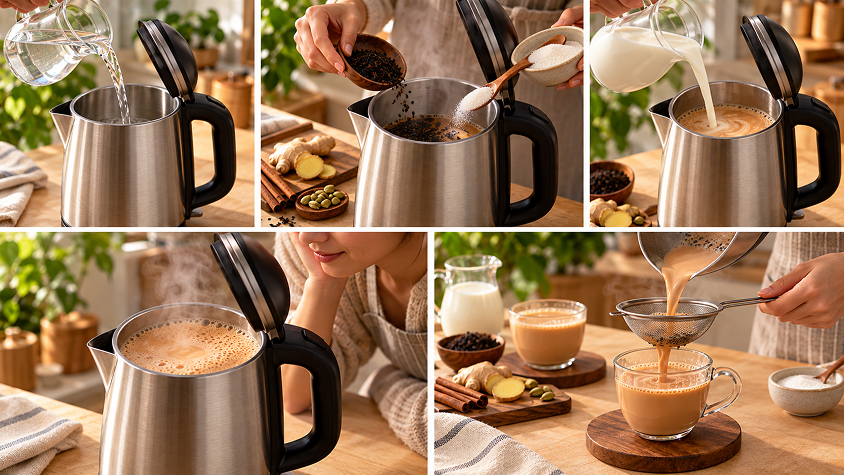
    Here’s exactly how to make milk tea using an electric kettle, including the ratios, the timing and the trick that keeps milk from erupting all over your counter.

    Can you really make milk tea in an electric kettle?

    Yes, you can, and plenty of people do it every day. The honest caveat is that milk behaves very differently from water. Water just heats and boils; milk foams up fast, climbs the sides and can scorch onto the heating element if you walk away. So while the answer to “can we make milk tea in an electric kettle” is a clear yes, it comes with a rule: stay next to it. As long as you’re watching and you don’t let it reach a hard rolling boil, a kettle handles milk tea perfectly well. A kettle with a wider opening and a stainless steel interior makes the job easier, since you can see what’s happening and it’s simpler to clean afterwards.

    What you’ll need

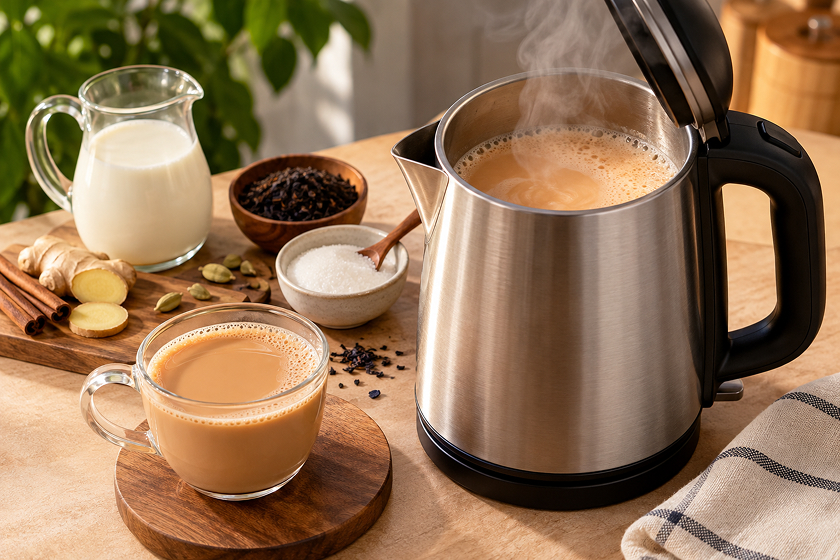
    For a single strong cup you’ll want water, milk, loose tea or a tea bag (black tea is traditional), and sugar to taste. If you like a spiced chai, keep a few cardamom pods, a slice of ginger or a pinch of cinnamon nearby. That’s it. Nothing here is fussy, and you can scale it up for two by roughly doubling everything.

    How to make milk tea, step by step

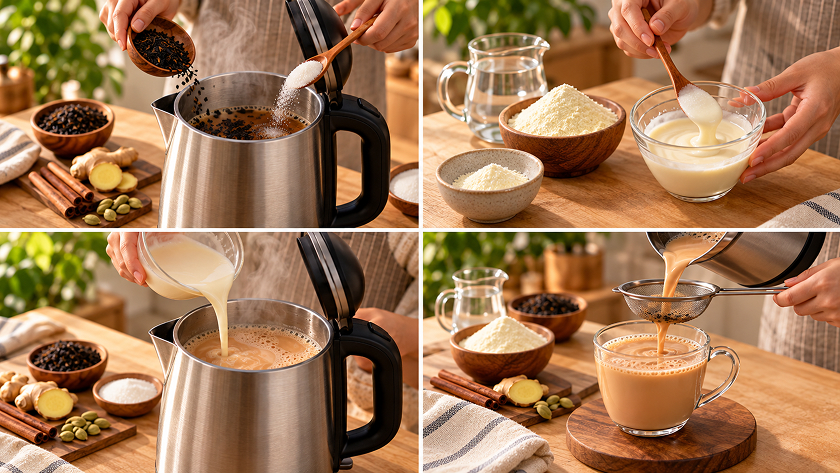
    1. Start with the water. Pour in about a third of a cup of water per serving and let it come to a boil.
    2. Add the tea. Drop in your tea leaves or bag along with the sugar, and if you’re spicing it, add your cardamom or ginger now. Let it steep in the hot water for two to three minutes so the tea brews strong before the milk goes in. This step is what gives milk tea its depth, so don’t skip straight to the milk.
    3. Pour in the milk. Add roughly two-thirds of a cup of milk per serving, so you’re working with about a one-to-two water-to-milk ratio. Switch the kettle back on.
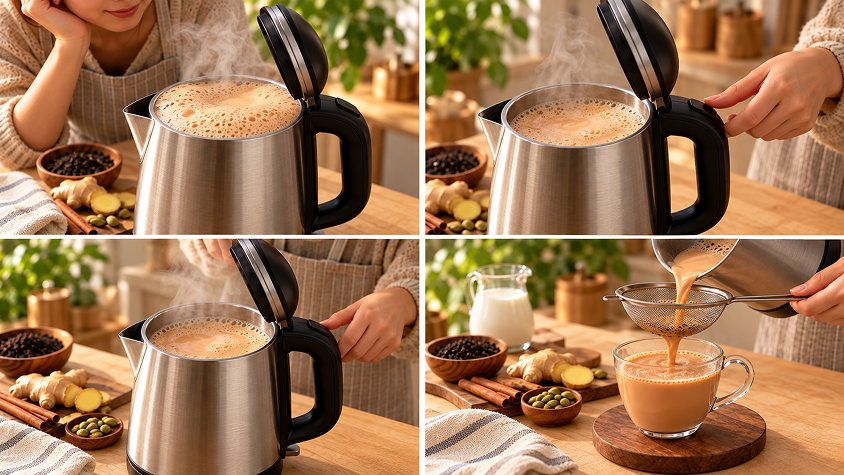
    4. Watch it closely. Heat the mixture until it’s steaming and just beginning to rise, then switch off before it hits a full boil. If your kettle auto-shuts-off, be ready to flick it back on for short bursts to build the heat gradually.
    5. Strain and serve. Pour through a small strainer into your cup, taste, and adjust the sugar. That’s a full cup of milk tea from nothing but a kettle.

    Using milk powder instead of fresh milk

    No fresh milk on hand? Milk powder works beautifully and is actually easier to control because it won’t foam over the way liquid milk does. Boil your water, steep the tea and sugar, then stir a couple of spoonfuls of milk powder into a little warm water first to make a smooth paste before adding it in. Mixing it into a paste stops it clumping. Warm the whole thing through for another minute and you’ve got the same creamy result with less risk of a mess.

    Getting the strength and ratio right

    The balance most people enjoy is about one part water to two parts milk, but this is where you get to make it yours. More milk gives a rounder, creamier cup; more water lets the tea come through sharper. If your tea tastes weak, the fix is usually a longer steep in the water stage rather than more leaves, and if it tastes flat, it often just needs a touch more sugar to lift it. Brew a couple of cups and you’ll quickly find the ratio that suits you.

    The boil-over problem, and how to avoid it

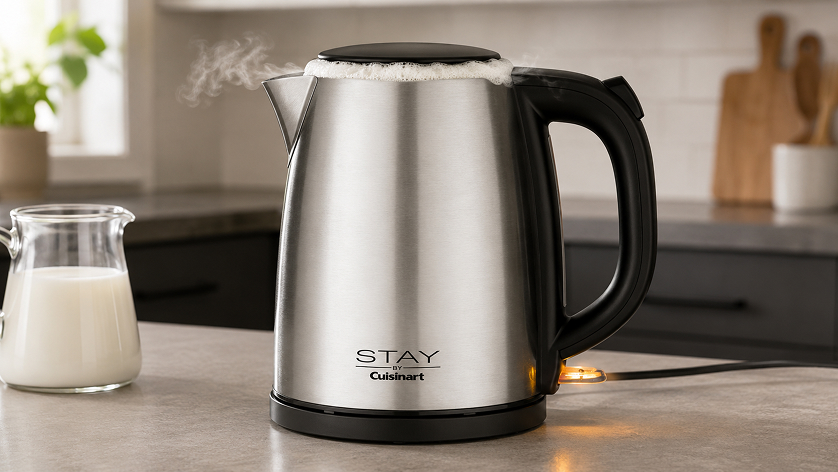
    This is the part that catches everyone. Milk contains proteins and fats that trap steam as it heats, so instead of bubbling gently like water, it foams up all at once and can surge over the rim in seconds. The way to prevent it is simple: never leave the kettle during the milk stage, and cut the heat the moment you see the surface start to rise and foam. Heating in short bursts rather than one long blast gives you far more control. If you do let it get away from you, that’s also how milk scorches onto the base, which is a genuine chore to clean, so a few seconds of attention saves you a lot of scrubbing later.

    Ways to change it up

    Once the basic method is second nature, the variations are endless. A cardamom pod and a thin slice of ginger turn it into a warming masala-style chai. A spoon of brown sugar instead of white gives a deeper, almost caramel note. Swap in green tea and less milk for something lighter, or stir in a little cocoa for a chocolatey version on a cold evening. The kettle doesn’t care what you throw at it, so treat the base recipe as a starting point rather than a fixed rule.

    Cleaning up so your next cup tastes right

    Milk is the one thing you don’t want to leave sitting in a kettle. Rinse it out with warm water straight after pouring, because dried milk film clings on and can taint the flavor of whatever you make next. If any milk did catch on the bottom, a short soak with a little baking soda lifts it without scrubbing. Give the inside a proper descale every so often too, the same way you would after boiling plain water, and your kettle will keep turning out clean-tasting milk tea cup after cup.

  • How to Clean and Descale an Electric Kettle (Vinegar, Baking Soda, Citric Acid & More)

    How to Clean and Descale an Electric Kettle (Vinegar, Baking Soda, Citric Acid & More)

    If the water coming out of your kettle has started to taste a little flat, or you’ve noticed a chalky film clinging to the inside, your kettle is overdue for a clean. It happens to every kettle eventually, and it has nothing to do with how careful you are. It’s just what water leaves behind when you heat it, day after day.

    The good news is that bringing an electric kettle back to a spotless, fresh-tasting state takes about ten minutes of hands-on effort and a couple of ingredients you almost certainly already have. Below is a complete walkthrough covering everything from a light monthly refresh to the stubborn stuff, plus how to handle rust, mold, burnt milk and that odd smell some kettles develop.

    What that white stuff inside your kettle actually is

    Those cloudy flakes, the chalky ring near the waterline, and the pale spots on the bottom are all the same thing: limescale. When you boil water, the dissolved calcium and magnesium in it get left behind as the water evaporates, and over time these mineral deposits harden into a crusty layer. If you live in a hard water area, it builds up fast; with softer water it takes longer, but it still comes.

    So if you’ve ever peered inside and wondered what the white residue at the bottom is, that’s your answer. It isn’t dirt, it isn’t dangerous in small amounts, and it doesn’t mean your kettle is broken. Left alone, though, it dulls the heating element, makes your kettle work harder, and can give your tea a faintly metallic edge. That’s the real reason to descale on a schedule rather than waiting until the buildup is thick enough to flake into your cup.

    How often you should clean and descale it

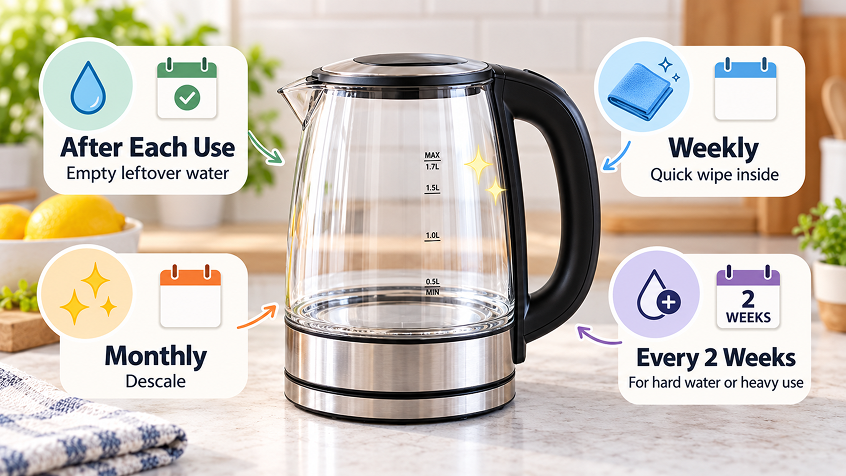
    A quick descale once a month keeps most kettles in good shape. If your water is very hard or you’re boiling several times a day, every two weeks is a safer rhythm. Alongside that, a fast wipe of the inside once a week and emptying out any leftover water after you’re done stops fresh deposits from setting in. Think of it as two habits: a light weekly touch-up and a proper monthly deep clean.

    Cleaning a brand-new kettle before its first use

    A new kettle deserves a rinse before it makes your first cup. Manufacturing can leave a faint plastic or metallic taste, so fill it to the max line with fresh water, bring it to a boil, and tip that water away. Repeat once or twice, and if the smell lingers, add a splash of vinegar or a squeeze of lemon to the second boil. After a rinse it’s ready to go.

    How to clean an electric kettle with vinegar

    Plain white vinegar is the most reliable descaler there is, because the acid dissolves mineral buildup without scrubbing. Here’s the method that works every time:

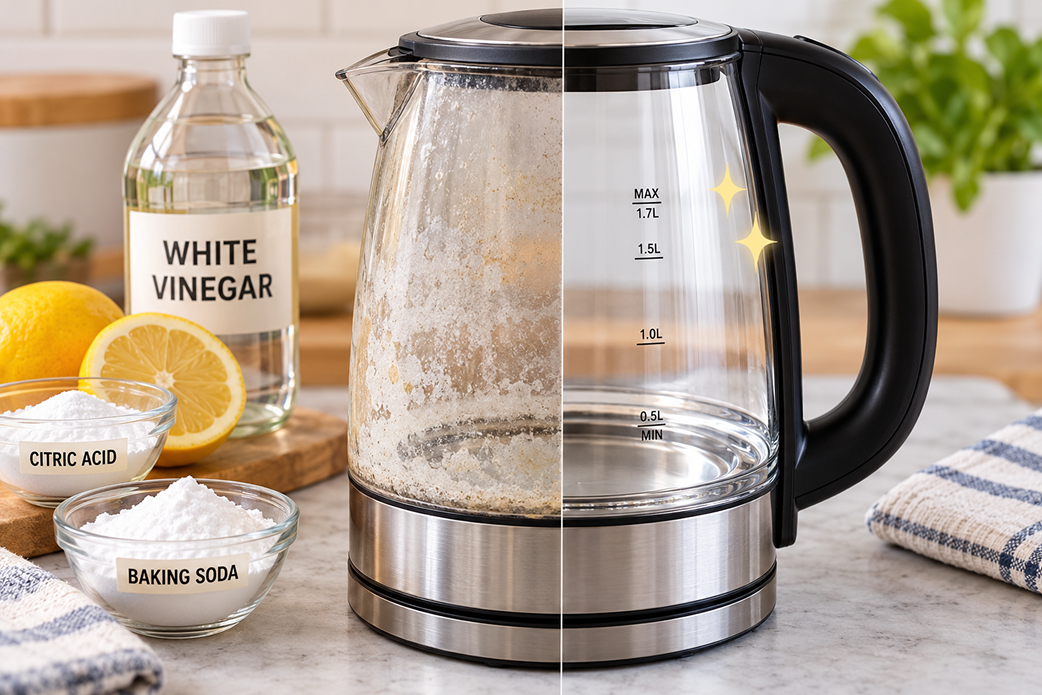
    1. Fill the kettle about halfway with equal parts water and white vinegar. For a heavily scaled kettle, a stronger mix leaning toward more vinegar is fine.
    2. Bring it to a full boil, then switch it off and let the solution sit for 20 minutes to an hour. This soak is where the real work happens, so don’t rush it.
    3. Pour everything out. Most of the scale will have loosened; wipe any remaining specks away with a soft cloth or a non-abrasive sponge.
    4. Rinse two or three times with clean water, then boil a full kettle of plain water and discard it so no vinegar taste carries into your next drink.

    Apple cider vinegar works in exactly the same way if that’s what you have on hand, though it can leave a slightly stronger scent that a couple of extra rinses will clear. Vinegar won’t harm the kettle itself, so there’s no need to worry about the acid damaging the interior when it’s diluted like this.

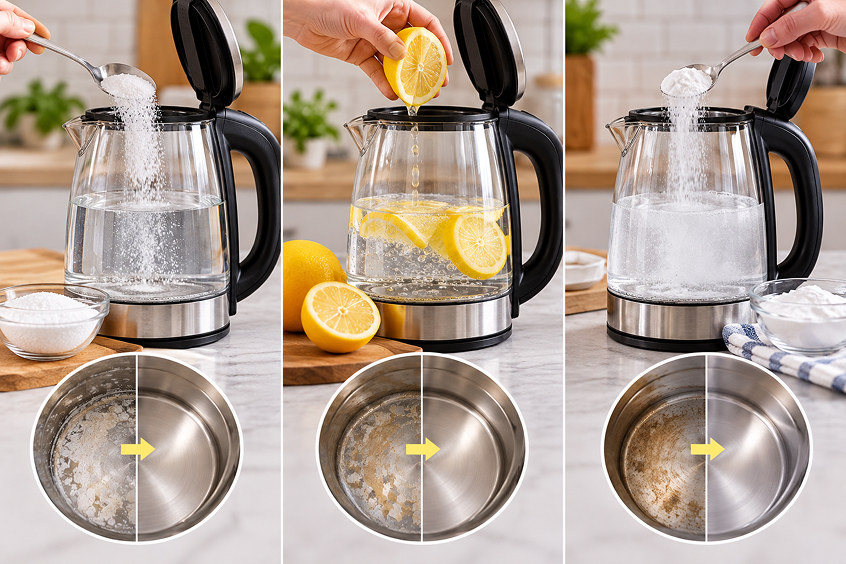
    No vinegar? Citric acid, lemon and baking soda all work

    If you’d rather not deal with the smell, you have good alternatives. Citric acid is the tidiest of them: stir a tablespoon or two of the powder into a kettle of water, boil, let it stand for 15 to 20 minutes, then rinse. It cuts through limescale just as well as vinegar and leaves almost no odor.

    Lemon does the same job with ingredients from the fruit bowl. Squeeze the juice of one lemon into the kettle (or drop in a few sliced pieces), top up with water, boil, and let it sit before rinsing. It clears the scale and leaves a clean citrus smell behind.

    Baking soda is the one to reach for when you want a gentle scrub rather than an acid soak. Add a teaspoon to a kettle of water, boil, let it cool a little, then use a soft sponge to work at any spots that are still holding on. A paste of baking soda and a little water, dabbed onto a cloth, is also handy for lifting marks near the base. Cream of tartar dissolved in boiling water is another mild option that does much the same thing.

    Cleaning the outside, the bottom and the base

    The body of the kettle just needs a wipe with a damp cloth and a drop of dish soap; dry it afterwards so you don’t trade water spots for soap streaks. Never dunk the base or the electrical connection in water, and keep moisture away from the plug contacts. For a stainless steel exterior that’s lost its shine, a tiny amount of olive oil on a soft cloth brings the finish back and helps fingerprints slide off in future. The metal plate at the bottom, where scale tends to settle, usually comes clean during a vinegar or citric acid soak, but a soft brush can coax off anything stubborn once the deposits have softened.

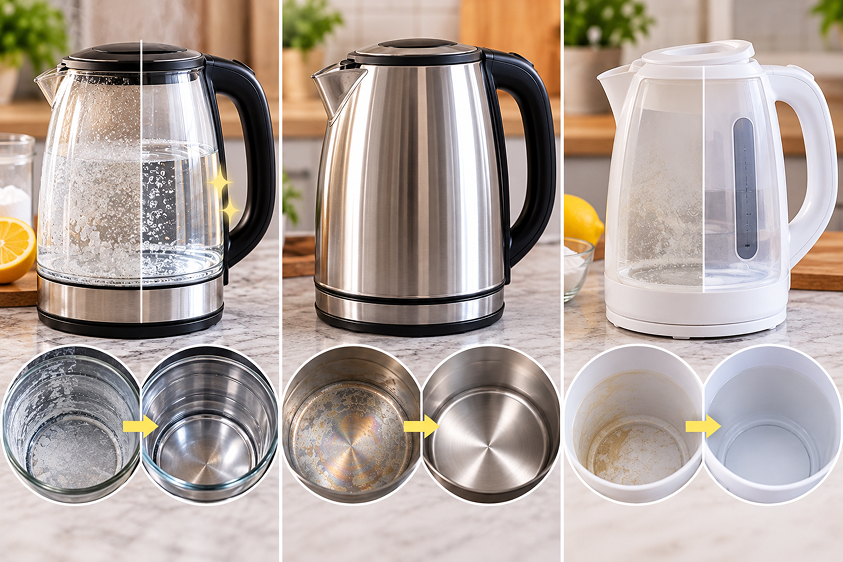
    Glass, stainless steel and plastic kettles each want slightly different care

    A glass kettle shows every smudge, so it benefits from more frequent descaling to stay clear; the upside is you can see exactly when it needs doing. Acid soaks are perfectly safe on glass. A stainless steel kettle hides scale better but can develop rainbow-ish heat tints inside, which a vinegar or citric acid soak lifts nicely. Plastic kettles need the gentlest touch: skip anything abrasive that could scratch the interior, stick to vinegar, lemon or citric acid, and rinse thoroughly, since plastic can hold onto smells more than metal or glass.

    Fixing the problems a normal descale won’t touch

    Rust spots

    Small orange or brown spots on a metal kettle are usually surface rust from minerals sitting on damp steel, not the kettle rotting through. A paste of baking soda and water rubbed gently over the spot, or a vinegar soak followed by a light scrub, lifts most of it. For a metal kettle prone to it, drying the inside after each use is the single best way to keep it from rusting again. A little surface rust that you’ve cleaned off isn’t something to panic about, but if the interior is heavily corroded and flaking, that’s the point to retire the kettle rather than keep drinking from it.

    Mold

    Mold can appear if water is left sitting in a warm kettle for days, and yes, it can grow inside one that isn’t emptied. Fill the kettle with a strong vinegar-and-water mix, boil, and leave it to sit for an hour so the acid kills the growth, then scrub the affected areas, rinse very well, and do a final plain-water boil. Going forward, tipping out leftover water and leaving the lid open to air-dry stops it coming back.

    Burnt milk and scorch marks

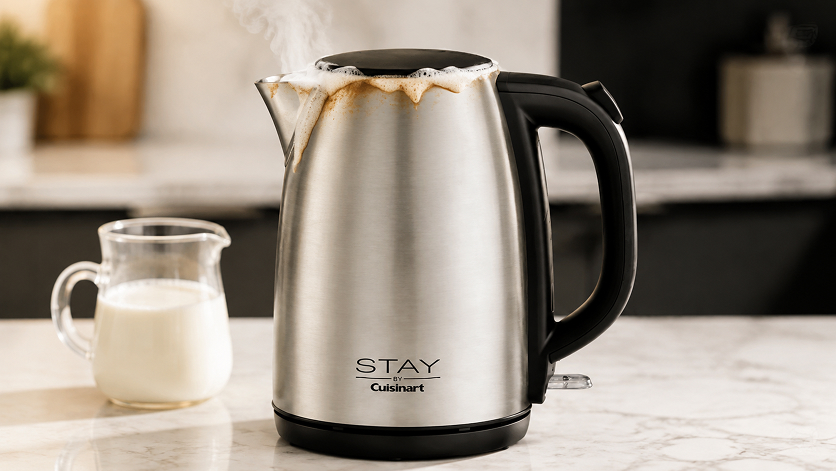
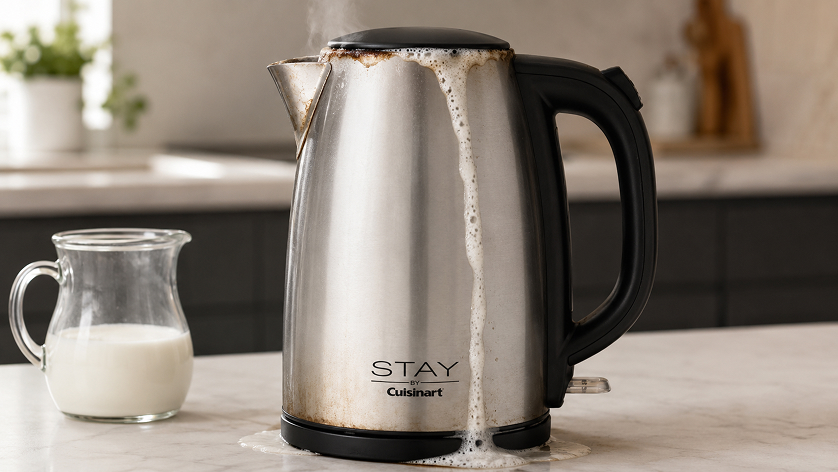
    If milk has boiled over or scorched onto the element, don’t scrape at it while it’s dry. Cover the burnt area with a baking soda and water paste, or fill the kettle with a baking soda solution and boil it, then let it soak until the residue softens and wipes away. Brown stains and burn marks near the base respond to the same treatment repeated once or twice.

    A musty or fishy smell

    An odd odor, sometimes described as fishy or musty, usually comes from trapped minerals, stagnant water or, in newer kettles, residue from the manufacturing process. A vinegar or lemon boil clears it in most cases: descale as above, rinse thoroughly, then boil a fresh kettle of water with a little lemon and discard it. Leaving the lid open between uses so the inside can dry keeps the smell from returning.

    Stubborn hard water and brown stains

    When a single soak doesn’t fully clear the staining, the fix is almost always time rather than force. Repeat the vinegar or citric acid soak and leave it longer, up to a couple of hours, before wiping. Cloudy water-line marks and brown mineral staining that look permanent nearly always come away once the acid has had enough contact time to break the deposit down.

    Keeping the buildup from coming back

    Once your kettle is clean, a few small habits keep it that way. Empty out any water you didn’t use instead of letting it sit, give the inside a quick weekly wipe, and if your area has particularly hard water, boiling filtered water rather than straight from the tap dramatically slows how fast scale returns. Stay on top of a monthly descale and you’ll rarely face a heavy buildup again, which means better-tasting water and a kettle that heats quickly for years rather than months.

  • How Does an Electric Kettle Work? A Plain-English Guide

    An electric kettle is one of those appliances you use every day without ever thinking about what’s happening inside it. You flip a switch, and two to four minutes later you have boiling water. But the mechanism behind that click-off is genuinely clever, and once you understand it, everything else — why it’s so fast, why it shuts off on its own, why the cordless base won’t fit your neighbor’s kettle — makes sense. Here’s the whole picture.

    What Is an Electric Kettle?

    An electric kettle is a countertop appliance with a built-in electric heating element that boils water without a stovetop. You fill it, switch it on, and it heats the water directly using electricity from a wall outlet. That’s the entire premise.

    What is an electric kettle used for? Mostly the small, hot-water jobs you’d otherwise do on the hob: tea, coffee, instant noodles, oatmeal, French press, baby formula, or just hot water on demand. The purpose of an electric kettle is speed and convenience — it delivers boiling water faster than a pot and with far less babysitting.

    One quick point of confusion worth clearing up: an electric kettle is not an electric water heater. A water heater is the tank in your basement that supplies your taps and shower. A kettle is a portable jug for boiling small amounts of drinking water. If you landed here looking for tank-heater diagrams, this isn’t that — but you’re in the right place for how a kettle (or electric jug, as it’s called in some countries) actually works.

    How an Electric Kettle Works, Step by Step

    Here’s the full sequence, from plug-in to click-off. This is how an electric kettle heats water, broken into the actual stages:

    1. You plug in and switch on. Flipping the switch completes an electrical circuit, letting current flow from the outlet into the kettle’s heating element.
    2. Electricity meets resistance. The element is usually a coil of nichrome — a nickel-chromium alloy that resists the flow of electricity. That resistance converts electrical energy into heat, the same way a toaster or space heater glows. A typical kettle element runs around 1,500 watts, which is why it heats so quickly.
    3. Heat transfers to the water. In modern kettles the element sits at the base in direct contact with the water (either exposed or as a concealed flat plate). Heat passes straight into the water by conduction — no hotplate, no pan, no middleman.
    4. Convection spreads the heat. Hot water at the bottom rises, cooler water sinks to take its place, and this circulation — convection — heats the whole volume evenly instead of just scorching the bottom layer.
    5. The water boils. At sea level the water reaches about 100°C (212°F), rolls into a full boil, and starts pumping out steam. That steam is the trigger for the next part.

    That direct-contact design is the secret to how an electric kettle works so fast. A stovetop kettle has to heat the metal base first, then pass that heat to the water — you lose energy at every handoff. An electric kettle dumps nearly all its energy straight into the water, so almost none is wasted.

    How Does the Auto Shutoff Know When to Stop?

    This is the part most guides skip, and it’s the cleverest bit. How does an electric kettle know when to turn off? It listens for steam.

    When water boils, steam travels up a small channel hidden inside the handle or wall of the kettle. At the bottom of that channel sits a bimetallic disc — two different metals bonded together that expand at different rates when heated. As the steam warms the disc, one metal expands faster than the other, and at a set temperature the disc suddenly snaps into a curved shape. That snap physically pushes a lever that breaks the circuit and cuts the power. That’s the “click” you hear.

    So the mechanism doesn’t measure the water directly — it detects the steam that only appears at boiling point. That’s how an electric kettle switches off automatically without any electronics at all. Some higher-end and variable-temperature kettles swap the mechanical disc for an electronic thermistor that reads the exact water temperature, letting you stop at, say, 80°C for green tea. But the humble bimetallic disc still runs the majority of kettles on the market.

    Why does this matter? Safety. The same thermostat system prevents the element from running dry — if the kettle overheats without enough water, the disc trips and kills the power before anything melts or catches fire. When a kettle stops working, a failed thermostat or heavy mineral scale insulating the sensor is often the culprit, which is why descaling matters (more on that below).

    How Long Does It Take to Boil, and What Temperature Does It Reach?

    How long does an electric kettle take to boil water? For a typical 1 to 1.5 liters, expect roughly 2 to 4 minutes. The exact time depends on three things: the wattage of the element, how much water you’re heating, and the starting temperature of that water. A 3,000-watt UK kettle will beat a 1,500-watt US model, and a full kettle naturally takes longer than a single cup.

    What temperature does an electric kettle boil at? Water boils at about 100°C (212°F) at sea level, and that doesn’t change with brand or price — physics sets the number, not the manufacturer. At higher altitudes water boils at a slightly lower temperature because there’s less air pressure holding it in liquid form.

    Does an electric kettle boil water fully? Yes — a working kettle brings water to a genuine rolling boil, which is exactly why it’s trusted for making water safe to drink. If you want the full breakdown of wattage, running costs, and how power ratings affect speed, see our dedicated guide on how many watts an electric kettle uses.

    Does an Electric Kettle Keep Water Warm?

    A basic kettle does not. Once it clicks off, it stops heating entirely and the water begins cooling immediately. In an uninsulated stainless or plastic kettle, water stays pleasantly hot for maybe 15 to 30 minutes and drops to lukewarm within an hour.

    Kettles with a keep warm setting work differently. Instead of shutting off for good, they let the water cool to a set target — often around 60 to 90°C — then briefly pulse the element back on to hold that temperature, cycling on and off for anywhere from 20 minutes to a few hours. Double-walled insulated kettles go further and physically trap the heat, so water stays hot far longer even without power. So how long does water stay hot in an electric kettle? Anywhere from 20 minutes in a bare-bones model to several hours in an insulated one with keep-warm engaged.

    How Do Cordless Electric Kettles Work?

    A cordless electric kettle is the kind almost everyone owns now. It comes in two parts: a power base that plugs into the wall and stays put, and the kettle body (the “pod”) that lifts freely off it. The base has a central contact plate; the bottom of the kettle has a matching connector. Set the kettle down and the contacts meet, completing the circuit. Lift it off and the circuit breaks — which is exactly why you can carry the kettle to your mug without a cord dangling behind it.

    Brands like Cuisinart work on this same principle: the base carries the mains power and the electrical contacts, while the kettle itself holds the water, the element, and the controls. There’s no battery involved — the kettle only draws power while it’s seated on the base.

    Are electric kettle bases interchangeable? Almost never. Even when two bases look identical, the contact pin layout, the power rating, and the safety keying are designed to pair one specific kettle with one specific base. Mixing a kettle with the wrong brand’s base risks a bad connection, overheating, or simply no contact at all. Treat the base and kettle as a matched set, and if you lose or break a base, buy the exact replacement for your model rather than a generic one.

    Is Water Boiled in an Electric Kettle Safe to Drink?

    Yes. The boiling physics are identical to a stovetop kettle — water reaches 100°C and the heat kills off the microorganisms that make water unsafe. Reputable kettles use food-grade stainless steel or BPA-free plastic and heating elements rated for contact with drinking water.

    The one thing that affects quality over time is mineral scale. In hard-water areas, calcium builds up on the element and interior as chalky white deposits. It won’t hurt you, but it slows heating and can flake into your drink, so descale every few weeks with a little vinegar or citric acid. Our full cleaning guide covers the exact routine.

    A Short History: Who Invented the Electric Kettle?

    The electric kettle is older than most people guess, and its story is really the story of getting the element closer to the water.

    • 1891 — the first electric kettle. The Carpenter Electric Company in the United States built the earliest electric kettle. But the heating element sat in a separate compartment underneath the water rather than in it, so it took over ten minutes to boil — barely faster than the stove.
    • 1922 — the submerged element. Arthur Leslie Large, working with Bulpitt & Sons (the company behind the Swan brand) in Birmingham, England, sealed the element inside a metal casing and dropped it directly into the water. Boil times fell dramatically, and this is the design every kettle still uses today.
    • Mid-1950s — automatic shutoff. The first fully automatic kettles with a thermostatic switch arrived, adding the steam-triggered bimetallic disc that clicks the kettle off on its own. That completed the template for the modern kettle.

    So when people ask what country invented the electric kettle, the honest answer is layered: the concept was American, but the breakthrough that made it genuinely fast and practical was British.

    Electric Kettle vs Stovetop or Microwave: Which Wins?

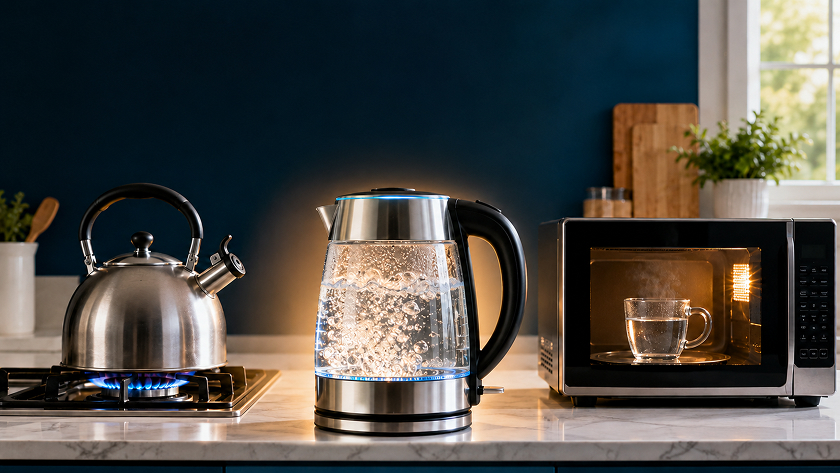
    For boiling water specifically, the electric kettle wins on speed and efficiency almost every time. The submerged element puts heat directly into the water with very little lost to the surrounding air, while a stovetop wastes energy heating the burner and pan, and a microwave heats unevenly and can’t bring water to a reliable rolling boil. For the full head-to-head on speed, energy use, and cost, see our comparison of the electric kettle vs stove vs microwave.

    The short version: if your main job is turning cold water into boiling water fast, the electric kettle is the tool built for exactly that — and now you know precisely how it pulls it off.

    Frequently Asked Questions

    How does an electric kettle know when to turn off?

    When the water boils, steam rises through an internal channel to a bimetallic disc — two bonded metals that expand at different rates. At boiling point the disc snaps shape, trips a lever, and breaks the circuit, cutting the power. That’s the click you hear. Some kettles use an electronic temperature sensor instead.

    How long does an electric kettle take to boil water?

    Usually 2 to 4 minutes for 1 to 1.5 liters. The exact time depends on the kettle’s wattage, how much water you’re heating, and the starting temperature. Higher-wattage kettles and smaller amounts of water boil noticeably faster.

    What temperature does an electric kettle boil at?

    About 100°C (212°F) at sea level, regardless of the brand — physics sets that number, not the manufacturer. At higher altitudes water boils slightly cooler because there’s less air pressure. Variable-temperature kettles can also stop early at settings like 80°C for tea.

    Are electric kettle bases interchangeable?

    Generally no. Contact pin layouts, power ratings, and safety keying are matched to one specific kettle, even when two bases look alike. Using the wrong base risks poor contact or overheating, so replace a lost or broken base with the exact one for your model.

    Does an electric kettle keep water warm?

    A basic kettle shuts off completely and starts cooling right away, staying hot for maybe 15 to 30 minutes. Models with a keep-warm setting pulse the element on and off to hold a target temperature, and insulated double-walled kettles trap heat for hours.

    Who invented the electric kettle and when?

    The Carpenter Electric Company built the first electric kettle in the US in 1891, but it was slow. In 1922 Arthur Leslie Large in Birmingham, England submerged the element directly in the water, and by the mid-1950s automatic shutoff kettles set the modern template.

  • Can You Boil Milk in an Electric Kettle? What to Know First

    Can You Boil Milk in an Electric Kettle? What to Know First

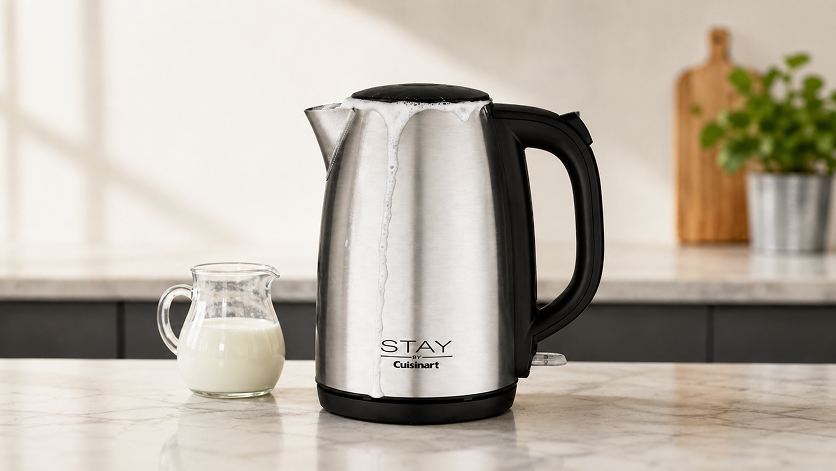
    Short answer: you can, but you really shouldn’t. Almost any electric kettle will physically heat milk, but milk scorches, foams over the electrical base, gums up the heating element, and can leave a burnt smell that taints the next few pots of water you boil. The kettle’s automatic shut-off, the whole reason a kettle is convenient, is calibrated for water, not milk, so it often fails to click off at the right moment.

    There’s a real difference between splashing a little milk in to warm it and trying to boil a full kettle of it. Neither is a good idea, but the second is how people melt a heating element or trip a warranty. Below is exactly why milk behaves this way, the safer alternatives ranked, and a genuine cleaning protocol for when it’s already gone wrong.

    Can an Electric Kettle Boil Milk? The Honest Answer

    So can we use an electric kettle to boil milk? Mechanically, yes — the element heats whatever liquid is in the chamber. But “can it” and “should it” are different questions. Manufacturers design kettles for water, and most user manuals explicitly warn against milk, juice, or anything but plain water. Put simply: can you put milk in an electric kettle and get away with it once? Maybe. Do it regularly and you’ll ruin the kettle and possibly the milk.

    If you’re the type who likes to know why your appliance behaves the way it does, our guide on how an electric kettle actually works explains the heating element and steam sensor setup that milk quietly sabotages.

    Why Milk Scorches and Burns in an Electric Kettle

    Water is simple, it heats evenly and boils at 212°F (100°C). Milk is not water. It’s an emulsion of fat, protein (mostly casein), and sugar (lactose) suspended in water, and each of those reacts to direct heat in a way that plain water doesn’t.

    Here’s the number that matters: milk starts to scorch at roughly 180°F (82°C), a full 30 degrees below where water would even boil. So milk burns onto the element long before the kettle would normally decide it’s “done.” The proteins and sugars sitting against the hot metal undergo the Maillard reaction, the same browning that gives seared steak its crust, except here it caramelizes and chars directly onto your heating element, creating a hard, dark residue and that unmistakable burnt-milk smell.

    Two things then happen at once:

    • A protein skin forms on the surface. That skin traps steam underneath it instead of letting it escape gradually the way water vapor does.
    • Pressure builds and releases suddenly. The result isn’t a gentle rolling boil, it’s a violent foam-up that erupts over the rim in seconds.

    That’s why milk won’t boil in a kettle the way water does. It goes from calm to overflowing almost instantly, and it does so right on top of an electrical base.

    Why the Auto Shut-Off Fails With Milk

    This is the part most articles skip, and it’s the real mechanical root of the problem. Your kettle shuts off using a steam-triggered thermostat, usually a bimetallic strip near the spout or lid. When water boils, it produces a predictable plume of steam that heats that strip, it flexes, and the switch clicks off.

    Milk breaks this system in two ways. First, that protein skin on the surface traps steam rather than releasing a clean plume, so the sensor may not get the signal it’s waiting for. Second, milk foams over the boiling threshold before it generates enough consistent steam to trip the switch. The kettle keeps heating a liquid that’s already scorching, which means overheating, a baked-on element, and in a worst case a shut-off that never triggers at all.

    If milk has already caused your kettle to misbehave or stop shutting off cleanly, that’s a repair-territory problem, not just a cleaning one.

    What Actually Happens If You Do It Anyway

    People still ask, is it safe to boil milk in an electric kettle? Here’s the concrete risk list, in order of how much it’ll cost you:

    • Boil-over onto the electrical base. Milk foams fast and unpredictably. Liquid on or around the base contacts is the genuine safety hazard here.
    • Lingering burnt smell. Scorched milk residue bakes onto the element and can flavor your next several pots of “plain” boiled water.
    • Bacterial and mold growth. Milk film trapped around the element and under the mesh filter is a feeding ground. Leftover dairy accelerates both limescale and microbial buildup between uses, the same reason mold can grow in a neglected electric kettle.
    • Permanent discoloration and damage. That charred layer often doesn’t fully come off, and repeated exposure shortens the element’s life.

    Safer Ways to Warm Milk (Ranked)

    Whether you want to warm milk for coffee or heat it for a mug of cocoa, these beat the kettle every time:

    1. Stovetop saucepan. The most controllable option. Medium-low heat, stir constantly, pull it the moment it steams. Best for larger amounts.
    2. Microwave in bursts. Fastest for a single mug. Heat in 15–30 second bursts, stirring between each, and stop around 150°F before a skin forms.
    3. Dedicated milk frother/warmer. Purpose-built for this, with a capped temperature (usually 160–170°F) so it can’t scorch. If you warm milk daily, this is the real fix.
    4. Double boiler. The gentlest, effectively scorch-proof method, ideal for delicate steamed milk.

    Making milk tea? Don’t dump raw milk in the kettle. Boil the water in your kettle first, steep your tea, then add warm milk separately off the heat. You get all the convenience of the kettle with none of the scorching, the correct way to make milk tea in an electric kettle.

    If You Genuinely Have No Other Option (Travel or Dorm)

    Sometimes a kettle is all you’ve got. If you must, minimize the damage:

    • Heat only a small splash, never a full kettle.
    • Use the lowest setting or shortest cycle if your kettle has variable temperature.
    • Never walk away. Watch for the skin and foam rising and pull it before it climbs the sides.
    • Clean it immediately, don’t let residue cool and set.

    How to Get Burnt Milk Out of an Electric Kettle (Step by Step)

    This is where competitors just say “use vinegar” and move on. Here’s the full protocol to remove burnt milk from an electric kettle properly:

    1. Unplug and cool completely. Never clean a hot kettle or one that’s still connected to power.
    2. Empty and rinse loose residue. Tip out the milk and rinse with warm water to clear anything not baked on.
    3. Vinegar boil-out. Fill with equal parts water and white vinegar, bring to a boil, then switch off and let it sit 15–20 minutes. The acid loosens the scorched protein layer.
    4. Baking soda paste for stubborn spots. Make a thick paste of baking soda and water, apply to charred patches with a soft cloth or non-scratch sponge, and gently work them loose. Never use metal scrubbers or steel wool — they scar the element and stainless interior.
    5. Citric acid or lemon for odor. If a burnt smell lingers, boil water with a tablespoon of citric acid (or a few lemon slices), let it stand, and pour out. This targets the smell specifically.
    6. Clean the mesh filter. Pop out the spout filter and scrub it separately, milk film clings here and breeds bacteria if ignored.
    7. Rinse and dry. Run two or three plain-water rinse cycles until no vinegar or soda taste remains, then leave the lid open to air-dry fully before storing.

    Critical warning: never submerge the base or immersible electrical unit in water. For the full routine that keeps this from becoming a habit, see our complete guide on choosing and caring for an electric kettle.

    The Bottom Line

    Can milk be heated in an electric kettle? Technically yes; sensibly no. Milk scorches 30 degrees below water’s boiling point, foams over unpredictably, and defeats the very sensor that makes a kettle safe. Use your kettle for water, its actual job, and warm milk on the stove, in the microwave, or in a dedicated frother. Your kettle, your milk, and your nose will all be better for it.

    Frequently Asked Questions

    Can milk be boiled in an electric kettle?

    It can be, but you shouldn’t. Boiling is worse than gently warming, milk scorches onto the element around 180°F, foams over the electrical base, and the burnt residue is hard to remove and can taint future boils. Boiling maximizes every risk.

    Will milk boil in a kettle the same way water does?

    No. Water releases steam gradually and boils evenly. Milk forms a protein skin that traps steam, then erupts into foam and overflows in seconds. It goes from calm to boiling over almost instantly, which is why kettles can’t handle it safely.

    Can you put milk in an electric kettle just to warm it, not boil it?

    You can warm a small splash on the lowest setting while watching it closely, but it’s still not ideal, even warming leaves residue that needs cleaning right away. A stovetop pan, microwave, or milk frother is safer and just as fast.

    Does heating milk in a kettle ruin the appliance?

    It can over time. Scorched milk bakes onto the heating element, causing discoloration and lingering odors, while trapped residue accelerates limescale and bacterial buildup. It can also confuse the auto shut-off sensor, leading to overheating.

    How do you get the burnt milk smell out of a kettle?

    Boil a mix of water and white vinegar, let it sit 15–20 minutes, then follow up with a citric acid or lemon-water boil aimed specifically at odor. Scrub scorched spots with a baking soda paste and a soft sponge, then rinse several times with plain water.

    Is there a kettle designed to heat milk safely?

    Yes, dedicated electric milk warmers and frothers are built for it, with temperatures capped around 160–170°F so milk can’t scorch. If you warm milk regularly, that’s the real solution rather than risking your water kettle.

  • How to Use an Electric Kettle the Right Way: A First-Time Guide

    How to Use an Electric Kettle the Right Way: A First-Time Guide

    You just unboxed your first electric kettle, and you’re wondering if there’s more to it than “fill it, plug it in, wait for the click.” There is — but only a little. The good news is that an electric kettle is one of the most forgiving appliances in your kitchen. The part most guides skip is the very first use: the rinse, the smell, and the moment you know it’s actually done. So let’s walk through it the way we’d walk a friend through their first 30 minutes with a new kettle.

    Before Your First Boil: Unboxing and Cleaning

    Pull off every scrap of packaging first, including the thin protective film manufacturers often leave on the body and base. Kettles ship with a light protective coating and pick up dust and manufacturing residue in the factory and the box. That’s why the first thing you should never do is boil water and drink it.

    Open the lid and wipe the interior with a little mild dish soap and a soft cloth, then rinse well. Never submerge the base or the electrical contacts in water, only the kettle body touches soap and water, and even then, keep the outer base plate dry.

    Now the step almost every article mentions but rarely explains: the boil-and-discard cycle. Fill the kettle to its max line, bring it to a full boil, and pour the water down the drain. Do this once or twice. Why? That first boil lifts any leftover residue and that faint “new plastic” smell out of the kettle so it never ends up in your tea. It takes five minutes and it’s the difference between a first cup that tastes like water and one that tastes like a factory.

    Setting Up Your Kettle

    Set the base on a flat, dry, heat-safe surface, pushed back from the edge of the counter so a stray elbow can’t knock it. Route the cord so it isn’t stretched taut or draped across a walkway — most bases have a small channel underneath to coil excess cord. If you have a cordless electric kettle (the most common design today), the kettle body lifts freely off a powered base plate. Seat it back down until it sits flush and clicks into place; if it’s not seated on the contacts, it won’t heat.

    How to Fill an Electric Kettle Correctly

    Open the lid, or the pour spout, on some models — and add fresh, cold or room-temperature water. Reheating already-boiled water tends to taste flat, so start fresh each time.

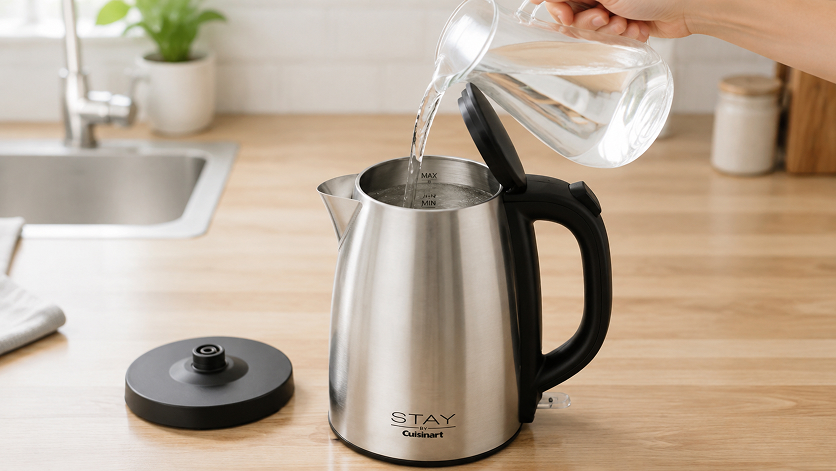
    Look inside for two markings: a MIN line and a MAX line. Stay between them. Below the min line, the heating element can be exposed and overheat; above the max line, boiling water can spit out of the spout and steam can burn your hand. A simple habit that saves energy and time: only fill what you actually need. Boiling two cups instead of a full kettle for a single mug of tea is faster and cheaper.

    If your tap water is hard, filtered water tastes cleaner and leaves far less chalky mineral scale inside, which means less cleaning later. If you’re curious about what’s happening inside as it heats, we break it down in how an electric kettle works.

    How to Turn On an Electric Kettle

    Find the power control. On basic kettles it’s a rocker switch at the base of the handle, press it down and it stays down while heating. On models with a base panel or digital display, you’ll press a button or turn a dial instead.

    If your kettle has temperature presets, choose your setting before you press start, pick the tea or coffee preset, or dial in a specific temperature, then hit the button. An indicator light or a lit display confirms it’s heating. That glow is your “it’s working” signal.

    How to Know When an Electric Kettle Is Done

    This is the question new owners ask most, and the answer is reassuringly simple. Nearly every modern kettle has automatic shut-off: when the water reaches a rolling boil, a thermostat trips, the switch clicks back up, and the indicator light goes out. That audible click and the light switching off is the signal it’s done. On digital models, the display beeps or shows the target temperature has been reached.

    One thing to understand: steady steam or a whistle is not the same as auto shut-off. Steam venting from the spout just means the water is hot, always glance at the switch or light to confirm it has actually powered down.

    If your kettle keeps clicking off before it boils, the usual culprit is limescale on the heating element fooling the thermostat — a good descaling fixes it. If it won’t click off at all, unplug it and let it cool; a stuck switch or a lid that isn’t fully closed can keep the sensor from tripping. We cover those snags in more detail in our troubleshooting guidance, but on day one, the rule is simple: if it doesn’t shut itself off within a minute of a hard boil, switch it off manually and check the lid is latched.

    Pouring Safely

    Wait a few seconds after the click before lifting, it lets the boil settle so water doesn’t surge out of the spout. Lift by the handle only, keep the lid latched shut (an open lid lets steam escape toward your hand), and pour steadily, spout angled away from your body. If you’re boiling back-to-back, give the kettle a minute to cool before refilling with cold water; adding cold water to a scorching-hot element repeatedly shortens its life.

    Making Your First Cup: Tea, Coffee, and Plain Water

    Here’s where temperature matters. Boiling water isn’t right for everything.

    • Tea: Black and herbal teas want a full boil, around 212°F (100°C). Green and white teas are delicate — pour water at about 160–185°F (70–85°C), or boiling water rested for 30–60 seconds, or they turn bitter. Pour over the bag or infuser and steep 2–3 minutes for green, 3–5 for black.
    • Coffee: For pour-over or French press, aim for 195–205°F (90–96°C) — just off the boil. If you don’t have temperature control, boil and wait about 30 seconds before pouring.
    • Plain boiled water: Great for instant oatmeal, noodles, cooking, or sterilizing. Water brought to a rolling boil in a clean kettle is safe to drink, see what to know about boiling milk and other liquids before you try anything beyond water.

    A preset kettle does this math for you. A basic on/off kettle just needs you to let boiling water cool for a moment — a thermometer or a 30-second wait is all it takes.

    After You’re Done

    Empty any water you didn’t use rather than leaving it to sit, standing water encourages mineral spots and, over weeks, scale. Power off at the switch and, if you won’t use it for a while, unplug the base. Let the kettle cool completely before wiping it down or descaling.

    Quick Brand Notes: How the Controls Differ

    The steps above apply to every kettle, but the buttons don’t. Here’s how the popular consumer models handle it.

    BrandControlsHow you turn it on / off
    ChefmanOne-touch temperature presets + keep-warm button on select modelsTap a preset (or the boil button) to start; it auto-shuts off, and you press the power/keep-warm button off. To turn off a Chefman kettle mid-cycle, press the power button or lift it from the base.
    CosoriTemperature dial or presets tuned for tea and coffee, often with a hold functionSelect temperature, press start; display shows progress and holds temp until you press off.
    Hamilton BeachSimple physical on/off switch, no presets on most modelsFlip the switch down to boil; it clicks up automatically when done.
    OventeSingle switch with an LED power indicator and auto shut-offPress the switch; the LED glows while heating and shuts off at boil.
    AromaBasic single-switch on/off, budget-friendly simplicityPress to boil, auto shut-off at the boil — nothing to set.
    Stagg EKG (Fellow)Precision digital temperature dial + HOLD mode for pour-overTurn the dial to your target temp, press to start; HOLD keeps it there, and it auto-enters standby after about an hour.

    Notice the pattern: the more a kettle is built for coffee and specialty tea, the more control it hands you. A Hamilton Beach or Aroma is one-switch simple; a Stagg EKG or Cosori lets you nail an exact temperature. Neither is “better”, it depends on whether you drink drip tea or dial in a pour-over. If you’re still deciding, our electric kettle buying guide lines up the trade-offs.

    That’s the whole ritual. Rinse and boil-and-discard once, fill between the lines, press start, wait for the click, and pour by the handle. Do it a few times and it becomes muscle memory, the kettle earns its spot as the fastest, most-used appliance on your counter.

    Frequently Asked Questions

    Do you need to clean a new electric kettle before first use?

    Yes. Wipe the interior with mild soap and water (keep the base dry), then run one or two boil-and-discard cycles with plain water. This clears manufacturing residue, dust, and the faint new-plastic smell so your first real cup tastes clean.

    How do you know when an electric kettle is done boiling?

    Listen for the switch to click back up and watch the indicator light or display turn off, that’s the automatic shut-off tripping at a rolling boil. Steam or a whistle alone doesn’t mean it’s finished, so always confirm the switch has powered down.

    Why does my electric kettle keep clicking off before the water boils?

    Usually limescale buildup on the heating element is fooling the thermostat into thinking it’s hotter than it is. Descale the kettle with a water-and-vinegar or citric acid solution and the problem typically clears. A lid that isn’t fully closed can also cause early shut-off.

    Can you leave water in an electric kettle overnight?

    It’s fine occasionally, but it’s not a habit we’d recommend. Standing water leaves mineral spots and speeds up scale buildup, and repeatedly boiling old water tastes flat. Empty the kettle after use and fill fresh each time for the best taste.

    How much water should you put in an electric kettle?

    Always stay between the MIN and MAX lines marked inside. Below the minimum, the heating element can overheat; above the maximum, boiling water can spit from the spout. For efficiency, only fill what you actually need for the cups you’re making.

    Is it safe to leave an electric kettle plugged in all the time?

    Modern kettles with auto shut-off are safe to leave plugged in, but there’s no benefit to it. For first-time owners we suggest switching it off and unplugging the base when it’s not in use, it saves a trickle of energy and adds a layer of peace of mind.

  • Is Water Boiled in an Electric Kettle Safe? The Honest Answer

    Is Water Boiled in an Electric Kettle Safe? The Honest Answer

    The Short Answer: Is Water Boiled in an Electric Kettle Safe?

    Yes. For the vast majority of people, water boiled in an electric kettle is safe to drink. The boiling process itself is one of the oldest and most reliable ways to make water safer, it kills the pathogens that make you sick.

    The real question isn’t the boiling. It’s what your kettle is made of and how you use it. A cheap, degraded plastic kettle you never clean is a different story than a quality stainless steel or glass one you empty after each use.

    Bottom line up front: Boiling kills bacteria, viruses, and parasites. It does not remove chemicals, heavy metals, minerals, or microplastics. So “safe” depends on your water source and your kettle, not on the kettle being electric.

    Does Boiling Water Actually Kill Bacteria and Germs?

    This is where electric kettles genuinely shine. Bringing water to a rolling boil, 100°C (212°F), kills or inactivates virtually all disease-causing organisms: bacteria like E. coli and Salmonella, viruses such as hepatitis A and norovirus, and parasites like Giardia and Cryptosporidium.

    The CDC’s own guidance is blunt about it: bringing water to a full rolling boil for one minute (three minutes above 6,500 feet in elevation) makes it microbiologically safe to drink. Most pathogens die well before the boiling point, but a full boil removes any guesswork. Since electric kettles automatically shut off at a rolling boil, they hit that threshold every single time — no watching the pot, no undershooting.

    Does an Electric Kettle Sterilize or Purify Water?

    No — and this distinction matters. Boiling disinfects (kills living organisms). It does not purify. It won’t remove:

    • Heavy metals like lead or arsenic
    • Nitrates, chlorine, or fluoride
    • Dissolved minerals (the stuff that leaves limescale)
    • Microplastics

    If your tap water is biologically contaminated, boiling fixes it. If it’s chemically contaminated, boiling can actually concentrate some contaminants slightly as steam escapes. For chemical problems, you need a filter, not a kettle.

    Plastic vs Glass vs Stainless Steel: Which Kettle Material Is Safest?

    This is the part almost every article skips or fudges. The material touching your near-boiling water is the single biggest factor in whether “electric kettle water is good for health” or not. Here’s the honest comparison:

    MaterialLeaching riskTaste impactDurabilityVerdict
    Stainless steelVery low (food-grade 304)NeutralExcellentSafest all-round
    Borosilicate glassNone (inert)None — purest tasteFragileSafest for taste
    BPA-free plasticLow if certified & intactSlight when newGoodFine, with care
    Cheap/old plasticHigher (BPA, microplastics)Plastic-yDegradesReplace it

    Plastic: The worry here is real but often overstated. BPA (bisphenol A) and phthalates can leach from certain plastics under heat, and a 2019 study in Environmental Science & Technology found that heating drives up microplastic release. The catch: it only becomes a meaningful concern with non-BPA-free, degraded, scratched, or discolored plastic. A quality BPA-free kettle in good condition leaches negligibly. A ten-year-old bargain kettle with a cloudy, flaking interior is worth replacing.

    Glass (borosilicate): Chemically inert, nothing leaches, ever. It gives the cleanest taste and lets you see limescale building up. The only downside is that it can crack if knocked or thermally shocked.

    Stainless steel: Our default recommendation for most people. Food-grade 304 steel doesn’t leach under normal use and takes a beating for years. One caveat: avoid ultra-cheap, no-name units, where lower-grade metals can shed trace nickel or chromium. Look for a stated “304” or “18/8” food-grade spec.

    Is the Hamilton Beach Electric Kettle BPA-Free? Is Bodum?

    These are two of the most-searched brand questions, so let’s answer them directly. Hamilton Beach states that its electric kettles are BPA-free, and several models use glass or stainless steel construction anyway. Bodum also markets its electric kettles as BPA-free, with popular glass and stainless options. As always, confirm the spec on the exact model you’re buying, brands rotate designs, and the listing or manual will say. When in doubt, a glass or all-steel model sidesteps the question entirely.

    For a full material-by-material rundown and specific picks, see our guide on where to buy an electric kettle.

    The Cancer Question: Can an Electric Kettle Cause Cancer?

    Let’s be direct: there is no credible evidence that boiling water in an electric kettle causes cancer. The viral claims circulating online conflate two separate things, the harmless act of heating water, and the theoretical risk from chemicals in poor-quality materials.

    Boiling water does not create carcinogens. What could pose a tiny risk is prolonged high-heat contact with uncertified plastics (BPA/phthalates) or cheap uncoated metals (heavy metals) over years of use. Even then, regulators like the FDA and EFSA have set exposure limits, and the amounts leaching from a certified, intact kettle fall far below levels of concern. The WHO classifies the risk from properly treated boiled water as negligible.

    So the practical takeaway isn’t “kettles cause cancer.” It’s: use a certified, BPA-free or metal/glass kettle in good condition, and there’s no meaningful cancer risk to worry about.

    Is It Okay to Leave Water Sitting in the Kettle?

    It’s not dangerous, but it’s not ideal either. Water left standing overnight or for days develops a flat, stale taste as dissolved gases escape, accelerates limescale buildup, and gives any lingering minerals or biofilm a chance to sit. In uncoated aluminum kettles specifically, standing water can react with the metal over time.

    None of this will typically make you sick if you reboil it. But there’s an easy habit that avoids the whole issue:

    • Empty the kettle after each use and leave the lid open to dry
    • Refill with fresh water rather than topping up old water
    • Descale every few weeks with a vinegar-and-water solution (and rinse thoroughly afterward, vinegar residue is harmless but tastes off)

    Think of standing water as a taste-and-hygiene issue, not a safety emergency. For more day-to-day habits, our first-time guide to using an electric kettle covers the routine.

    Is It Safe to Leave an Electric Kettle Plugged In?

    On a modern, certified kettle, yes, leaving it plugged in draws essentially no standby power and poses very little risk. Electric kettles have no “on” state until you flip the switch, and quality units have automatic shut-off plus boil-dry protection.

    The real fire and shock risks come from specific failure points, not from the plug itself:

    • Frayed or worn power cords
    • A wet or damp base and connector
    • Cheap, uncertified units with unreliable auto shut-off

    Sensible habits: unplug it overnight or when you travel, keep the base dry, inspect the cord periodically, and buy a kettle carrying a recognized safety mark (UL or ETL in North America, CE/UKCA in Europe). Understanding how an electric kettle actually works makes these safeguards easier to appreciate.

    Is Reboiling Water in a Kettle Safe?

    For most people, yes. The popular fear that reboiling turns water toxic is largely a myth. The nuance: each boil evaporates a little water, which very slightly concentrates whatever was already dissolved — including nitrates, fluoride, or arsenic if your tap water contains them. On clean municipal water, this is a non-issue.

    The sensible rule: if your local tap water is high-quality, reboil without worry. If you’re in an area with known contamination, start with fresh water each time and consider filtering first.

    Bottom Line: How to Make Sure Your Kettle Water Is Safe

    Is heating water in an electric kettle safe? For nearly everyone, with a decent kettle, absolutely, and boiling makes questionable water safer, not more dangerous. Run through this quick checklist and you’ve covered every real risk:

    1. Choose stainless steel, glass, or certified BPA-free plastic
    2. Look for a safety mark (UL/ETL/CE) and a food-grade metal spec
    3. Empty and dry the kettle after use, don’t let water sit for days
    4. Descale regularly and rinse well
    5. Replace old, scratched, or discolored plastic kettles
    6. Unplug when you’re away, and check the cord and base

    Do those things and the answer to “is boiling water in an electric kettle safe to drink” is a confident yes. The kettle isn’t the risk, cheap materials and neglected habits are, and both are easy to avoid. Ready to upgrade to a safer model? Start with our complete electric kettle buying guide.

    Frequently Asked Questions

    Is water boiled in an electric kettle safe to drink?

    Yes. Boiling kills bacteria, viruses, and parasites, making water microbiologically safe. Just use a quality stainless steel, glass, or certified BPA-free kettle, and keep it clean, the material and your habits matter more than the boiling itself.

    Can an electric kettle cause cancer?

    There is no credible evidence that boiling water in an electric kettle causes cancer. Boiling doesn’t create carcinogens. Any tiny theoretical risk comes from cheap, degraded, or uncertified materials leaching chemicals, which a good BPA-free, glass, or steel kettle avoids entirely.

    Does boiling water in an electric kettle kill bacteria?

    Yes. A full rolling boil at 100°C (212°F) kills or inactivates virtually all disease-causing bacteria, viruses, and parasites. Since electric kettles auto-shut-off at boiling point, they reliably hit that threshold. Note that boiling disinfects but doesn’t remove chemicals, metals, or microplastics.

    Is a plastic electric kettle safe, or should I switch to glass or steel?

    A certified BPA-free plastic kettle in good condition is safe. The risk rises with cheap, scratched, or degraded plastic that can leach BPA or microplastics under heat. Stainless steel and borosilicate glass are inert and don’t leach, making them the safest long-term choices.

    Is it okay to leave water sitting in an electric kettle?

    It’s not dangerous, but it’s not ideal. Standing water tastes stale, speeds up limescale, and can pick up minor buildup. Empty the kettle after each use, let it air-dry, and refill with fresh water rather than reboiling day-old water.

    Is it safe to leave an electric kettle plugged in?

    On a modern, certified kettle, yes, standby draw is negligible and there’s no live heating until you switch it on. Real risks come from worn cords, damp bases, and uncertified units. Unplug when traveling, keep the base dry, and inspect the cord regularly.

  • Electric Kettle vs Stove vs Microwave: Which Is Faster and Cheaper?

    Electric Kettle vs Stove vs Microwave: Which Is Faster and Cheaper?

    Short version: for boiling water day in and day out, an electric kettle wins on speed, running cost and safety. A stovetop kettle earns its place when there’s no outlet or you want something that lasts decades, and the microwave is a backup, not a habit. Below we show the actual numbers so you can check them against your own utility bill.

    Quick Verdict: Which One Should You Actually Use?

    Most comparison articles end on “it depends on your priorities.” That’s a cop-out. Here’s the decisive version.

    MethodBest forOne-line verdict
    Electric kettleDaily hot drinks, apartments, dormsFastest and cheapest to run — the default choice for most people.
    Gas stovetopOutages, gas-only kitchens, big batchesSlower and less efficient, but works with no electricity.
    Electric coil stovetopYou already own oneThe slowest and priciest option — skip if you can.
    Induction cooktopModern kitchens, boiling in a potNearly as efficient as a kettle; great if you already cook on it.
    MicrowaveA single mug in a pinchUneven, risky for more than one cup — emergency use only.

    If you’re deciding which is better, an electric kettle or a stove kettle, and you have a working outlet, stop reading here and get the electric one. The rest of this page is for anyone who wants to see why, and the edge cases where the stovetop actually wins.

    Speed: Does an Electric Kettle Boil Water Faster?

    Yes, and it isn’t close. The reason is physics, not marketing. An electric kettle’s heating element sits in direct contact with the water (or right beneath a metal base plate), so almost all the heat goes straight into the liquid. A pot on a burner has to be heated first, and a lot of that energy escapes as hot air curling around the sides.

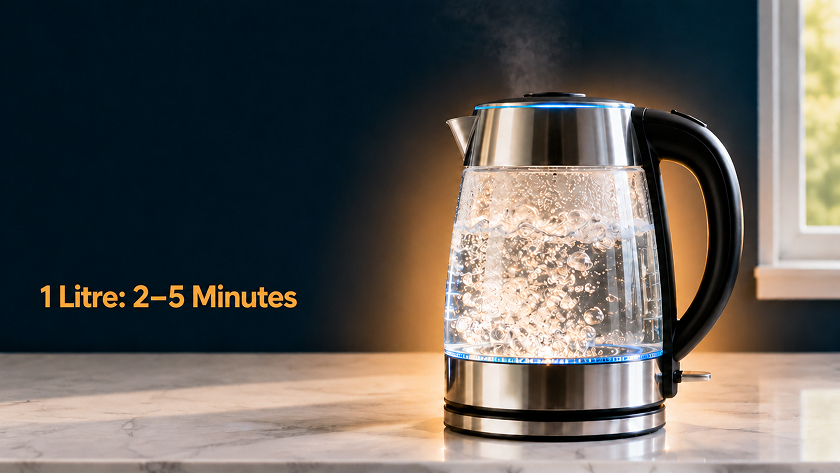
    Rough times to bring 1 litre from cold to boiling:

    • Electric kettle (1,500–3,000 W): 2–5 minutes
    • Induction cooktop: 3–5 minutes
    • Gas stovetop: 8–10 minutes
    • Electric coil stovetop: 10–12 minutes (worst heat transfer of the bunch)
    • Microwave: ~2–3 minutes for one mug, but it scales badly

    So is an electric kettle faster than a stove? For everyday quantities, comfortably, often twice as fast as gas and nearly three times faster than a coil burner. The higher the wattage, the quicker it boils; if you’re curious how that translates to your setup, see our guide on how many watts an electric kettle uses.

    Energy Efficiency: What Uses More Energy, an Electric Kettle or a Stove?

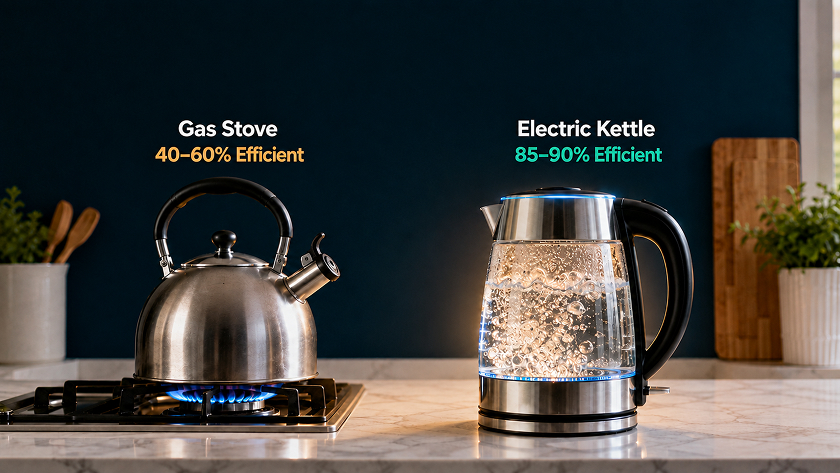
    Efficiency here means: of all the energy the appliance draws, how much actually ends up in the water? The gap is the whole story.

    MethodApprox. efficiencyWhy
    Electric kettle85–90%Element touches the water; insulated body traps heat
    Induction cooktop75–85%Heats the pot directly via magnetism, little wasted
    Electric coil stovetop70–75%Heat has to cross an air gap and the pot base
    Microwave50–65%Conversion and container losses; uneven heating
    Gas stovetop40–60%Flame spills around the pot; most heat escapes as ambient warmth

    That answers a few of the most-searched questions at once. What is more efficient, a stovetop kettle or an electric kettle? The electric kettle, by a wide margin. Is an electric kettle more energy efficient than gas? Almost double, because an open flame is one of the leakiest ways to heat anything. And which is more energy efficient, an electric kettle or a stovetop of any kind, the kettle wins every matchup except a close race with induction.

    One caveat that keeps things honest: gas and electricity are priced very differently per unit of energy, so “more efficient” doesn’t automatically mean “cheaper.” That’s the next section.

    Cost Comparison: Which Is Cheaper, an Electric Kettle or Stovetop?

    Let’s put real money on it. Assumptions, stated openly so you can scale them: electricity at $0.16/kWh, natural gas at $1.50/therm, and boiling 1 litre of water (which needs roughly 0.093 kWh of energy delivered into the water). We divide that by each method’s efficiency to get real consumption.

    MethodCost per litre boiledCost per year (2 boils/day)
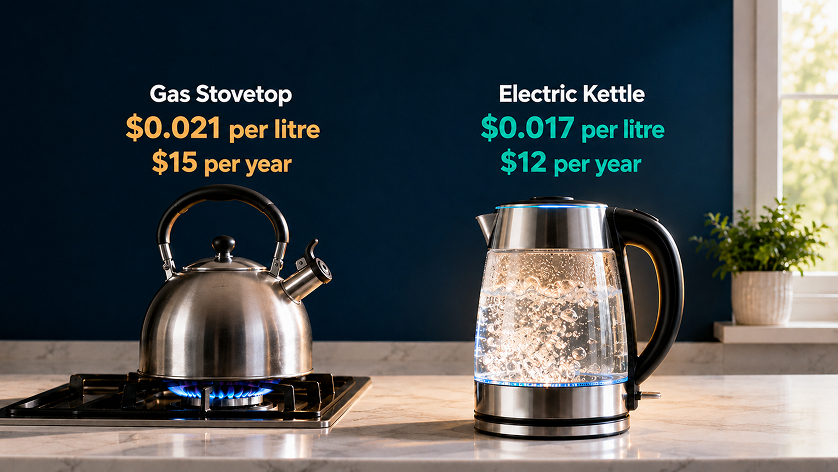
    Electric kettle~$0.017~$12
    Induction cooktop~$0.019~$14
    Gas stovetop~$0.021~$15
    Microwave~$0.026~$19
    Electric coil stovetop~$0.028~$20

    Two things jump out. First, is it cheaper to use an electric kettle or gas? The electric kettle is slightly cheaper per boil despite gas being a cheaper fuel, its efficiency makes up the difference. Second, the differences are small in absolute dollars. Nobody is getting rich switching kettles; you’re saving pocket change per year, not hundreds.

    Where cost really matters is upfront price versus payback. A basic stovetop kettle runs $15–$40. An electric kettle runs $20–$150 depending on features. If you spend $40 more on the electric model, the ~$8/year running-cost savings over a coil stovetop takes about five years to pay back, and roughly never versus gas. So don’t buy an electric kettle to “save money” on energy. Buy it because it’s faster, safer, and more convenient. For a fuller breakdown of running costs, see how many watts an electric kettle uses and what it costs to run.

    When the Stovetop Kettle Actually Wins

    A good stovetop kettle isn’t obsolete. It’s the better tool in specific situations:

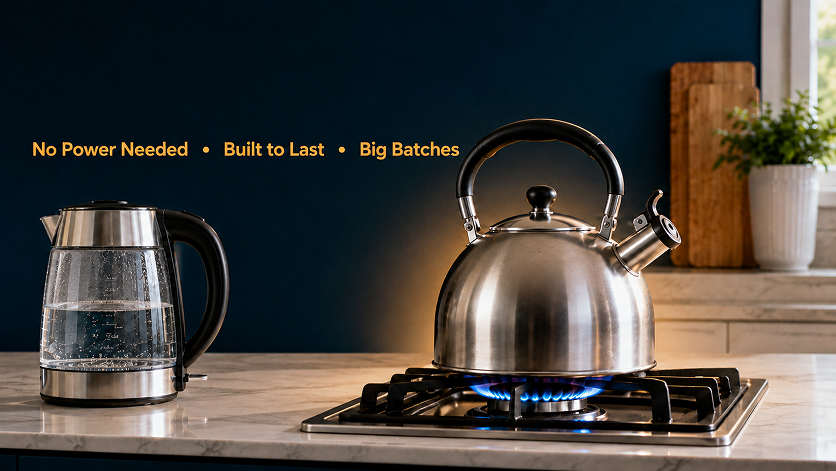
    • No outlet, no problem. Camping, RVs, boats, cabins, gas-only kitchens, and, crucially, power outages. A gas stovetop kettle boils water when the electric one is a paperweight.
    • Durability. There’s no heating element to burn out and no electronics to fail. A stainless steel stovetop kettle can last decades; electric kettles typically last 3–5 years of daily use.
    • Big batches. If you’re boiling several litres for canning or a crowd, a large pot on a strong gas burner can out-muscle a 1.7L kettle.
    • The ritual. Some people simply prefer the whistle and the look. That’s a real reason, just not a numbers one.

    Note that an induction cooktop needs an induction-compatible kettle (magnetic base). If you have induction, boiling in a suitable kettle or pot is nearly as efficient as a plug-in electric kettle.

    When the Electric Kettle Actually Wins (Most of the Time)

    For a typical household, this is the everyday winner, and the reasons go beyond speed:

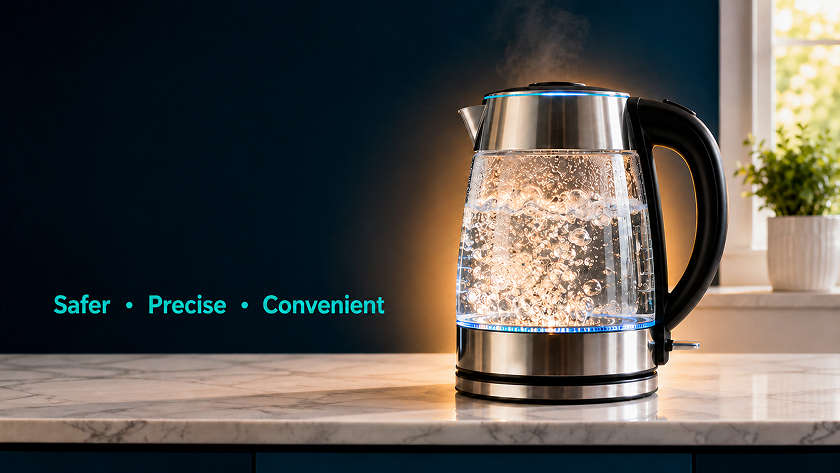
    • Safety. Auto shut-off and boil-dry protection mean it won’t run dry or scorch if you forget it. There’s no open flame and no hot burner left glowing. That’s a genuine reason electric kettles are welcome in dorms and small apartments where stovetops or open flames may be restricted.
    • Precision. Variable-temperature models let you hit 175°F for green tea, 195°F for pour-over coffee, or a safe temperature for baby formula, something a stovetop can only guess at.
    • Convenience. Fill, click, walk away. If you make hot drinks multiple times a day, the time saved adds up fast.

    Worried about what actually comes out of it? We cover that in whether water boiled in an electric kettle is safe, and if you’re new to one, our first-time guide to using an electric kettle walks through the basics. Curious how the direct-contact element works? Here’s how an electric kettle works, in plain English.

    What About the Microwave?

    Searchers keep asking is an electric kettle better than a microwave, and for boiling water, yes. A microwave can heat a single mug in a couple of minutes, but it heats unevenly (hot spots and cold spots), it can’t handle more than a cup or two efficiently, and it carries a real superheating risk: water can pass its boiling point without visibly bubbling, then erupt when disturbed. Always drop in a wooden stir stick or teaspoon first if you must microwave water.

    Verdict on the microwave: fine as an occasional backup for one mug, poor as a daily method. It loses to the kettle on speed at any volume above a single cup, and on taste for tea and coffee where even heating matters.

    Is a Stovetop or Electric Kettle Better? Final Answer

    So, which is better, an electric kettle or a stove top? For the vast majority of people, the electric kettle is the better everyday choice: it’s the fastest, the most energy efficient, cheaper per boil than gas or coil, and safer thanks to auto shut-off. That’s the honest reason to use an electric kettle, not the tiny energy savings, but the speed and peace of mind.

    The stovetop kettle wins in exactly three scenarios: no electricity (camping, outages, gas-only kitchens), you want an appliance that lasts 20+ years, or you’re boiling large batches. The microwave stays on the bench.

    Rule of thumb: if you have an outlet and make hot drinks daily, buy electric. If you need water where there’s no power, keep a stovetop kettle for backup.

    Decided electric is right for you? The next step is picking the right model, wattage, capacity, material, and temperature control all matter. Our complete guide to where to buy an electric kettle walks you through choosing one that’s genuinely worth it.

    Frequently Asked Questions

    Is a stovetop kettle better than electric?

    Only in specific cases. A stovetop kettle wins when there’s no electricity, camping, RVs, or power outages, and it tends to last far longer since there’s no heating element to fail. For everyday use with a working outlet, an electric kettle is faster, more energy efficient, and safer.

    What is more efficient, a stovetop kettle or an electric kettle?

    The electric kettle. It converts roughly 85–90% of its energy into heating the water because the element is in direct contact with it. A gas stovetop manages only about 40–60%, and an electric coil burner around 70–75%, because heat escapes around the pot.

    Is an electric kettle faster than a stove?

    Yes, usually by a wide margin. An electric kettle boils 1 litre in about 2–5 minutes, versus 8–10 minutes on gas and 10–12 minutes on an electric coil burner. Direct-contact heating simply transfers energy to water far more efficiently than an open flame or radiant burner.

    Which is cheaper, an electric kettle or a stovetop?

    Per boil, the electric kettle edges it out, roughly $0.017 per litre versus about $0.021 for gas and $0.028 for an electric coil at typical rates. The savings are small (only a few dollars a year), so choose electric for speed and safety rather than to cut your energy bill.

    Is a microwave faster than a kettle?

    For a single mug, a microwave is roughly comparable, but it loses badly beyond one cup, heats unevenly, and risks superheating (water erupting without bubbling). An electric kettle is faster and safer for any real quantity, so keep the microwave as a backup only.

    Does an electric kettle use more electricity than a stove?

    No. An electric kettle draws a lot of power (1,500–3,000 W) but only for a short burst, and it wastes very little of it. An electric stovetop runs longer and loses more heat to the air, so it actually uses more electricity to boil the same amount of water.


  • How Many Watts Does an Electric Kettle Use? Power and Cost to Run

    How Many Watts Does an Electric Kettle Use? Power and Cost to Run

    Most electric kettles use between 1,000 and 3,000 watts. That’s a wide range, and where your kettle lands depends less on the brand and more on the wall socket it plugs into. A kettle sold in Manchester is built to draw far more power than the same-size kettle sold in Los Angeles — and that single fact explains almost everything about boil times, running costs, and why you can’t buy a 3,000W kettle in the US.

    Below we’ll connect the three numbers that actually matter — watts, amps, and volts — then run real cost math for the US, UK, and Australia so you know exactly what a boil costs whether you’re paying in cents or pence.

    How Many Watts Does an Electric Kettle Really Use?

    The wattage of an electric kettle tells you how fast it turns electricity into heat. More watts means a faster boil, not a bigger bill (more on that later). Here’s what typical kettles pull by type:

    Kettle typeTypical wattageNotes
    Travel / compact (0.5L)650-1,000WBuilt to run on lower-amp travel adapters
    Standard US kettle (1.5-1.7L)1,200-1,500WCapped by 120V wiring
    Standard UK kettle (1.5-1.7L)2,200-3,000WMost sit at 3,000W
    Standard Australian kettle (1.5-1.7L)2,000-2,400WCapped by 10A sockets
    Fast-boil / family size (1.7L+)2,400-3,000WThe rapid-boil selling point

    So if someone asks “what is the wattage of an electric kettle,” the honest answer is: it depends on your country. A 3,000W kettle is standard in Britain and physically impossible on a normal US circuit.

    Watts, Amps and Volts: How They’re Connected

    You only need one formula, and it’s plain arithmetic:

    Watts = Volts × Amps

    Voltage is the “pressure” of the electricity coming from your wall. Amps (amperes) are the amount of current flowing. Multiply them and you get watts — the power the kettle actually uses. Rearranged, Amps = Watts ÷ Volts, which is how you work out how many amps an electric kettle draws.

    Two worked examples:

    • A 2,200W UK kettle on 230V: 2,200 ÷ 230 = about 9.6 amps.
    • A 3,000W UK kettle on 230V: 3,000 ÷ 230 = about 13 amps — right at the limit of a UK plug fuse.
    • A 1,500W US kettle on 120V: 1,500 ÷ 120 = about 12.5 amps.

    Notice the US kettle draws almost as many amps as the UK one while using half the watts. That’s the voltage difference doing the work — and it’s why the numbers printed on the base of your kettle matter far more than any generic average. If you want the mechanics behind that heating element, our plain-English guide to how an electric kettle works walks through it.

    Why Kettle Wattage Differs by Country

    This is the part every power-station blog skips. Kettle wattage is capped by the current your wiring and plug can safely carry, and that limit changes by region:

    • UK: A 13-amp plug fuse at 230V allows up to roughly 2,990W — so kettles top out near 3,000W.
    • US & Canada: A standard 15-amp kitchen circuit at 120V realistically supports about 1,440-1,800W once you leave safety headroom — so kettles sit around 1,500W.
    • Australia & New Zealand: A 10-amp socket at 230-240V allows up to roughly 2,400W — so kettles land near 2,000-2,400W.

    The practical result: a US kettle boils the same 1.7 litres noticeably slower than a UK one, because it’s pushing half the power. It isn’t a worse kettle — the grid simply hands it less to work with.

    WattageApprox. time to boil 1L
    1,000W~4 min 15 sec
    1,500W (typical US)~2 min 50 sec
    2,200W~1 min 55 sec
    3,000W (typical UK)~1 min 25 sec

    How to Find the Exact Wattage of Your Own Kettle

    Stop guessing — your kettle tells you directly. To find how many watts your electric kettle is, check, in order:

    1. The base or underside sticker. Flip the kettle (empty and cool) and look at the rating label. It lists voltage, wattage, and often the current draw — e.g. “220-240V ~ 2,000-2,400W.”
    2. The box or manual. The spec sheet lists rated power under “specifications.”
    3. A brand + model lookup. If the label is worn off, search the model number (usually molded into the plastic near the base) plus “specifications.”

    If a range is printed (say “2,000-2,400W”), that reflects the voltage range; on a standard 240V Australian supply it’ll run at the top of that band.

    What One Boil Actually Costs

    Here’s how much it costs to boil an electric kettle. The formula:

    Cost = (Watts ÷ 1,000) × hours run × price per kWh

    Boiling one mug (about 250ml) takes roughly 45-60 seconds; a full 1.7L takes 2-4 minutes depending on wattage. Using realistic 2026 electricity rates:

    TaskUS (~17¢/kWh)UK (~24.5p/kWh)AU (~30¢/kWh)
    One mug (250ml)~0.5¢~0.6p~0.9¢
    Full 1.7L kettle~1.2¢~2.3p~2.6¢

    So no — an electric kettle does not use a lot of electricity per boil. A single cup costs a fraction of a cent. The cost only adds up through repetition, which is where the monthly numbers come in.

    Monthly and Yearly Cost at Normal Use

    Most calculators bury this in one vague annual figure. Here’s the monthly and yearly cost of boiling a full kettle by how often you use it (UK rates, 3,000W kettle — the priciest common scenario):

    UsagePer dayPer monthPer year
    1× a day~2.3p~£0.70~£8.40
    4× a day (typical family)~9.2p~£2.80~£33.60
    8× a day (shared office kettle)~18.4p~£5.60~£67.20

    On US or Australian rates, divide those roughly in half (lower wattage, though AU’s higher per-kWh price narrows the gap). Even a heavily used office kettle rarely tops $30-70 a year. So does an electric kettle consume a lot of electricity overall? For a normal household, it’s a rounding error next to your fridge, water heater, or air conditioner.

    Does a Higher Wattage Kettle Cost More to Run?

    This trips people up. A 3,000W kettle draws more power, but it also finishes faster — so the total energy to heat the same water is roughly the same. Boiling 1L takes about 0.1 kWh whether your kettle is 1,500W or 3,000W; the 3,000W one just gets there in half the time.

    Where higher wattage genuinely saves money is less standby heat loss: a faster boil means less time for heat to escape into the air and the kettle body, so slightly more of your energy ends up in the water. For frequent users that trims a little waste. Does an electric kettle save energy compared with other methods? Often yes — see our breakdown of how the appliance works and why it heats water so efficiently.

    Kettle Wattage vs Water Heaters and Other Appliances

    Don’t confuse a countertop kettle with a tank water heater. A kettle is a sprinter; a water heater is a marathon runner:

    • Electric kettle: 1,000-3,000W, but runs for minutes a day.
    • Electric tank water heater: 3,000-4,500W, and can run for hours daily to keep a tank hot — which is why it costs far more despite similar wattage.
    • Microwave: ~1,000-1,200W, less efficient for water because it heats less evenly.
    • Stovetop: equivalent to ~1,500-2,000W of usable heat, but loses more to the air.

    The takeaway: wattage alone doesn’t determine cost — run time does. That’s why a 3,000W kettle is cheap to run and a 3,000W water heater isn’t.

    Running a Kettle on a Generator, Inverter or Power Station

    Because kettles are pure resistive heaters, their startup surge is small — running watts and surge watts are nearly identical. The catch is the sheer running load. To power a kettle off-grid you need a source rated above your kettle’s wattage with headroom:

    • A 1,500W US kettle needs at least a 1,800-2,000W inverter or power station.
    • A 3,000W UK kettle needs a 3,000W+ unit — which is why many portable stations struggle with British kettles and the brands selling them stay vague about it.

    Budget 20-25% above the rated wattage so the source isn’t running flat-out.

    Easy Ways to Cut Kettle Electricity Use

    Now tie it back to the numbers above:

    • Only boil what you need. Boiling a full 1.7L when you want one mug wastes about 85% of the energy. Across four boils a day, filling to one mug instead of full can save the difference between ~9p and ~2.4p daily — real money over a year.
    • Descale regularly. Limescale insulates the element, so it works harder and longer for the same boil. Our first-time user guide covers correct filling and care.
    • Use the kettle, not the stove, for small amounts. For a cup or two it’s the most efficient option in the kitchen.
    • Skip the re-boil. Reheating water you already boiled and let go cold is pure waste — and if you’re wondering whether that’s even safe, we cover it in is water boiled in an electric kettle safe.

    None of these are dramatic on their own. But knowing your kettle’s wattage — the number on its base — is what turns vague advice into a decision you can actually cost out.

    Frequently Asked Questions

    How many watts is a kettle in the UK, US, and Australia?

    UK kettles are typically 2,200-3,000W (usually 3,000W) on 230V. US kettles are around 1,200-1,500W on 120V. Australian kettles run 2,000-2,400W on 230-240V. The differences come down to each country’s plug and circuit limits, not the kettle’s design.

    How many amps does an electric kettle draw?

    Divide watts by volts. A 3,000W UK kettle on 230V draws about 13 amps — the limit of a UK plug fuse. A 1,500W US kettle on 120V draws about 12.5 amps. A 2,400W Australian kettle on 240V draws about 10 amps.

    How much does it cost to boil a kettle once?

    Very little. One mug costs roughly 0.5¢ in the US, 0.6p in the UK, or 0.9¢ in Australia. A full 1.7L kettle costs about 1.2¢ (US), 2.3p (UK), or 2.6¢ (AU) using typical 2026 rates.

    Does a higher wattage kettle use more electricity?

    Not really. A higher-wattage kettle boils faster, so it uses roughly the same total energy to heat the same water — it just gets there quicker. Heating 1L takes about 0.1 kWh regardless of wattage, and a faster boil even wastes slightly less heat to the air.

    How do I find out how many watts my specific kettle is?

    Flip the kettle over (empty and cool) and read the rating label on the base — it lists voltage and wattage. If it’s worn off, check the box, the manual, or search the model number printed near the base plus the word ‘specifications.’

    How many watts do I need to run a kettle on a generator or power station?

    Since kettles have almost no startup surge, size your power source about 20-25% above the kettle’s rated wattage. A 1,500W US kettle needs an 1,800-2,000W unit; a 3,000W UK kettle needs a 3,000W+ unit with headroom.

  • Electric Kettle Not Working? How to Fix It, Symptom by Symptom

    Electric Kettle Not Working? How to Fix It, Symptom by Symptom

    Before you toss it, know this: most electric kettle faults are fixable in under 10 minutes with no tools. A dirty contact, a tripped boil-dry cutout, or a bit of limescale causes far more “dead” kettles than a genuinely burnt-out element. This guide is symptom-first — find your exact problem below, jump to it, and skip the rest.

    Quick Fix Finder: Match Your Symptom to a Solution

    Pick the line that describes what your kettle is doing and go straight there.

    SymptomMost likely causeGo to
    No power, dead, won’t turn onOutlet, cord, dirty base contacts, blown fuseNo power
    Turns on but water stays coldLimescale on element, tripped thermal cutoffWon’t heat
    Water pooling under or around itOverfilling, worn seal, cracked bodyLeaking
    Lid stuck, won’t latch or openLimescale, loose hinge, broken cap springLid problems
    Switch won’t stay down / clicks offBoil-dry trip, debris, worn locking tabSwitch problems
    Loud, whistling, or rattlingLimescale (usually), loose partStrange noises
    Fishy or burning smellNew residue — or overheating plasticSmell — stop and read

    Can an electric kettle be repaired at all? Often, yes — the mechanical and mineral problems above are very DIY-friendly. What’s rarely worth repairing is a sealed heating element or a cracked body, and we’ll be honest about that at the end.

    Electric Kettle Has No Power or Won’t Turn On

    If nothing lights up, work through this in order — it’s almost always one of the first three.

    1. Rule out the obvious. Try a different wall outlet, and check the cord for kinks, fraying, or scorch marks. A damaged cord is a replace-the-cord (or replace-the-kettle) situation, not a bodge job.
    2. Reseat the kettle on its base. Lift it off and set it back down squarely. Cordless kettles only power up when the central contact lines up — a kettle sitting slightly off will look dead.
    3. Clean the contacts. The metal connector on the base and the matching ring under the kettle collect grime and mineral film. Unplug, let everything dry, and buff both with a dry cloth or a light pass of fine-grit sandpaper. This single step revives a surprising number of “broken” kettles.
    4. Reset boil-dry protection. If it was ever switched on empty or nearly empty, a safety cutout may have latched off. Unplug, let it cool for 15–20 minutes, fill with water past the minimum line, then plug back in.
    5. Check the plug fuse. On UK-style plugs, there’s a replaceable fuse inside the plug — swap it for a known-good one of the same rating before assuming the worst.

    Still nothing? The fault is likely the internal switch or thermal fuse — see the switch section below. Why did your electric kettle stop working suddenly with no warning? Nine times out of ten it’s a tripped cutoff or a dirty contact, not a dead motor — there’s no motor to die.

    Kettle Turns On But Won’t Heat (Element and Thermostat)

    If the light comes on but the water stays cold, power is reaching the kettle — so the problem is the heating circuit, not the plug.

    Descale first. A crust of limescale on the element acts like insulation, and it’s the number-one cause of weak or no heating. Fill with equal parts white vinegar and water, boil (or let it sit if it won’t boil), leave 20–30 minutes, then scrub gently and rinse twice. This is also how you fix an electric kettle that’s not heating properly or heats far too slowly.

    Reset the thermal cutoff. Kettles have a thermal cut-off that can latch open after an overheat. Unplug, let the kettle cool completely — a full 30 minutes — then plug in and try again. This clears a tripped thermostat in many cases.

    How do you know if the heating element is broken? If it’s descaled, fully cooled, correctly seated, and still won’t warm the water, the element or its internal thermal fuse has likely failed. And here’s the hard truth on how to fix an electric kettle heating element: in most budget and mid-range kettles the element is sealed into the base and not designed to be replaced. Unless yours is a high-end model with published spare parts, a dead element is a replace signal, not a repair.

    Fixing a Leaking Electric Kettle

    Why is your electric kettle leaking? Start with the least alarming cause and move down:

    • Overfilling. Water above the max line spits out of the spout during a vigorous boil and looks like a leak. Fill below max and see if it stops.
    • A worn gasket or seal. The rubber/silicone seal around the base collar or under the lid hardens and cracks with age. Many kettles sell a replacement seal cheaply — how you fix a leaking electric kettle is often just swapping this one part.
    • A hairline crack in the body. Food-safe silicone sealant can buy you time, but treat it as temporary. A cracked kettle body is not a safe long-term fix.

    Safety: if water is reaching the base, the cord entry, or the electrical connection, unplug it immediately and stop using it. Water and live contacts don’t mix.

    Lid Won’t Open, Close, or Latch Properly

    A sticky or floppy lid is usually mechanical and very fixable. How to fix an electric kettle lid, in order:

    • De-scale the latch. Mineral buildup gums up the hinge and catch. Soak the affected area or wipe with vinegar, then work the lid a few times.
    • Tighten the hinge. A small Phillips screwdriver often finds a loose screw at the hinge point.
    • Check the cap spring. Push-button lids use a small spring behind the button to hold the catch. When it pops loose or fatigues, the lid won’t stay shut. Reseating or replacing that cap spring — sold as a part for many models — restores the snap.
    • Lubricate stiff hinges with a dab of food-grade lubricant, never cooking oil, which goes rancid.

    On/Off Switch Problems (Won’t Stay Down or Clicks Off Early)

    How do you fix an electric kettle switch that won’t stay down? First, make sure it’s actually a switch fault and not the kettle doing its job — a switch that clicks off early is frequently boil-dry protection triggering because the water is below the minimum line, or the thermostat sensing steam. Fill properly and let it cool before blaming the switch.

    If it still won’t latch:

    • Brush debris and mineral residue out of the switch channel with a dry soft brush.
    • Look for a dislodged internal spring — the lever needs it to hold position.
    • If the plastic locking tab or the contacts are visibly worn, that’s a genuine part failure. On a cheap kettle it’s usually not worth a professional repair; on a premium one, an authorized service or a matching switch assembly is the route.

    How to Reset a Chefman Electric Kettle

    How do you reset a Chefman electric kettle? Most models don’t have a labeled reset button — a power cycle does it. Unplug the base, wait 60 seconds, reseat the kettle, and plug back in; this clears a tripped cutoff after a dry boil. If yours has a boil-dry switch on the base, let it cool fully first so it can reset. On digital/temperature-control Chefman models, hold the power and temperature buttons together for a few seconds to clear the control board. If it still won’t heat after that, the thermal fuse has likely blown — check your warranty before anything else.

    How to Reset a Cuisinart Electric Kettle

    How do you reset a Cuisinart electric kettle? Standard reset: unplug for 30–60 seconds, reseat the kettle on its base, and plug back in. For a stubborn fault or a frozen control panel on the digital models, unplug for a full 5 minutes to let the control board memory clear completely, then try again. If there’s still no heat after a reset, you’re usually looking at an element or thermal-cutoff failure — and Cuisinart’s multi-year warranty covers that on most models, so contact them rather than opening the base.

    Strange Noises: What’s Normal and What’s a Warning

    Why does your electric kettle make so much noise? Good news first: a lot of it is normal. The popping, crackling, rumbling, and even a whistling or high-pitched hum as it approaches a boil are just steam bubbles forming and collapsing against the element. A kettle that has gone noisy or louder over time almost always has one culprit: limescale. Mineral deposits trap steam bubbles and make them burst harder, so why your kettle is so loud usually has the same answer as why it heats slowly — buildup. Descale it (vinegar soak, above) and the racket typically drops right down.

    What isn’t normal is a loud metallic clang, rattle, or grinding — that points to a loose internal component, and it’s worth inspecting before further use.

    Fishy or Burning Smell: When to Stop and Unplug

    Why does your electric kettle smell fishy? There are two very different answers, and telling them apart matters.

    • Brand-new kettle: a faint plastic or fishy odor for the first few uses is manufacturing residue burning off. Boil and discard two or three full kettles of water and it should clear.
    • Older kettle: an ongoing fishy or musty smell usually comes from mineral scale or bacteria in stagnant water. Descale, wash the interior, and empty it after each use.

    Stop immediately if: the fishy or burning smell comes with heat, melting, or discoloration near the base or cord. That’s overheating plastic or resin — a genuine fire risk. Unplug it, don’t use it again, and don’t try to repair it. This is a replace, not a fix.

    When to Stop Fixing and Just Replace It

    We’re firm on this because most guides won’t be. Repair is worth it for dirty contacts, limescale, seals, lids, springs, and resets. Repair is not worth it for a sealed dead heating element, a cracked body, a damaged cord, or any sign of overheating plastic. A new, reliable budget kettle costs about what a service call would, and it comes with a warranty and none of the safety guesswork.

    The other question worth asking is age. Electric kettles typically last three to five years of daily use, so a well-used kettle with a failed element has simply reached the end of its life. If you’re replacing, our complete guide to where to buy an electric kettle covers what actually lasts, and it helps to understand how an electric kettle works so you can spot a well-built one. New kettle in hand? Start it off right with our first-time guide to using an electric kettle, and if you ever wonder about the water itself, here’s whether water boiled in an electric kettle is safe.

    Frequently Asked Questions

    Why has my electric kettle suddenly stopped working?

    The most common causes are a tripped boil-dry cutoff, dirty contacts between the kettle and its base, or a blown plug fuse — not a dead motor, since there isn’t one. Unplug, clean both contacts, let it cool for 15–20 minutes, refill past the minimum line, and try again before assuming the element has failed.

    How do I know if my kettle’s heating element is broken?

    If the power light comes on but the water stays cold after you’ve descaled the element, let the kettle cool completely, and reseated it properly, the element or its internal thermal fuse has likely failed. In most budget and mid-range kettles the element is sealed and not replaceable, so that usually means it’s time to replace the kettle.

    How do I reset my Chefman or Cuisinart electric kettle?

    For both, unplug the base, wait 30–60 seconds, reseat the kettle, and plug back in — this clears most tripped cutoffs. For a stubborn fault, unplug a Cuisinart for a full 5 minutes to reset its control board, or hold power plus temperature on a digital Chefman. If it still won’t heat, the thermal fuse has likely blown and you should check the warranty.

    Is it safe to use a kettle that smells fishy or burnt?

    A faint fishy or plastic smell in the first few uses of a new kettle is harmless residue burning off. But if the smell comes with heat, melting, or discoloration near the base or cord, stop immediately — that’s overheating plastic and a fire risk. Unplug it, stop using it, and replace it rather than trying to repair it.