
Most electric kettles use between 1,000 and 3,000 watts. That’s a wide range, and where your kettle lands depends less on the brand and more on the wall socket it plugs into. A kettle sold in Manchester is built to draw far more power than the same-size kettle sold in Los Angeles — and that single fact explains almost everything about boil times, running costs, and why you can’t buy a 3,000W kettle in the US.
Below we’ll connect the three numbers that actually matter — watts, amps, and volts — then run real cost math for the US, UK, and Australia so you know exactly what a boil costs whether you’re paying in cents or pence.
How Many Watts Does an Electric Kettle Really Use?
The wattage of an electric kettle tells you how fast it turns electricity into heat. More watts means a faster boil, not a bigger bill (more on that later). Here’s what typical kettles pull by type:
| Kettle type | Typical wattage | Notes |
|---|---|---|
| Travel / compact (0.5L) | 650-1,000W | Built to run on lower-amp travel adapters |
| Standard US kettle (1.5-1.7L) | 1,200-1,500W | Capped by 120V wiring |
| Standard UK kettle (1.5-1.7L) | 2,200-3,000W | Most sit at 3,000W |
| Standard Australian kettle (1.5-1.7L) | 2,000-2,400W | Capped by 10A sockets |
| Fast-boil / family size (1.7L+) | 2,400-3,000W | The rapid-boil selling point |
So if someone asks “what is the wattage of an electric kettle,” the honest answer is: it depends on your country. A 3,000W kettle is standard in Britain and physically impossible on a normal US circuit.
Watts, Amps and Volts: How They’re Connected
You only need one formula, and it’s plain arithmetic:
Watts = Volts × Amps
Voltage is the “pressure” of the electricity coming from your wall. Amps (amperes) are the amount of current flowing. Multiply them and you get watts — the power the kettle actually uses. Rearranged, Amps = Watts ÷ Volts, which is how you work out how many amps an electric kettle draws.
Two worked examples:
- A 2,200W UK kettle on 230V: 2,200 ÷ 230 = about 9.6 amps.
- A 3,000W UK kettle on 230V: 3,000 ÷ 230 = about 13 amps — right at the limit of a UK plug fuse.
- A 1,500W US kettle on 120V: 1,500 ÷ 120 = about 12.5 amps.
Notice the US kettle draws almost as many amps as the UK one while using half the watts. That’s the voltage difference doing the work — and it’s why the numbers printed on the base of your kettle matter far more than any generic average. If you want the mechanics behind that heating element, our plain-English guide to how an electric kettle works walks through it.
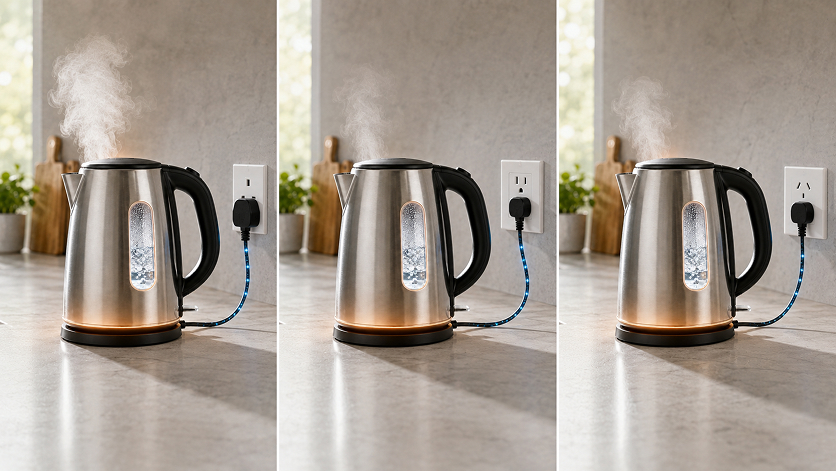
Why Kettle Wattage Differs by Country
This is the part every power-station blog skips. Kettle wattage is capped by the current your wiring and plug can safely carry, and that limit changes by region:
- UK: A 13-amp plug fuse at 230V allows up to roughly 2,990W — so kettles top out near 3,000W.
- US & Canada: A standard 15-amp kitchen circuit at 120V realistically supports about 1,440-1,800W once you leave safety headroom — so kettles sit around 1,500W.
- Australia & New Zealand: A 10-amp socket at 230-240V allows up to roughly 2,400W — so kettles land near 2,000-2,400W.
The practical result: a US kettle boils the same 1.7 litres noticeably slower than a UK one, because it’s pushing half the power. It isn’t a worse kettle — the grid simply hands it less to work with.
| Wattage | Approx. time to boil 1L |
|---|---|
| 1,000W | ~4 min 15 sec |
| 1,500W (typical US) | ~2 min 50 sec |
| 2,200W | ~1 min 55 sec |
| 3,000W (typical UK) | ~1 min 25 sec |

How to Find the Exact Wattage of Your Own Kettle
Stop guessing — your kettle tells you directly. To find how many watts your electric kettle is, check, in order:
- The base or underside sticker. Flip the kettle (empty and cool) and look at the rating label. It lists voltage, wattage, and often the current draw — e.g. “220-240V ~ 2,000-2,400W.”
- The box or manual. The spec sheet lists rated power under “specifications.”
- A brand + model lookup. If the label is worn off, search the model number (usually molded into the plastic near the base) plus “specifications.”
If a range is printed (say “2,000-2,400W”), that reflects the voltage range; on a standard 240V Australian supply it’ll run at the top of that band.
What One Boil Actually Costs
Here’s how much it costs to boil an electric kettle. The formula:
Cost = (Watts ÷ 1,000) × hours run × price per kWh
Boiling one mug (about 250ml) takes roughly 45-60 seconds; a full 1.7L takes 2-4 minutes depending on wattage. Using realistic 2026 electricity rates:
| Task | US (~17¢/kWh) | UK (~24.5p/kWh) | AU (~30¢/kWh) |
|---|---|---|---|
| One mug (250ml) | ~0.5¢ | ~0.6p | ~0.9¢ |
| Full 1.7L kettle | ~1.2¢ | ~2.3p | ~2.6¢ |
So no — an electric kettle does not use a lot of electricity per boil. A single cup costs a fraction of a cent. The cost only adds up through repetition, which is where the monthly numbers come in.
Monthly and Yearly Cost at Normal Use
Most calculators bury this in one vague annual figure. Here’s the monthly and yearly cost of boiling a full kettle by how often you use it (UK rates, 3,000W kettle — the priciest common scenario):
| Usage | Per day | Per month | Per year |
|---|---|---|---|
| 1× a day | ~2.3p | ~£0.70 | ~£8.40 |
| 4× a day (typical family) | ~9.2p | ~£2.80 | ~£33.60 |
| 8× a day (shared office kettle) | ~18.4p | ~£5.60 | ~£67.20 |
On US or Australian rates, divide those roughly in half (lower wattage, though AU’s higher per-kWh price narrows the gap). Even a heavily used office kettle rarely tops $30-70 a year. So does an electric kettle consume a lot of electricity overall? For a normal household, it’s a rounding error next to your fridge, water heater, or air conditioner.
Does a Higher Wattage Kettle Cost More to Run?
This trips people up. A 3,000W kettle draws more power, but it also finishes faster — so the total energy to heat the same water is roughly the same. Boiling 1L takes about 0.1 kWh whether your kettle is 1,500W or 3,000W; the 3,000W one just gets there in half the time.
Where higher wattage genuinely saves money is less standby heat loss: a faster boil means less time for heat to escape into the air and the kettle body, so slightly more of your energy ends up in the water. For frequent users that trims a little waste. Does an electric kettle save energy compared with other methods? Often yes — see our breakdown of how the appliance works and why it heats water so efficiently.
Kettle Wattage vs Water Heaters and Other Appliances
Don’t confuse a countertop kettle with a tank water heater. A kettle is a sprinter; a water heater is a marathon runner:
- Electric kettle: 1,000-3,000W, but runs for minutes a day.
- Electric tank water heater: 3,000-4,500W, and can run for hours daily to keep a tank hot — which is why it costs far more despite similar wattage.
- Microwave: ~1,000-1,200W, less efficient for water because it heats less evenly.
- Stovetop: equivalent to ~1,500-2,000W of usable heat, but loses more to the air.
The takeaway: wattage alone doesn’t determine cost — run time does. That’s why a 3,000W kettle is cheap to run and a 3,000W water heater isn’t.
Running a Kettle on a Generator, Inverter or Power Station
Because kettles are pure resistive heaters, their startup surge is small — running watts and surge watts are nearly identical. The catch is the sheer running load. To power a kettle off-grid you need a source rated above your kettle’s wattage with headroom:
- A 1,500W US kettle needs at least a 1,800-2,000W inverter or power station.
- A 3,000W UK kettle needs a 3,000W+ unit — which is why many portable stations struggle with British kettles and the brands selling them stay vague about it.
Budget 20-25% above the rated wattage so the source isn’t running flat-out.
Easy Ways to Cut Kettle Electricity Use
Now tie it back to the numbers above:
- Only boil what you need. Boiling a full 1.7L when you want one mug wastes about 85% of the energy. Across four boils a day, filling to one mug instead of full can save the difference between ~9p and ~2.4p daily — real money over a year.
- Descale regularly. Limescale insulates the element, so it works harder and longer for the same boil. Our first-time user guide covers correct filling and care.
- Use the kettle, not the stove, for small amounts. For a cup or two it’s the most efficient option in the kitchen.
- Skip the re-boil. Reheating water you already boiled and let go cold is pure waste — and if you’re wondering whether that’s even safe, we cover it in is water boiled in an electric kettle safe.
None of these are dramatic on their own. But knowing your kettle’s wattage — the number on its base — is what turns vague advice into a decision you can actually cost out.
Frequently Asked Questions
How many watts is a kettle in the UK, US, and Australia?
UK kettles are typically 2,200-3,000W (usually 3,000W) on 230V. US kettles are around 1,200-1,500W on 120V. Australian kettles run 2,000-2,400W on 230-240V. The differences come down to each country’s plug and circuit limits, not the kettle’s design.
How many amps does an electric kettle draw?
Divide watts by volts. A 3,000W UK kettle on 230V draws about 13 amps — the limit of a UK plug fuse. A 1,500W US kettle on 120V draws about 12.5 amps. A 2,400W Australian kettle on 240V draws about 10 amps.
How much does it cost to boil a kettle once?
Very little. One mug costs roughly 0.5¢ in the US, 0.6p in the UK, or 0.9¢ in Australia. A full 1.7L kettle costs about 1.2¢ (US), 2.3p (UK), or 2.6¢ (AU) using typical 2026 rates.
Does a higher wattage kettle use more electricity?
Not really. A higher-wattage kettle boils faster, so it uses roughly the same total energy to heat the same water — it just gets there quicker. Heating 1L takes about 0.1 kWh regardless of wattage, and a faster boil even wastes slightly less heat to the air.
How do I find out how many watts my specific kettle is?
Flip the kettle over (empty and cool) and read the rating label on the base — it lists voltage and wattage. If it’s worn off, check the box, the manual, or search the model number printed near the base plus the word ‘specifications.’
How many watts do I need to run a kettle on a generator or power station?
Since kettles have almost no startup surge, size your power source about 20-25% above the kettle’s rated wattage. A 1,500W US kettle needs an 1,800-2,000W unit; a 3,000W UK kettle needs a 3,000W+ unit with headroom.
Leave a Reply