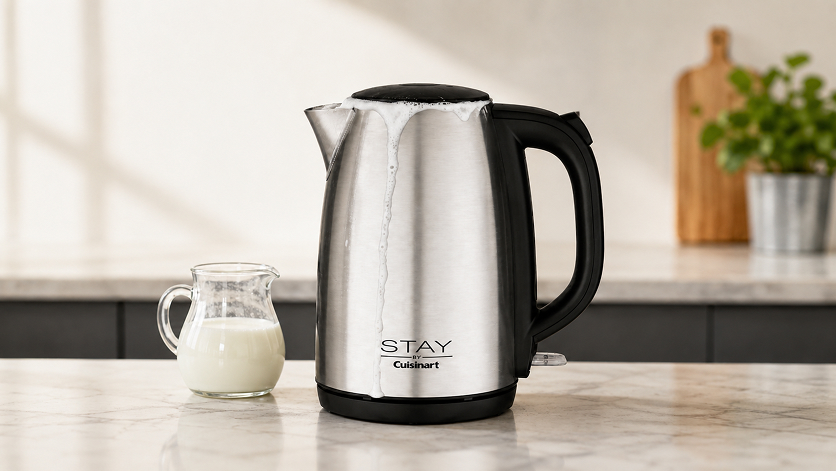
Short answer: you can, but you really shouldn’t. Almost any electric kettle will physically heat milk, but milk scorches, foams over the electrical base, gums up the heating element, and can leave a burnt smell that taints the next few pots of water you boil. The kettle’s automatic shut-off, the whole reason a kettle is convenient, is calibrated for water, not milk, so it often fails to click off at the right moment.
There’s a real difference between splashing a little milk in to warm it and trying to boil a full kettle of it. Neither is a good idea, but the second is how people melt a heating element or trip a warranty. Below is exactly why milk behaves this way, the safer alternatives ranked, and a genuine cleaning protocol for when it’s already gone wrong.
Can an Electric Kettle Boil Milk? The Honest Answer
So can we use an electric kettle to boil milk? Mechanically, yes — the element heats whatever liquid is in the chamber. But “can it” and “should it” are different questions. Manufacturers design kettles for water, and most user manuals explicitly warn against milk, juice, or anything but plain water. Put simply: can you put milk in an electric kettle and get away with it once? Maybe. Do it regularly and you’ll ruin the kettle and possibly the milk.
If you’re the type who likes to know why your appliance behaves the way it does, our guide on how an electric kettle actually works explains the heating element and steam sensor setup that milk quietly sabotages.
Why Milk Scorches and Burns in an Electric Kettle
Water is simple, it heats evenly and boils at 212°F (100°C). Milk is not water. It’s an emulsion of fat, protein (mostly casein), and sugar (lactose) suspended in water, and each of those reacts to direct heat in a way that plain water doesn’t.
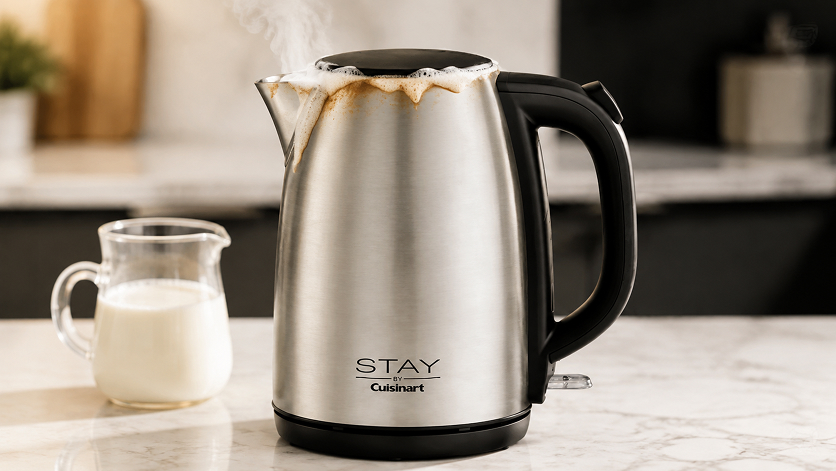
Here’s the number that matters: milk starts to scorch at roughly 180°F (82°C), a full 30 degrees below where water would even boil. So milk burns onto the element long before the kettle would normally decide it’s “done.” The proteins and sugars sitting against the hot metal undergo the Maillard reaction, the same browning that gives seared steak its crust, except here it caramelizes and chars directly onto your heating element, creating a hard, dark residue and that unmistakable burnt-milk smell.
Two things then happen at once:
- A protein skin forms on the surface. That skin traps steam underneath it instead of letting it escape gradually the way water vapor does.
- Pressure builds and releases suddenly. The result isn’t a gentle rolling boil, it’s a violent foam-up that erupts over the rim in seconds.
That’s why milk won’t boil in a kettle the way water does. It goes from calm to overflowing almost instantly, and it does so right on top of an electrical base.
Why the Auto Shut-Off Fails With Milk
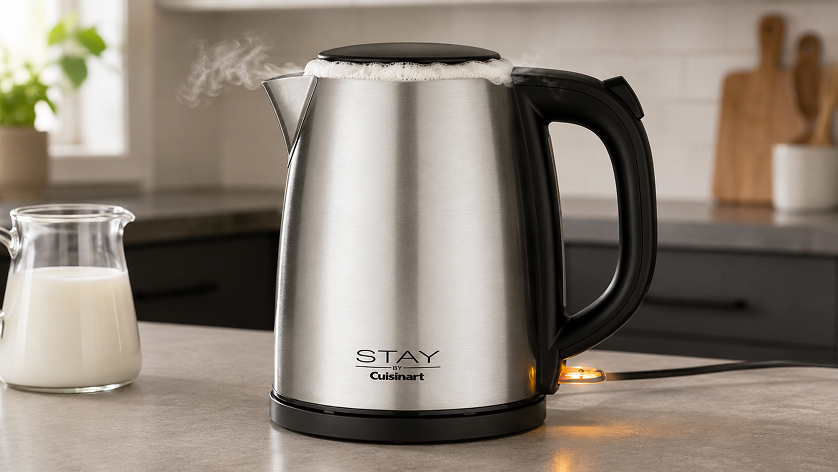
This is the part most articles skip, and it’s the real mechanical root of the problem. Your kettle shuts off using a steam-triggered thermostat, usually a bimetallic strip near the spout or lid. When water boils, it produces a predictable plume of steam that heats that strip, it flexes, and the switch clicks off.
Milk breaks this system in two ways. First, that protein skin on the surface traps steam rather than releasing a clean plume, so the sensor may not get the signal it’s waiting for. Second, milk foams over the boiling threshold before it generates enough consistent steam to trip the switch. The kettle keeps heating a liquid that’s already scorching, which means overheating, a baked-on element, and in a worst case a shut-off that never triggers at all.
If milk has already caused your kettle to misbehave or stop shutting off cleanly, that’s a repair-territory problem, not just a cleaning one.
What Actually Happens If You Do It Anyway
People still ask, is it safe to boil milk in an electric kettle? Here’s the concrete risk list, in order of how much it’ll cost you:
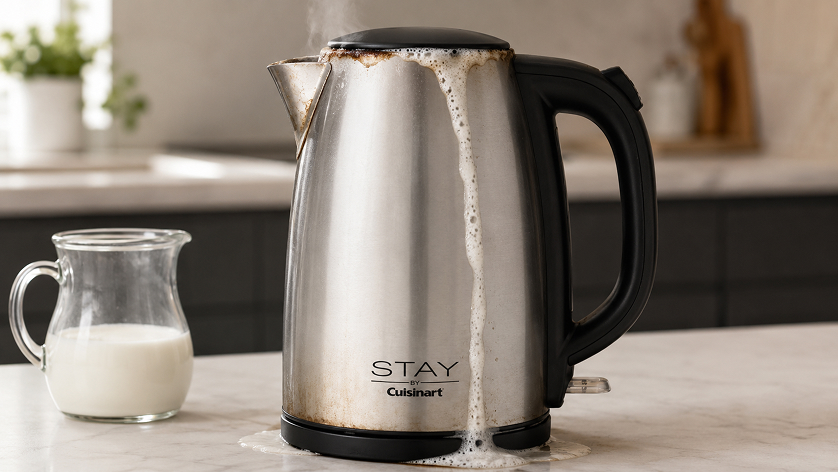
- Boil-over onto the electrical base. Milk foams fast and unpredictably. Liquid on or around the base contacts is the genuine safety hazard here.
- Lingering burnt smell. Scorched milk residue bakes onto the element and can flavor your next several pots of “plain” boiled water.
- Bacterial and mold growth. Milk film trapped around the element and under the mesh filter is a feeding ground. Leftover dairy accelerates both limescale and microbial buildup between uses, the same reason mold can grow in a neglected electric kettle.
- Permanent discoloration and damage. That charred layer often doesn’t fully come off, and repeated exposure shortens the element’s life.
Safer Ways to Warm Milk (Ranked)
Whether you want to warm milk for coffee or heat it for a mug of cocoa, these beat the kettle every time:
- Stovetop saucepan. The most controllable option. Medium-low heat, stir constantly, pull it the moment it steams. Best for larger amounts.
- Microwave in bursts. Fastest for a single mug. Heat in 15–30 second bursts, stirring between each, and stop around 150°F before a skin forms.
- Dedicated milk frother/warmer. Purpose-built for this, with a capped temperature (usually 160–170°F) so it can’t scorch. If you warm milk daily, this is the real fix.
- Double boiler. The gentlest, effectively scorch-proof method, ideal for delicate steamed milk.
Making milk tea? Don’t dump raw milk in the kettle. Boil the water in your kettle first, steep your tea, then add warm milk separately off the heat. You get all the convenience of the kettle with none of the scorching, the correct way to make milk tea in an electric kettle.
If You Genuinely Have No Other Option (Travel or Dorm)
Sometimes a kettle is all you’ve got. If you must, minimize the damage:
- Heat only a small splash, never a full kettle.
- Use the lowest setting or shortest cycle if your kettle has variable temperature.
- Never walk away. Watch for the skin and foam rising and pull it before it climbs the sides.
- Clean it immediately, don’t let residue cool and set.
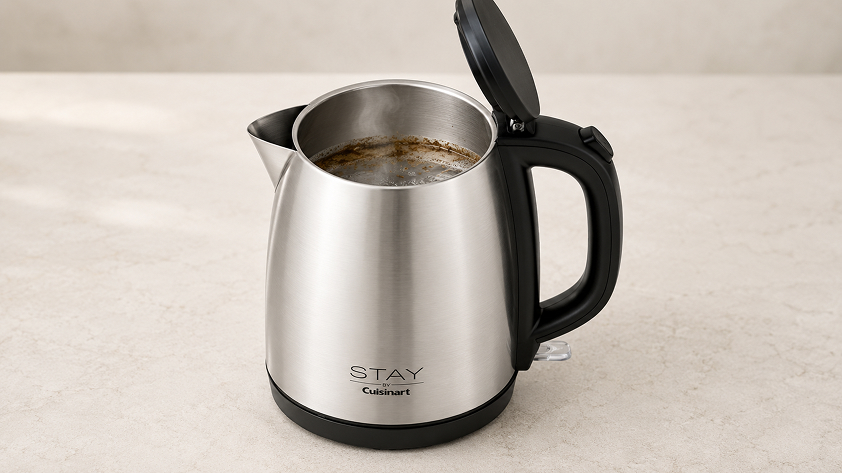
How to Get Burnt Milk Out of an Electric Kettle (Step by Step)
This is where competitors just say “use vinegar” and move on. Here’s the full protocol to remove burnt milk from an electric kettle properly:
- Unplug and cool completely. Never clean a hot kettle or one that’s still connected to power.
- Empty and rinse loose residue. Tip out the milk and rinse with warm water to clear anything not baked on.
- Vinegar boil-out. Fill with equal parts water and white vinegar, bring to a boil, then switch off and let it sit 15–20 minutes. The acid loosens the scorched protein layer.
- Baking soda paste for stubborn spots. Make a thick paste of baking soda and water, apply to charred patches with a soft cloth or non-scratch sponge, and gently work them loose. Never use metal scrubbers or steel wool — they scar the element and stainless interior.
- Citric acid or lemon for odor. If a burnt smell lingers, boil water with a tablespoon of citric acid (or a few lemon slices), let it stand, and pour out. This targets the smell specifically.
- Clean the mesh filter. Pop out the spout filter and scrub it separately, milk film clings here and breeds bacteria if ignored.
- Rinse and dry. Run two or three plain-water rinse cycles until no vinegar or soda taste remains, then leave the lid open to air-dry fully before storing.
Critical warning: never submerge the base or immersible electrical unit in water. For the full routine that keeps this from becoming a habit, see our complete guide on choosing and caring for an electric kettle.
The Bottom Line
Can milk be heated in an electric kettle? Technically yes; sensibly no. Milk scorches 30 degrees below water’s boiling point, foams over unpredictably, and defeats the very sensor that makes a kettle safe. Use your kettle for water, its actual job, and warm milk on the stove, in the microwave, or in a dedicated frother. Your kettle, your milk, and your nose will all be better for it.
Frequently Asked Questions
Can milk be boiled in an electric kettle?
It can be, but you shouldn’t. Boiling is worse than gently warming, milk scorches onto the element around 180°F, foams over the electrical base, and the burnt residue is hard to remove and can taint future boils. Boiling maximizes every risk.
Will milk boil in a kettle the same way water does?
No. Water releases steam gradually and boils evenly. Milk forms a protein skin that traps steam, then erupts into foam and overflows in seconds. It goes from calm to boiling over almost instantly, which is why kettles can’t handle it safely.
Can you put milk in an electric kettle just to warm it, not boil it?
You can warm a small splash on the lowest setting while watching it closely, but it’s still not ideal, even warming leaves residue that needs cleaning right away. A stovetop pan, microwave, or milk frother is safer and just as fast.
Does heating milk in a kettle ruin the appliance?
It can over time. Scorched milk bakes onto the heating element, causing discoloration and lingering odors, while trapped residue accelerates limescale and bacterial buildup. It can also confuse the auto shut-off sensor, leading to overheating.
How do you get the burnt milk smell out of a kettle?
Boil a mix of water and white vinegar, let it sit 15–20 minutes, then follow up with a citric acid or lemon-water boil aimed specifically at odor. Scrub scorched spots with a baking soda paste and a soft sponge, then rinse several times with plain water.
Is there a kettle designed to heat milk safely?
Yes, dedicated electric milk warmers and frothers are built for it, with temperatures capped around 160–170°F so milk can’t scorch. If you warm milk regularly, that’s the real solution rather than risking your water kettle.
Leave a Reply