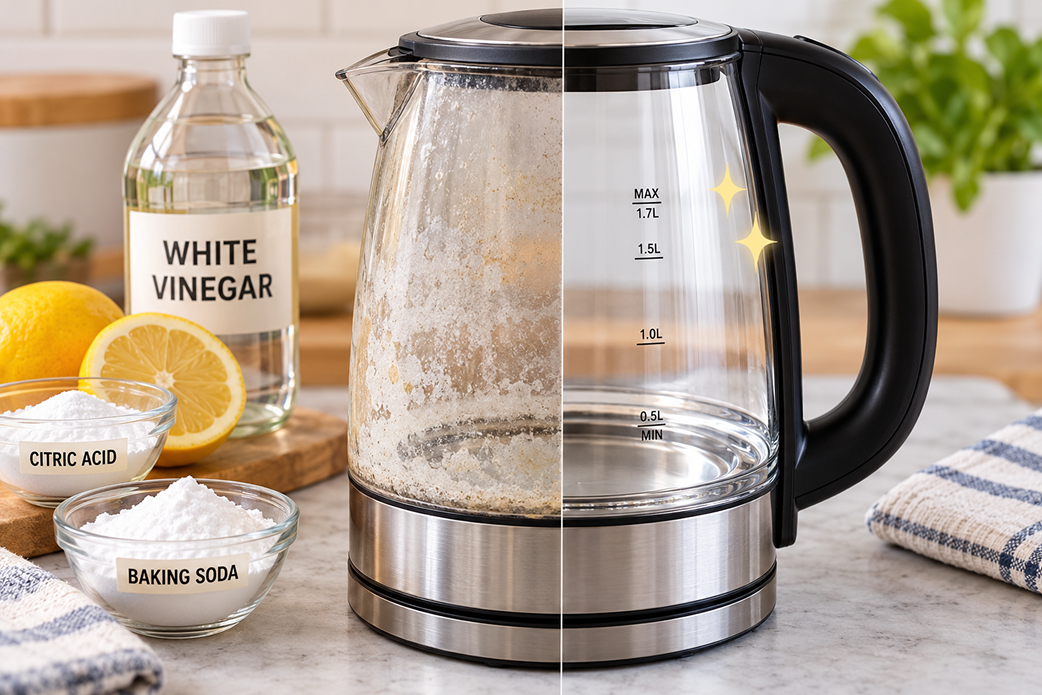
If the water coming out of your kettle has started to taste a little flat, or you’ve noticed a chalky film clinging to the inside, your kettle is overdue for a clean. It happens to every kettle eventually, and it has nothing to do with how careful you are. It’s just what water leaves behind when you heat it, day after day.
The good news is that bringing an electric kettle back to a spotless, fresh-tasting state takes about ten minutes of hands-on effort and a couple of ingredients you almost certainly already have. Below is a complete walkthrough covering everything from a light monthly refresh to the stubborn stuff, plus how to handle rust, mold, burnt milk and that odd smell some kettles develop.
What that white stuff inside your kettle actually is
Those cloudy flakes, the chalky ring near the waterline, and the pale spots on the bottom are all the same thing: limescale. When you boil water, the dissolved calcium and magnesium in it get left behind as the water evaporates, and over time these mineral deposits harden into a crusty layer. If you live in a hard water area, it builds up fast; with softer water it takes longer, but it still comes.
So if you’ve ever peered inside and wondered what the white residue at the bottom is, that’s your answer. It isn’t dirt, it isn’t dangerous in small amounts, and it doesn’t mean your kettle is broken. Left alone, though, it dulls the heating element, makes your kettle work harder, and can give your tea a faintly metallic edge. That’s the real reason to descale on a schedule rather than waiting until the buildup is thick enough to flake into your cup.
How often you should clean and descale it
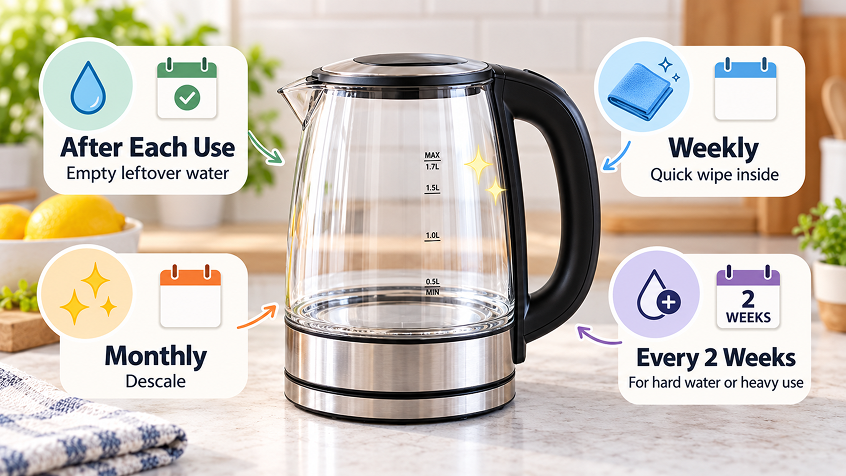
A quick descale once a month keeps most kettles in good shape. If your water is very hard or you’re boiling several times a day, every two weeks is a safer rhythm. Alongside that, a fast wipe of the inside once a week and emptying out any leftover water after you’re done stops fresh deposits from setting in. Think of it as two habits: a light weekly touch-up and a proper monthly deep clean.
Cleaning a brand-new kettle before its first use
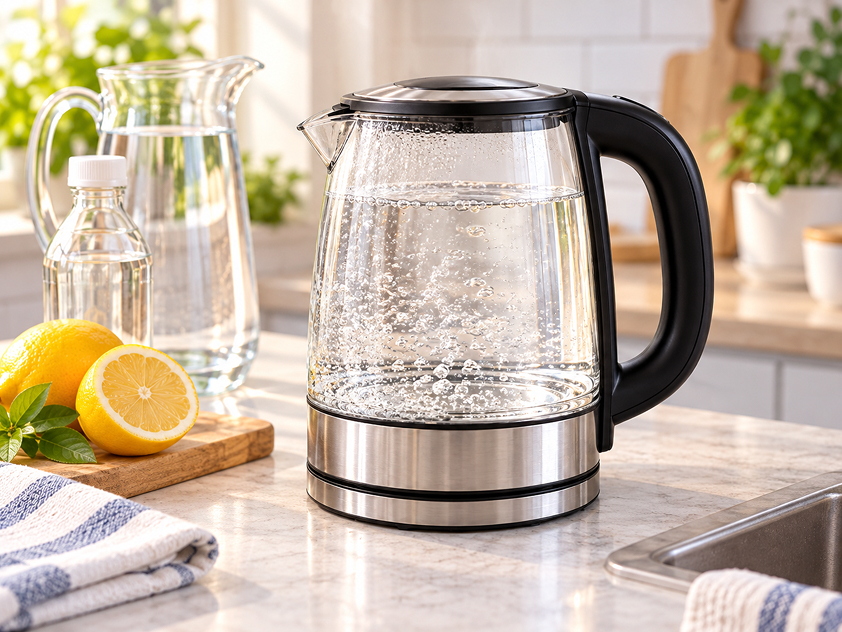
A new kettle deserves a rinse before it makes your first cup. Manufacturing can leave a faint plastic or metallic taste, so fill it to the max line with fresh water, bring it to a boil, and tip that water away. Repeat once or twice, and if the smell lingers, add a splash of vinegar or a squeeze of lemon to the second boil. After a rinse it’s ready to go.
How to clean an electric kettle with vinegar
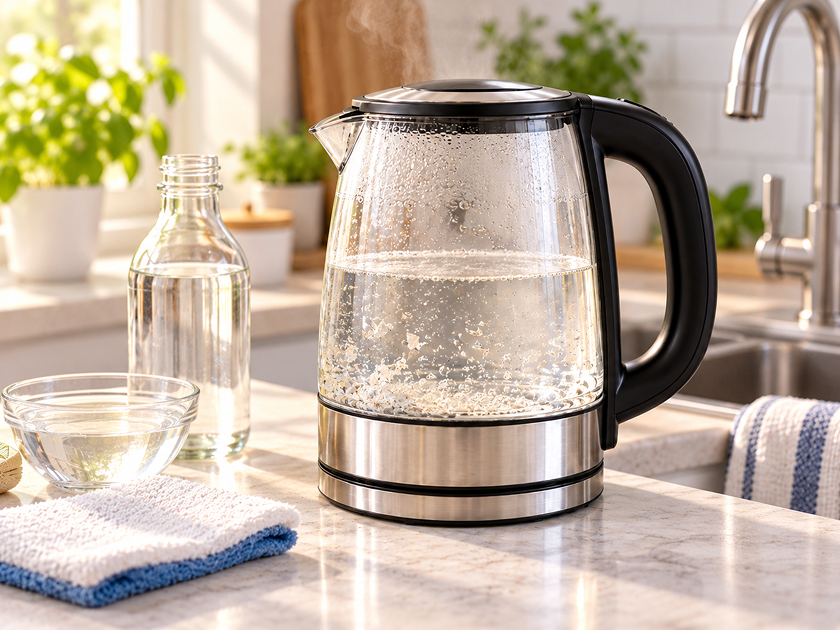
Plain white vinegar is the most reliable descaler there is, because the acid dissolves mineral buildup without scrubbing. Here’s the method that works every time:
- Fill the kettle about halfway with equal parts water and white vinegar. For a heavily scaled kettle, a stronger mix leaning toward more vinegar is fine.
- Bring it to a full boil, then switch it off and let the solution sit for 20 minutes to an hour. This soak is where the real work happens, so don’t rush it.
- Pour everything out. Most of the scale will have loosened; wipe any remaining specks away with a soft cloth or a non-abrasive sponge.
- Rinse two or three times with clean water, then boil a full kettle of plain water and discard it so no vinegar taste carries into your next drink.
Apple cider vinegar works in exactly the same way if that’s what you have on hand, though it can leave a slightly stronger scent that a couple of extra rinses will clear. Vinegar won’t harm the kettle itself, so there’s no need to worry about the acid damaging the interior when it’s diluted like this.
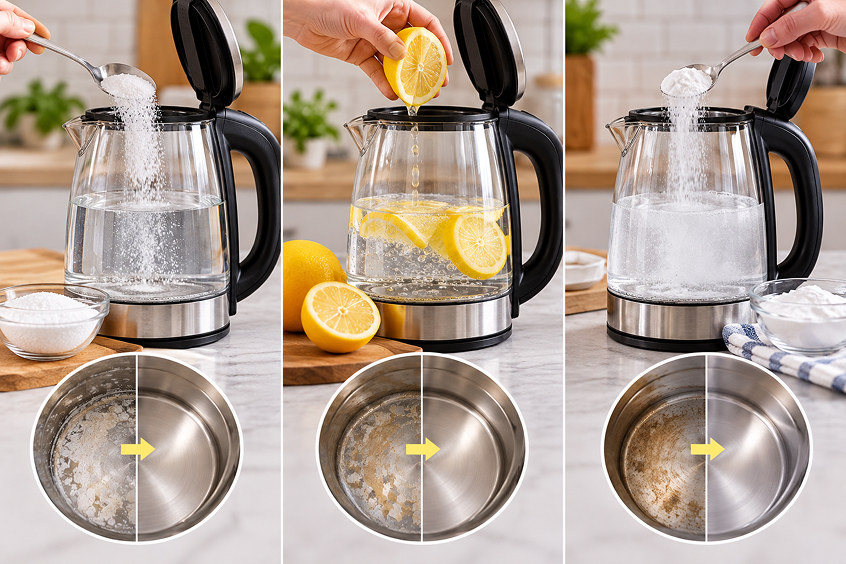
No vinegar? Citric acid, lemon and baking soda all work
If you’d rather not deal with the smell, you have good alternatives. Citric acid is the tidiest of them: stir a tablespoon or two of the powder into a kettle of water, boil, let it stand for 15 to 20 minutes, then rinse. It cuts through limescale just as well as vinegar and leaves almost no odor.
Lemon does the same job with ingredients from the fruit bowl. Squeeze the juice of one lemon into the kettle (or drop in a few sliced pieces), top up with water, boil, and let it sit before rinsing. It clears the scale and leaves a clean citrus smell behind.
Baking soda is the one to reach for when you want a gentle scrub rather than an acid soak. Add a teaspoon to a kettle of water, boil, let it cool a little, then use a soft sponge to work at any spots that are still holding on. A paste of baking soda and a little water, dabbed onto a cloth, is also handy for lifting marks near the base. Cream of tartar dissolved in boiling water is another mild option that does much the same thing.
Cleaning the outside, the bottom and the base
The body of the kettle just needs a wipe with a damp cloth and a drop of dish soap; dry it afterwards so you don’t trade water spots for soap streaks. Never dunk the base or the electrical connection in water, and keep moisture away from the plug contacts. For a stainless steel exterior that’s lost its shine, a tiny amount of olive oil on a soft cloth brings the finish back and helps fingerprints slide off in future. The metal plate at the bottom, where scale tends to settle, usually comes clean during a vinegar or citric acid soak, but a soft brush can coax off anything stubborn once the deposits have softened.
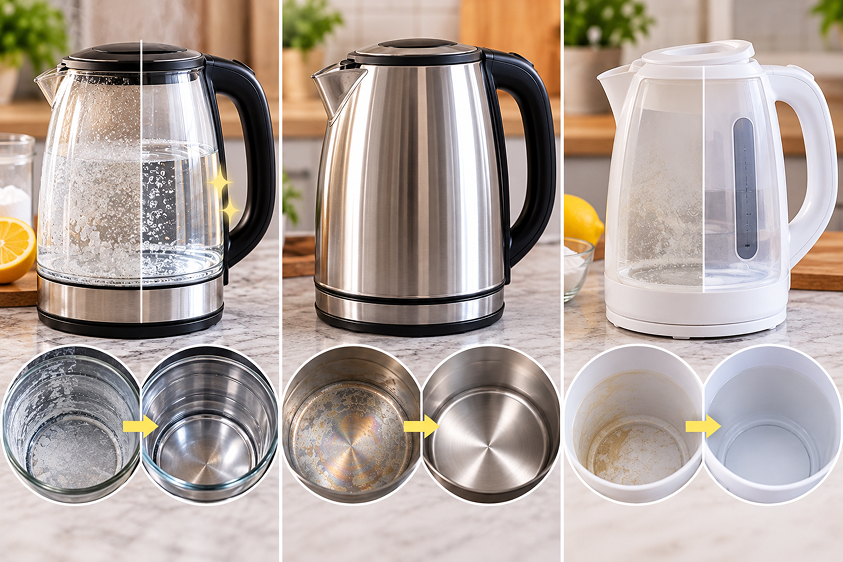
Glass, stainless steel and plastic kettles each want slightly different care
A glass kettle shows every smudge, so it benefits from more frequent descaling to stay clear; the upside is you can see exactly when it needs doing. Acid soaks are perfectly safe on glass. A stainless steel kettle hides scale better but can develop rainbow-ish heat tints inside, which a vinegar or citric acid soak lifts nicely. Plastic kettles need the gentlest touch: skip anything abrasive that could scratch the interior, stick to vinegar, lemon or citric acid, and rinse thoroughly, since plastic can hold onto smells more than metal or glass.
Fixing the problems a normal descale won’t touch
Rust spots
Small orange or brown spots on a metal kettle are usually surface rust from minerals sitting on damp steel, not the kettle rotting through. A paste of baking soda and water rubbed gently over the spot, or a vinegar soak followed by a light scrub, lifts most of it. For a metal kettle prone to it, drying the inside after each use is the single best way to keep it from rusting again. A little surface rust that you’ve cleaned off isn’t something to panic about, but if the interior is heavily corroded and flaking, that’s the point to retire the kettle rather than keep drinking from it.
Mold
Mold can appear if water is left sitting in a warm kettle for days, and yes, it can grow inside one that isn’t emptied. Fill the kettle with a strong vinegar-and-water mix, boil, and leave it to sit for an hour so the acid kills the growth, then scrub the affected areas, rinse very well, and do a final plain-water boil. Going forward, tipping out leftover water and leaving the lid open to air-dry stops it coming back.
Burnt milk and scorch marks
If milk has boiled over or scorched onto the element, don’t scrape at it while it’s dry. Cover the burnt area with a baking soda and water paste, or fill the kettle with a baking soda solution and boil it, then let it soak until the residue softens and wipes away. Brown stains and burn marks near the base respond to the same treatment repeated once or twice.
A musty or fishy smell
An odd odor, sometimes described as fishy or musty, usually comes from trapped minerals, stagnant water or, in newer kettles, residue from the manufacturing process. A vinegar or lemon boil clears it in most cases: descale as above, rinse thoroughly, then boil a fresh kettle of water with a little lemon and discard it. Leaving the lid open between uses so the inside can dry keeps the smell from returning.
Stubborn hard water and brown stains
When a single soak doesn’t fully clear the staining, the fix is almost always time rather than force. Repeat the vinegar or citric acid soak and leave it longer, up to a couple of hours, before wiping. Cloudy water-line marks and brown mineral staining that look permanent nearly always come away once the acid has had enough contact time to break the deposit down.
Keeping the buildup from coming back
Once your kettle is clean, a few small habits keep it that way. Empty out any water you didn’t use instead of letting it sit, give the inside a quick weekly wipe, and if your area has particularly hard water, boiling filtered water rather than straight from the tap dramatically slows how fast scale returns. Stay on top of a monthly descale and you’ll rarely face a heavy buildup again, which means better-tasting water and a kettle that heats quickly for years rather than months.
Leave a Reply