Blog

  • How to Remove Rust From an Electric Kettle (And Stop It Coming Back)

    How to Remove Rust From an Electric Kettle (And Stop It Coming Back)

    Most rust guides you’ll find were written for stovetop kettles you can dunk in a sink. An electric kettle is a different animal: it has a sealed electrical base, an exposed heating element, and a power connector that must never get wet. Clean it the wrong way and you don’t just fail to remove the rust — you can kill the kettle.

    Here’s how to do it properly, plus the one thing the vinegar listicles never tell you: some rust means clean it, and some rust means stop using the kettle today.

    Quick Answer: How to Remove Rust From an Electric Kettle

    1. Unplug the kettle and let it cool completely.
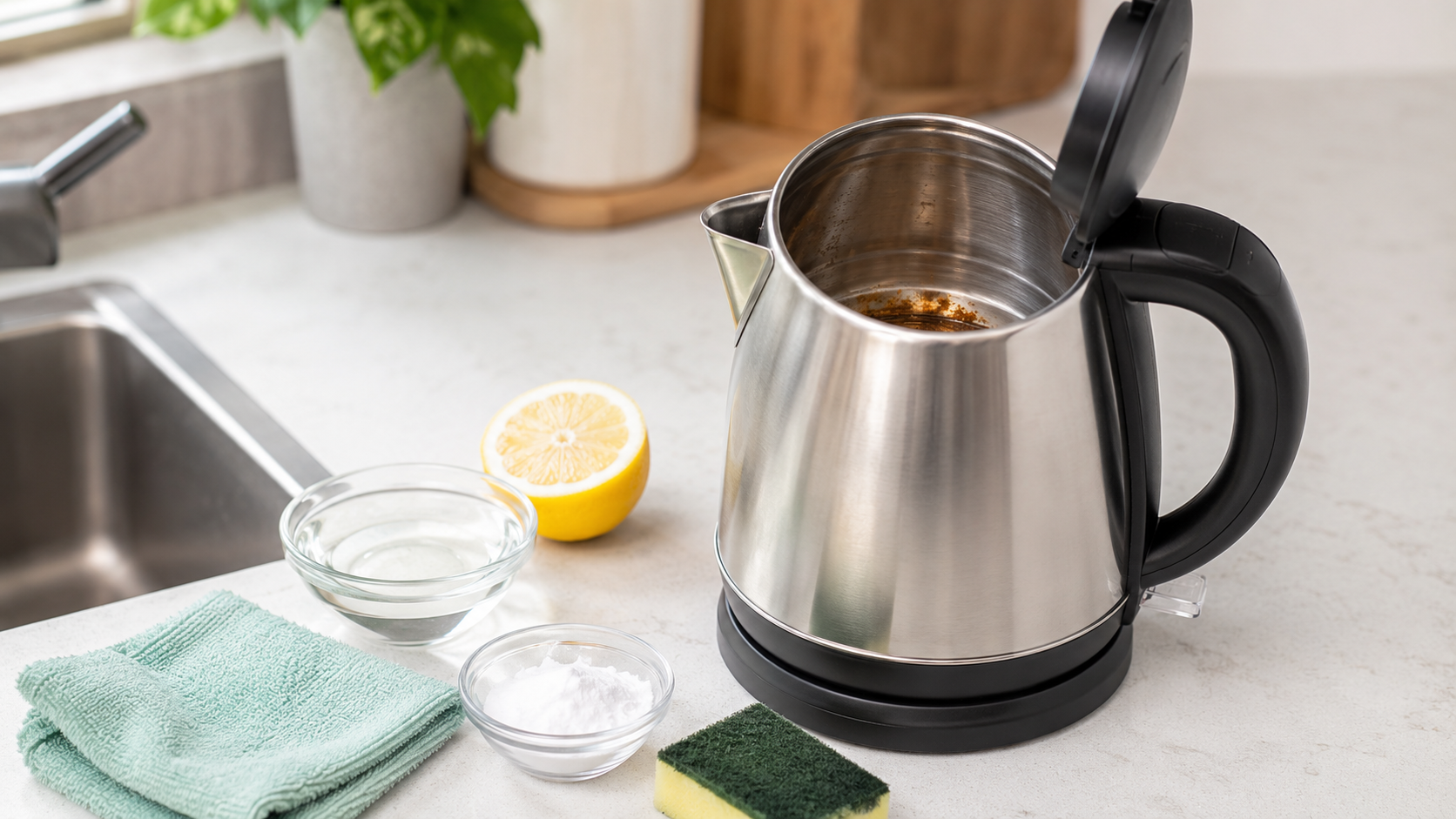
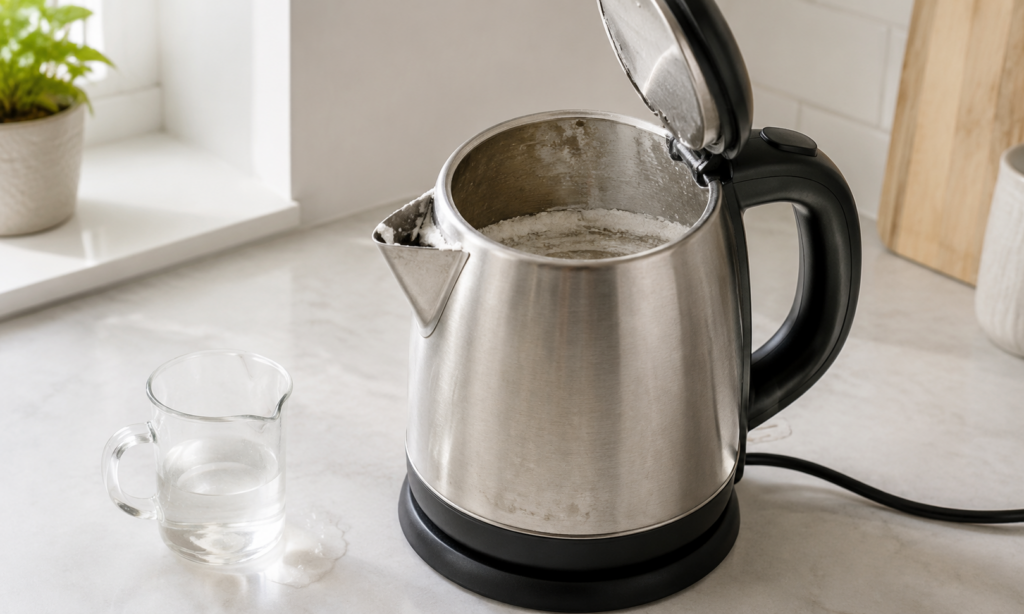
    2. Fill it with equal parts water and white vinegar (or lemon juice) up to just above the rust line.
    3. Boil once, switch off, and let it soak 30 to 60 minutes.
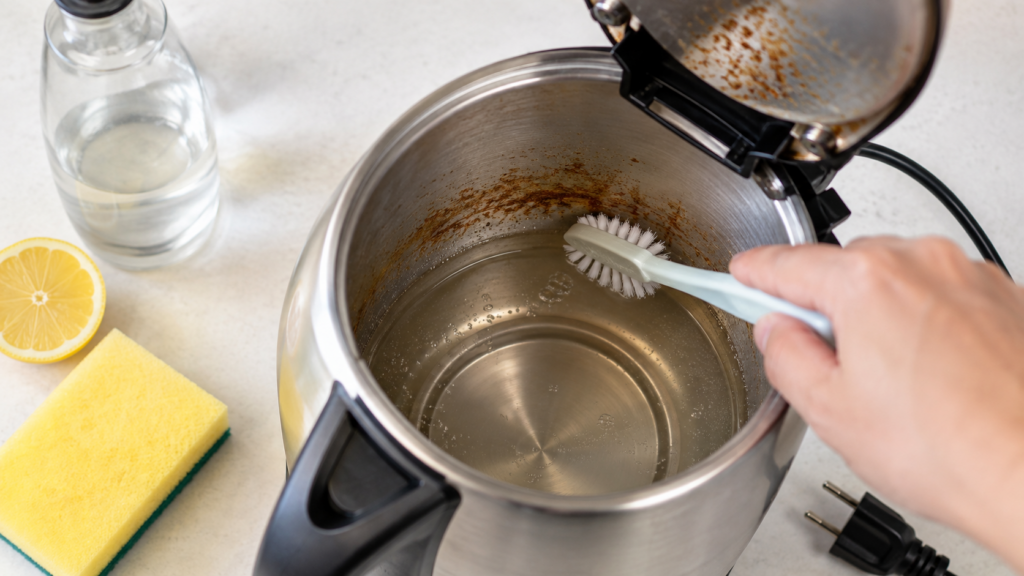
    4. Tip it out and scrub gently with a soft-bristle brush or sponge — never steel wool on a coated interior.
    5. Rinse three to five times, then boil a batch of plain water and discard it before normal use.

    This handles surface rust on the interior wall or lid. If rust has reached the exposed heating coil, skip the scrubbing — read the safety section below first, because that’s a replace decision, not a cleaning one.

    Why Does an Electric Kettle Rust in the First Place?

    Rust is iron plus oxygen plus moisture. Your kettle supplies all three: the heating element and some interior parts contain iron, and water sits against them every day. Three things speed it up.

    • Trapped moisture. Condensation collects under the lid and in the spout after every boil. If you close the lid on a warm, damp kettle, that water has nowhere to go.
    • Hard water. Mineral deposits (limescale) build a rough, porous layer that holds moisture against the metal and seeds corrosion underneath.
    • Standing water. Leaving water in the kettle overnight is the single most common cause of rust spots we see.

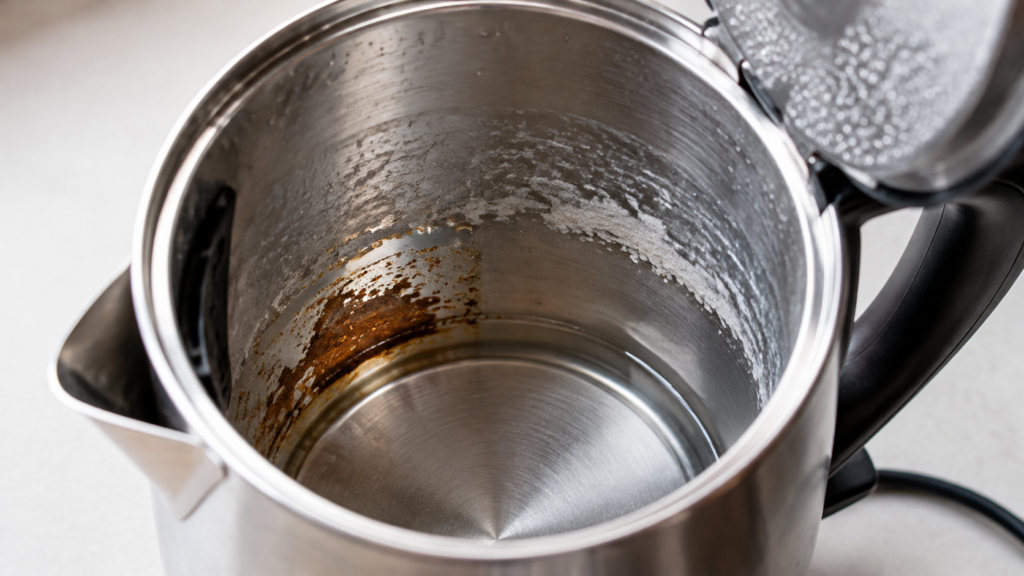
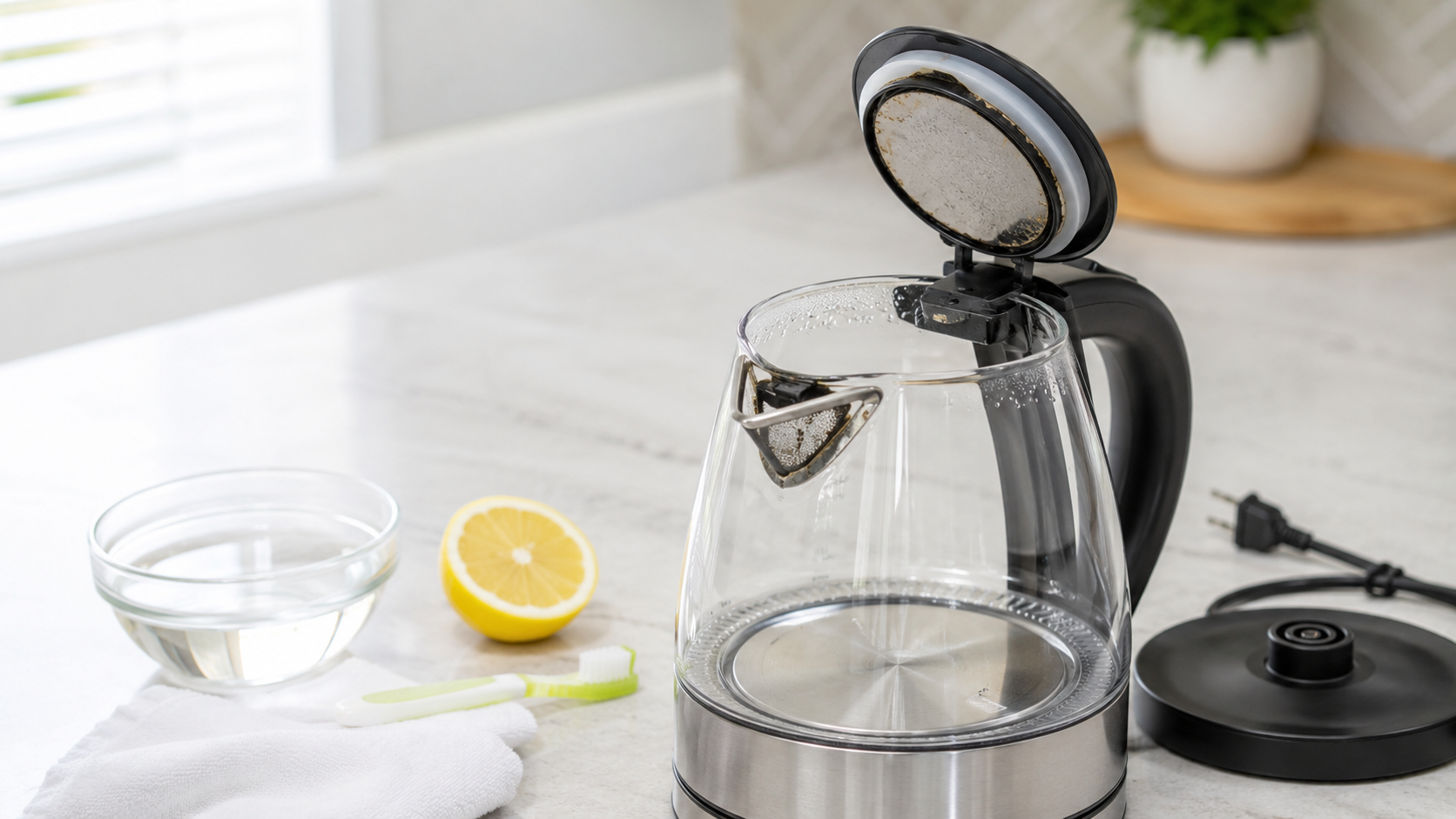
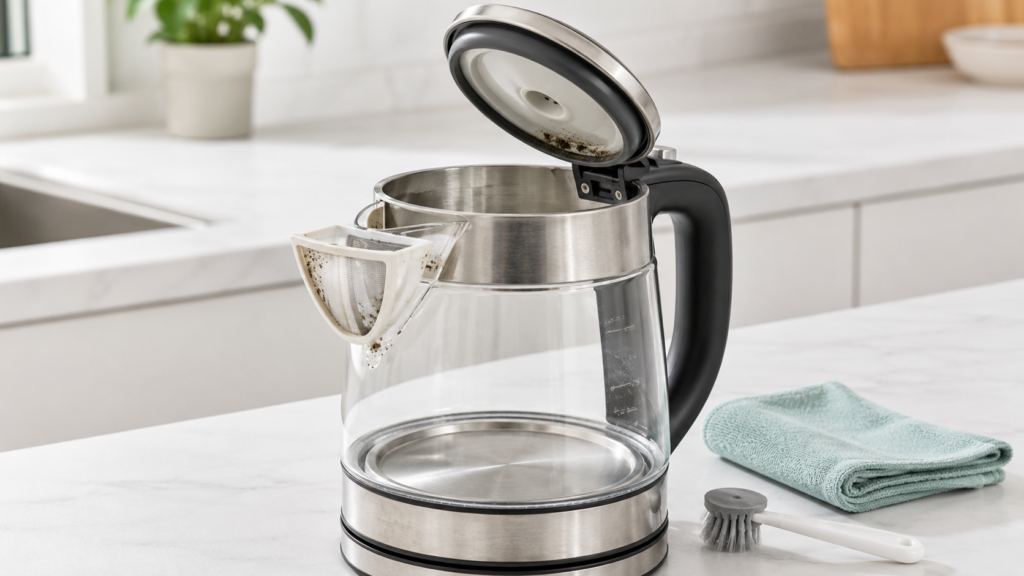
    First, make sure it’s actually rust. People confuse two very different things. True rust is reddish-brown, flaky, and sits in patches. Limescale is white, gray, or chalky and crusty, usually around the waterline and on the element. Limescale is harmless and descales away easily. If what you’re seeing is white or gray, you don’t have a rust problem — you have a descaling job, and our guide on whether kettle water is safe covers why that mineral scale is nothing to worry about.

    Is Rust in an Electric Kettle Dangerous?

    Let’s give a straight answer, because the other guides won’t.

    Iron oxide — actual rust — is not toxic in the small amounts you’d ever ingest from a kettle. Your body handles trace iron fine. So a few light surface spots that you clean off are not a health emergency.

    But “not toxic” isn’t the whole story. Here’s the honest verdict:

    • Light surface rust on the interior wall or lid: clean it and keep using the kettle. Low risk.
    • Rust that flakes into the water no matter how often you clean: stop. Flaking rust means the protective surface is failing, and you’ll be drinking bits of it.
    • Rust on the visible heating coil or element itself: stop using it and replace the kettle. This isn’t a taste or health-of-the-water issue — it’s an electrical one. Corrosion on or around the element can compromise the seal between the water and the wiring, and that’s where water-and-electricity risk lives.

    Rule of thumb: if you can wipe the rust off cosmetic surfaces, clean it. If the rust is part of the heating element, buy a new kettle.

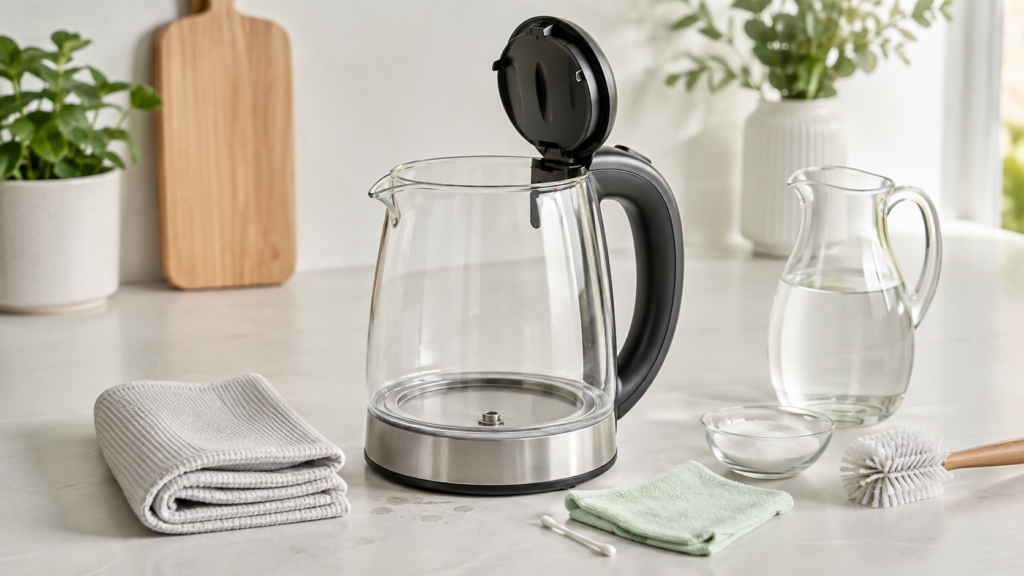
    What You’ll Need

    • White vinegar or lemon juice (either works — both are mild acids)
    • Baking soda for stubborn spots
    • A soft cloth or non-scratch sponge
    • A soft-bristle brush (an old toothbrush is perfect)
    • Dish soap and rubber gloves

    Note what’s not on the list: steel wool and wire brushes. They’ll strip the finish off a stainless interior and shred a nonstick or enamel-coated one, creating fresh raw metal for rust to grow on. Only reach for a fine wire brush if you have a bare stainless steel interior and the rust genuinely won’t budge — and even then, go gently.

    How to Clean Rust From Inside an Electric Kettle, Step by Step

    This is the core method for getting rust out of the interior — the walls, floor, and lid.

    1. Unplug and cool. Never work on a plugged-in or hot kettle. Full stop.
    2. Fill with your acid solution. Equal parts water and white vinegar, or straight lemon juice topped up with water, to just above the highest rust spot.
    3. Boil, then soak. Bring it to a boil, switch off, and leave it 30 to 60 minutes. The acid loosens the rust bond and dissolves the limescale holding it in place.
    4. Scrub gently. Empty the kettle and work the rust spots with a soft brush or sponge in small circles. Most surface rust lifts here.
    5. Hit stubborn spots with baking soda. Make a paste of baking soda and a little water, dab it on the remaining marks, and scrub lightly. Baking soda is a mild abrasive that clears rust stains without scratching. This is also the trick for removing rust stains that leave a shadow even after the flakes are gone.
    6. Rinse and purge. Rinse three to five times until there’s no vinegar smell, then boil one full batch of plain water and pour it out. Now the kettle’s ready for tea again.

    How to Remove Rust From the Heating Element and Base

    This is where electric kettles need their own rules, and where generic advice gets dangerous.

    Never submerge the base. Never pour or spray solution near the power connector. The base houses the electrical contacts. Water in there ruins the kettle at best and creates a shock hazard at worst.

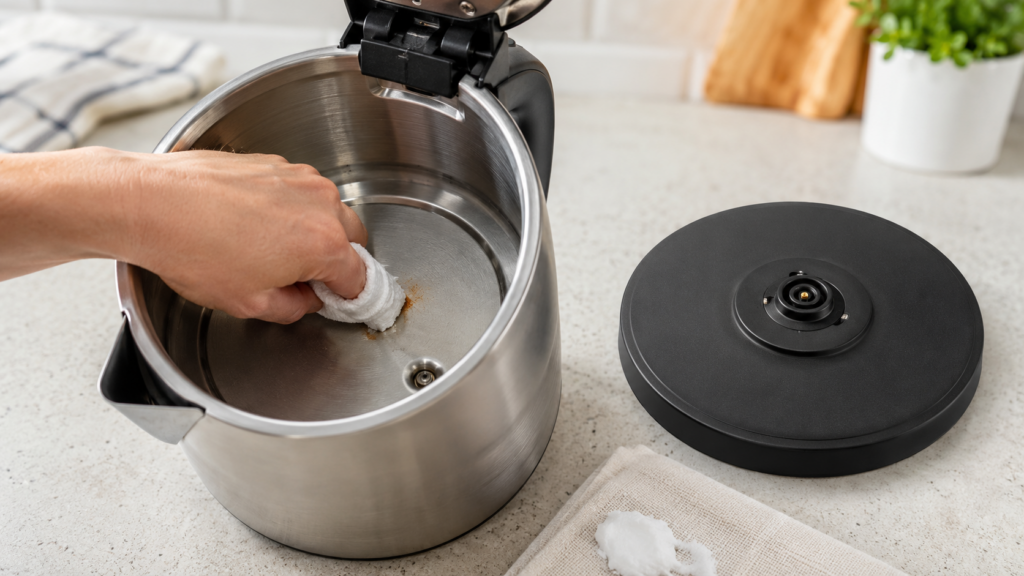
    For light rust or discoloration around a covered element, the vinegar soak above usually reaches it — the solution sits on the kettle floor where the element lives. For a spot that needs direct attention, wrap a vinegar-dampened cloth around your finger or a brush and dab the area. Damp, not dripping. You’re spot-treating, not flooding.

    To clean rust from the bottom of the kettle exterior or around the base, use a barely-damp cloth with a little baking soda paste, wipe, then dry immediately. Keep the kettle unplugged and let it air-dry fully — an hour at least — before it goes back on the base.

    And the line worth repeating: if the rust is pitting or flaking off the exposed metal coil itself, this isn’t a cleaning job. That kettle is done. Head to the replacement section.

    Stainless Steel vs. Coated Interiors

    The right method depends on what your kettle is made of.

    • Bare stainless steel: tolerates the vinegar soak, baking soda paste, and light brushing well. Fun fact — many “rust” spots on stainless are actually surface staining from minerals in the water, and they wipe off with baking soda without any real corrosion underneath.
    • Nonstick, enamel, or plastic-lined interiors: acid soak yes, abrasion no. Stick to a soft sponge and baking soda paste only. Scratching the coating exposes the metal beneath and guarantees the rust comes back worse.

    How to Keep Your Electric Kettle From Rusting Again

    Removing rust is the easy part. Stopping it is what actually saves you the hassle. Every one of these targets a root cause specific to electric kettles.

    • Empty it after every use. Don’t leave water sitting, and never overnight. This alone prevents most rust.
    • Leave the lid open to dry. Let condensation escape instead of trapping it against warm metal. Give it a quick wipe if you can.
    • Descale monthly. Run a vinegar or citric-acid boil-soak once a month even when you see no rust. Limescale is what seeds future corrosion, so clearing it early keeps rust from ever getting a foothold. This is the same routine you’d use for general everyday kettle care.
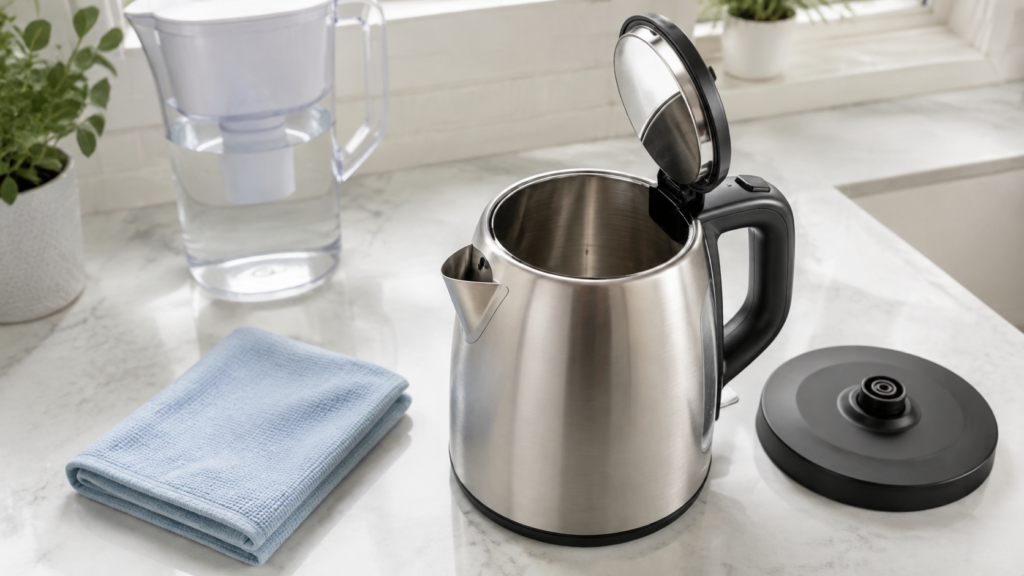
    • Use filtered or softened water if you’re in a hard-water area. Less mineral load means less scale and less rust.
    • Wipe the exterior and base occasionally with a dry cloth so you catch any surface rust early, while it’s still a two-minute fix.

    When to Stop Cleaning and Buy a New Kettle

    Cleaning has limits. Replace the kettle if:

    • Rust keeps flaking into the water despite a proper clean.
    • Rust has reached the heating element coil itself.
    • Rust returns within a week or two of every cleaning — that’s a sign the interior coating has failed and it’ll only get worse.
    • The kettle is old and you’re cleaning it more often than you’re using it.

    A decent electric kettle isn’t expensive, and a failing one wastes energy and your time. If you’re at this point, our complete electric kettle buying guide walks through what to look for — including which interior materials resist rust best in the first place. And if your kettle is acting up in other ways too, the symptom-by-symptom troubleshooting guide is worth a look before you decide.

    Bottom line: light surface rust is a 45-minute vinegar job and nothing to fear. Rust on the element is a replace-it signal. Learn to tell them apart, dry the kettle out after every use, and you’ll rarely have to deal with either again.

    Frequently Asked Questions

    Is it safe to drink water boiled in a rusty electric kettle?

    In small amounts, iron oxide isn’t toxic, so water from a lightly rust-spotted kettle you’ve cleaned is generally fine. But if rust is flaking into the water or sits on the heating element itself, stop using the kettle — that’s a sign the surface or the electrical seal is failing, not just a cosmetic stain.

    Can you use vinegar in an electric kettle without damaging it?

    Yes. A 50/50 water-and-white-vinegar solution is safe for cleaning and descaling and won’t harm stainless steel or coated interiors. Just rinse thoroughly afterward and boil a batch of plain water before your next drink so there’s no aftertaste.

    Does rust affect the taste of tea or coffee?

    It can. Rust and the limescale that comes with it give water a faint metallic or flat taste that carries into tea and coffee. Cleaning the rust and descaling monthly restores a clean, neutral taste.

    How often should you descale to prevent rust?

    Once a month for average use, or every two to three weeks if you have hard water. Descaling removes the limescale that traps moisture against the metal and seeds rust, so regular descaling is the best rust prevention there is.

    How do you tell rust apart from limescale in a kettle?

    Rust is reddish-brown, flaky, and appears in patches. Limescale is white, gray, or chalky and usually forms around the waterline and on the element. Limescale is harmless and descales off easily; only reddish-brown flaking is true rust.

  • Mold in Your Electric Kettle: Where It Hides, How to Clean It, and How to Keep It Gone

    Mold in Your Electric Kettle: Where It Hides, How to Clean It, and How to Keep It Gone

    Short answer: yes, mold can absolutely grow in an electric kettle. And it’s not because you’re doing anything gross — it’s because a kettle is a warm, damp, enclosed box with a rubber seal and a few residue traps, which is close to a perfect home for mold spores.

    Most guides tell you “boil some vinegar” and leave it there. That misses the point. The mold in a kettle almost never lives in the open water reservoir where you’d notice it — it hides in the parts you never look at, and boiling water doesn’t sterilize those parts. Let’s fix that properly, and do it without wrecking the electrical base or the heating element.

    Can Mold Really Grow in an Electric Kettle?

    Yes. Mold needs three things: moisture, warmth, and something organic to feed on. An electric kettle hands it all three. Water left standing after a boil keeps surfaces damp. The residual heat keeps things warm for hours. And the thin film left behind by tea, coffee, and even the trace organics in tap water gives spores something to eat.

    Here’s the part nobody explains: boiling doesn’t prevent regrowth. When you boil, you kill the spores that happen to be in the water at that moment. But the second the kettle cools, airborne spores land on the damp gasket, the spout, and the underside of the lid — surfaces the boil never sterilized because they’re above the waterline or shielded from full heat. Two or three days of “boil, cool, sit damp, repeat” is all it takes for a colony to establish. So no, boiling every day does not keep a kettle mold-free.

    Where Mold Actually Hides in an Electric Kettle

    This is the gap in almost every article you’ll find. “Clean inside the kettle” is useless advice when the mold isn’t in the obvious spot. Check these, in order of likelihood:

    • The rubber lid gasket or seal. The single most common hiding place. It stays damp, it’s shaded, and it’s textured — mold’s favorite terrain. Peel it back and look underneath.
    • The underside of the lid and the steam vent. Condensation collects here every time you boil, then never fully dries.
    • The spout opening and the mesh pour filter. That little limescale filter in the spout traps organic film and stays wet. Pop it out if it’s removable.
    • Crevices around the base and pouring rim. The seam where the body meets the base collects splashes. Important: this is near the electrical unit — clean it with a barely-damp cloth, never by submerging.

    If you’ve got a plastic or stainless kettle, mold can be harder to spot than in a glass one. In glass kettles you’ll see it early; in opaque models you often smell it before you see it.

    Mold vs. Limescale: How to Tell the Difference

    Searchers constantly ask, “Is this mold or just mineral buildup?” It matters, because the fixes overlap but the risks don’t. Here’s a quick identification test:

    ClueLimescaleMold
    ColorWhite, cream, chalkyBlack, green, orange, or pink
    TextureHard, gritty, crustyFuzzy, slimy, or spotty
    LocationOn the heating element and base, at the waterlineOn the seal, lid, and spout — the damp, shaded parts
    SmellNoneMusty, damp, earthy
    Wipes off?No — needs acid to dissolveSmears when wet, leaves a stain

    Rule of thumb: hard white crust on the metal element is limescale; fuzzy dark specks near the rubber seal are mold. If you’re dealing with reddish or brown staining on the metal, that may be rust instead — see our guide on how to remove rust from an electric kettle.

    Signs You Have Mold in Your Kettle

    • A musty or damp smell coming from the spout, even after rinsing.
    • Tea or coffee that tastes faintly off or “earthy.”
    • Dark spots or fuzzy patches near the lid, seal, or spout.
    • Discoloration that smears rather than wiping clean with plain water.

    A funny taste in your brew is often the first warning — the water reads fine, but it picks up spores on the way out through a moldy spout.

    Is It Safe to Drink Water From a Moldy Kettle?

    For a healthy adult, a small amount of water from a lightly moldy kettle is unlikely to make you seriously ill — but we don’t recommend it, and here’s the honest nuance most pages skip.

    Boiling kills live mold, but it does not neutralize the allergens and some toxins mold leaves behind once it has colonized a surface. So “I boil it, so it’s fine” isn’t quite true. The real risk depends on who’s drinking it:

    • Higher risk: people with asthma, mold allergies, respiratory conditions, or a compromised immune system. For them, stop using the kettle and clean it before the next brew.
    • Lower risk: healthy adults, occasional exposure, small visible amounts. Still worth cleaning promptly, but not a medical emergency.

    If you’re wondering about water safety more broadly, we cover it in is water boiled in an electric kettle safe. The bottom line on mold: visible growth means clean it now, don’t drink around it.

    How to Clean Mold Out of an Electric Kettle Safely

    This is where electric kettles differ from stovetop ones, and where generic advice gets dangerous. Follow this method to get mold out of an electric kettle without harming the wiring or the element.

    1. Unplug it and let it cool completely. Never clean a warm or connected kettle.
    2. Vinegar-water soak. Fill to about half with a 1:1 mix of white vinegar and water. Bring it to a boil, switch off, and let it sit for 20–30 minutes. Vinegar’s acidity kills mold and loosens limescale at the same time.
    3. Pour out and scrub gently. Use a soft sponge or a bottle brush. For stubborn spots, a baking soda paste (baking soda + a little water) works without scratching.
    4. Citric acid alternative. If you dislike the vinegar smell, dissolve 1–2 tablespoons of citric acid in a full kettle of water, boil, and let sit. It’s odor-free and food-safe.
    5. Rinse thoroughly — twice. Fill, boil, discard. Any cleaning taste left behind ends up in your tea.

    What NOT to do, ever:

    • Never submerge the base or the electrical unit. Wipe the exterior with a damp cloth only, and keep liquid away from the plug contacts.
    • Never use steel wool or abrasive pads on the heating element — scratches strip protective coatings and give future mold and scale more surface to cling to.
    • Skip bleach if you can. If you must use it for a bad case, dilute heavily, rinse at least three times, and boil-and-discard twice afterward. Bleach residue is not something you want in a drink.

    Don’t Forget the Lid Seal and Spout

    This is where other guides stop short — and it’s exactly where the mold lives. A perfectly clean reservoir means nothing if the gasket is still furry.

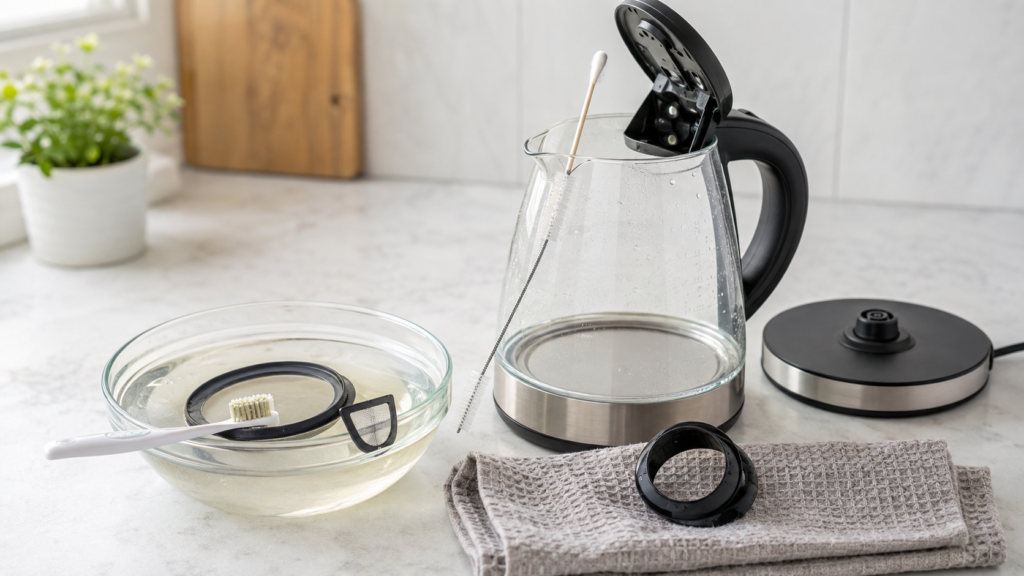
    • If your kettle has a detachable gasket or filter, remove it, soak it in warm vinegar water for 10 minutes, and scrub with an old toothbrush.
    • Use a cotton swab or narrow bottle brush to get into the spout and the steam vent — the two spots a sponge can’t reach.
    • Let everything air-dry fully before reassembling. Trapping moisture under a reattached seal just restarts the cycle.

    How Often Should You Clean Your Electric Kettle to Prevent Mold?

    Frequency should match how you use it and your water:

    • Daily: empty the kettle and leave the lid open to air-dry after your last use.
    • Weekly: wipe the seal and spout with a damp cloth.
    • Monthly (biweekly in hard-water areas): a full vinegar or citric-acid descale-and-clean.

    Hard water and humid kitchens speed everything up — buildup feeds mold, so descaling more often genuinely helps. For the complete step-by-step routine, see how to use an electric kettle the right way.

    7 Habits That Keep Mold From Coming Back

    1. Empty it after boiling. Standing water is the number-one cause — don’t leave it overnight.
    2. Leave the lid open or ajar so the interior and seal dry fully.
    3. Store it somewhere ventilated, not shut in a cupboard while still damp.
    4. Use filtered water to cut down on the minerals and organics mold feeds on.
    5. Descale on a schedule instead of waiting for buildup.
    6. Dry the gasket separately with a cloth — it’s the slowest part to air-dry.
    7. Never leave tea bags or coffee residue sitting in the reservoir.

    Do those seven things and the question stops being “how do I get rid of mold in my electric kettle” and becomes “why does my kettle never get moldy anymore.” That’s the goal.

    Frequently Asked Questions

    Can mold grow in a kettle if you boil it every day?

    Yes. Boiling only kills spores in the water at that moment — it doesn’t sterilize the lid seal, spout, or vent, which stay damp after the kettle cools. Daily boiling can still leave those shaded parts colonized within a few days.

    Is it safe to drink water from a kettle with mold?

    For healthy adults, a small amount is unlikely to cause serious harm, but we don’t recommend it. Boiling doesn’t neutralize the allergens mold leaves behind. It’s riskier for people with asthma, mold allergies, or weakened immune systems — clean the kettle before your next brew.

    How do I know if it’s mold or just limescale?

    Limescale is white, hard, and gritty, and forms on the heating element at the waterline. Mold is black, green, orange, or pink, feels fuzzy or slimy, sits near the rubber seal and spout, and smells musty. Limescale needs acid to dissolve; mold smears when wet.

    Does vinegar kill mold in a kettle?

    Yes. A 1:1 white vinegar and water solution, boiled and left to sit for 20–30 minutes, kills mold and dissolves limescale at once. Follow with a soft scrub of the seal and spout, then rinse and boil-and-discard twice before use.

    Can mold grow in a stainless steel kettle?

    Yes. Stainless steel resists rust but doesn’t stop mold, which grows on residue and the rubber seal rather than the metal itself. It’s just harder to spot than in a glass kettle, so check the lid, gasket, and spout regularly.

    Is it OK to use bleach to clean mold out of an electric kettle?

    It works but it’s a last resort. Dilute it heavily, keep it away from the electrical base, and rinse at least three times plus two boil-and-discard cycles afterward. Vinegar or citric acid is safer for something you drink from and usually just as effective.

  • How Long Do Electric Kettles Last? When to Replace and How to Recycle One

    How Long Do Electric Kettles Last? When to Replace and How to Recycle One

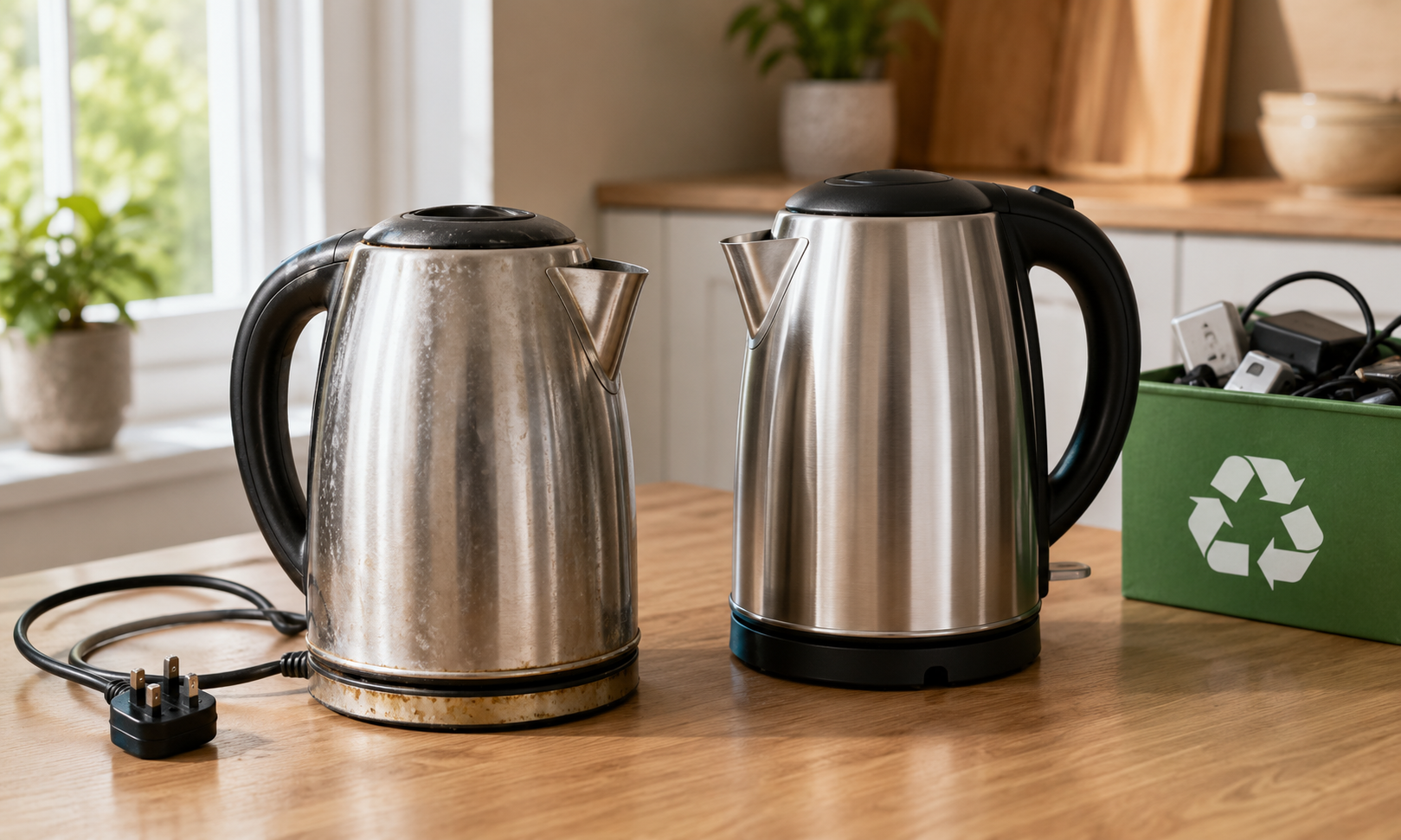
    Short answer: most electric kettles last 3 to 5 years, with an industry average of around 4.4 years. Look after a well-built stainless steel model — and stay on top of descaling — and you can push that to 10 years or more. A cheap plastic kettle used hard in a limescale-heavy area might tap out in two.

    That’s the headline. But “how long does an electric kettle last” is really three questions in one: how long should it last, how do you know when it’s done, and what do you do with it afterward. We’ll cover all three, because nobody else seems to put them on the same page.

    How Long Should an Electric Kettle Last? (Lifespan by Material)

    The single biggest predictor of lifespan is what the kettle is made of and how well the heating element is protected. Here’s the realistic range for each type with normal daily use:

    Kettle typeTypical lifespanWhy
    Plastic / budget2–4 yearsThinner components, exposed elements, plastic that warps and taints over time
    Glass3–5 yearsScale is easy to spot, but the base seals and lids fail before the glass does
    Ceramic4–7 yearsDurable body, but heavy and prone to chips that expose the interior
    Stainless steel5–10+ yearsConcealed flat-plate element, sturdy build, resists warping and cracking

    Brand tier matters too. A £15–£20 supermarket kettle is built to a price and usually gives you 2–3 years. A £40–£70 mid-range model from a known appliance brand typically clears 4–6. Premium kettles with a concealed element and a proper metal body are the ones that reach a decade — that’s where the price difference actually earns its keep.

    Corded vs cordless makes little difference to the kettle itself, but cordless models add one wear point: the contact between the kettle and its base. Slamming the kettle down or lifting it mid-boil wears that connector faster.

    What Affects How Long Your Kettle Lasts

    Water hardness is the number one killer. Every boil in a hard-water area leaves a little more limescale on the heating element. That scale insulates the element, forcing it to work harder and run hotter to hit the same temperature — which is exactly how elements burn out early. If you’re in a hard-water region, your kettle’s life is roughly whatever the table above says, minus a year or two, unless you descale.

    Usage frequency stacks on top of that. A kettle boiled eight times a day in a busy household ages faster than one used twice on weekends — more thermal cycling, more scale, more wear on the switch.

    Then there are the self-inflicted ones. Boiling the kettle dry (or near-dry) is the fastest way to destroy an element. Overfilling past the max line stresses the seals. Using metal utensils inside a plastic or glass kettle scratches the surface and gives scale and mold more to cling to. For the full routine, see our guide to using an electric kettle the right way.

    8 Signs It’s Time to Replace Your Electric Kettle

    Some of these are annoyances. Some are safety issues. We’ve flagged which is which.

    1. It boils noticeably slower than it used to. Usually scale on the element. Try a full descale first — if speed doesn’t recover, the element is degrading.
    2. The auto shut-off stops working. If it doesn’t click off when the water boils, replace it. A kettle that won’t stop boiling is a fire and steam-burn risk.
    3. The water tastes metallic or plasticky even after cleaning. Once a taint won’t descale out, the interior has broken down.
    4. Cloudy or gritty water after boiling. Flaking scale or degrading material ending up in your cup.
    5. Cracks, warping, or melted plastic near the base. Heat damage that will only get worse.
    6. Loud popping, grinding, or rattling beyond the normal rumble of a boil.
    7. Frayed cord, sparking, browning at the plug, or it trips your breaker/RCD. Stop using it immediately — this is not a “finish the week” situation.
    8. Limescale that won’t clear even after a thorough descale. The scale has bonded to the element permanently.

    If the problem is mechanical rather than degradation-based, it may be fixable — our symptom-by-symptom kettle repair guide walks through what’s worth trying before you give up on it.

    Safety First: When “It Still Boils” Isn’t the Same as “It’s Still Safe”

    This is the part most lifespan articles skip. An old kettle can keep boiling water long after it stops being safe. The two failure modes that matter:

    Electrical. Cords fray internally where they flex, plugs loosen, and the moisture-heat cycle degrades insulation. A kettle handles mains voltage right next to boiling water — a compromised cord or cracked element is a genuine shock and fire hazard, not a cosmetic one.

    Mechanical. A failed auto shut-off means boil-dry risk and scalding steam. A cracked base seal can let water reach the electrics.

    Rule of thumb: performance problems (slow boil, taste) can wait for a convenient replacement. Anything electrical — sparking, tripping, a hot or discolored plug, a frayed cord — means unplug it and stop using it today.

    How to Make Your Kettle Last Longer

    Most early deaths are preventable. The big three:

    • Descale on a schedule that matches your water. Monthly in hard-water areas, every three months in soft-water areas. White vinegar or citric acid, a boil, a soak, a rinse. This single habit is worth years.
    • Never boil dry, and don’t overfill. Keep the water between the min and max lines.
    • Empty it after use. Standing water breeds scale and, over time, mold around the lid and seals. Leave the lid open to dry.

    If you’re wondering whether all this scale is affecting your water quality, we cover that in is water boiled in an electric kettle safe.

    Repair or Replace? A Quick Cost Check

    The math is usually simple. A replacement element or a new cord assembly, plus your time, often costs more than half the price of a new kettle — and on a budget model, more than the whole thing. Repair makes sense when:

    • It’s a premium kettle and only the cord or a single serviceable part has failed.
    • It’s still under warranty — check before you spend a penny; many brands run 2–3 years.

    Otherwise, think in cost-per-year. A £50 kettle that lasts five years costs £10 a year. A £20 one that dies in two costs the same £10 a year but sends more to landfill and gives you a worse experience along the way. When you’re ready to buy, our electric kettle buying guide covers what actually lasts.

    How to Dispose of or Recycle an Old Electric Kettle

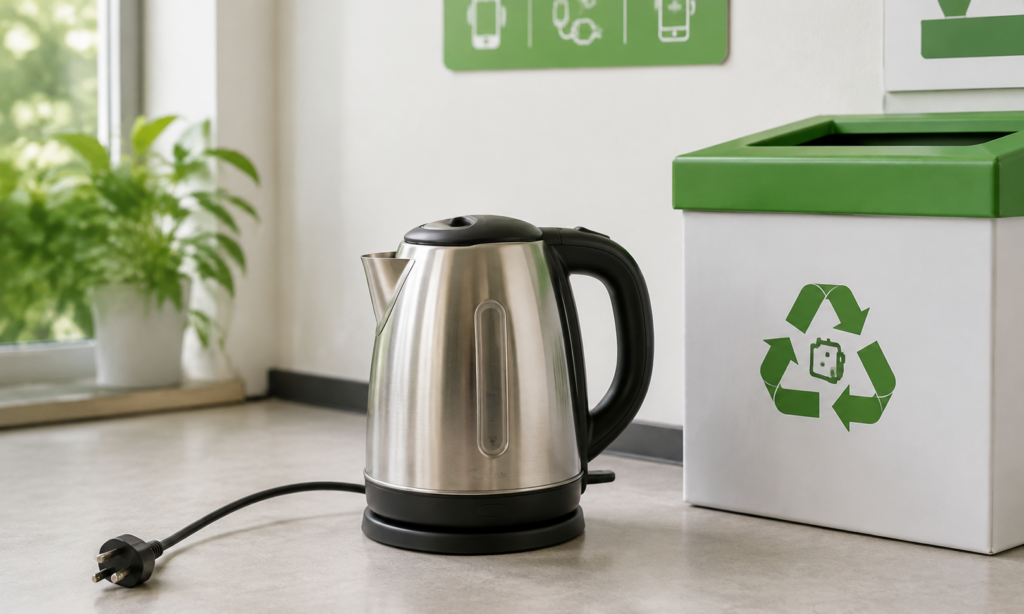
    Here’s the rule almost nobody states plainly: a broken electric kettle should not go in your regular household bin. It’s electrical waste (WEEE in the UK and EU; e-waste under EPA guidance in the US), and it contains a heating element and wiring that recycling systems are set up to recover. In many places, binning it is against local rules.

    Use this quick decision tree:

    If it still works:

    • Donate it to a charity shop, thrift store, or reuse organisation.
    • Resell or give it away locally.

    If it’s broken:

    1. Retailer take-back. Buying a replacement? Most large electrical retailers must take your old one back — sometimes in store, sometimes on delivery of the new one. Ask at checkout.
    2. Local recycling centre / household waste site. Nearly all have a dedicated small-electricals or WEEE bin. Free to drop off.
    3. Manufacturer take-back. Some brands run their own return or recycling schemes — check the website.
    4. Municipal special collection. Many councils run kerbside small-electricals collections or periodic collection days.

    Before you recycle it, don’t cut the cord off — kettles go into WEEE recycling whole, plug and all. Do remove any detachable parts a scheme asks you to separate (a limescale filter, a loose lid), and empty out any water. In the US, Earth911 is the fastest way to find a nearby e-waste drop-off; in the UK, your council website or the Recycle Now locator points you to the closest one.

    Bottom Line: Should You Replace Your Kettle Today?

    Expect 3–5 years from an average kettle and up to 10 from a well-kept premium one. If yours is just slow or tastes off, descale it first — you may buy another year. If it’s sparking, tripping the breaker, or won’t switch off, replace it now and recycle the old one through a proper e-waste route, not the bin. That’s the whole decision, start to finish.

    Frequently Asked Questions

    How long should an electric kettle last?

    A decent electric kettle should last 3 to 5 years with normal daily use. Premium stainless steel models with a concealed element can last 10 years or more if you descale them regularly and never boil them dry. Budget plastic kettles often only manage 2 to 4 years.

    What is the average lifespan of an electric kettle?

    The commonly cited average is about 4.4 years. That figure blends everything from cheap plastic kettles that fail early to well-maintained steel ones that run for a decade, so where your kettle lands depends mainly on build quality, your water hardness, and how often you descale.

    How do I know when my kettle is going bad?

    Watch for slower boiling that doesn’t improve after descaling, a metallic or plasticky taste, cloudy water, cracks or warping near the base, a shut-off that won’t click off, and any electrical warning sign like a frayed cord, sparking, or a tripped breaker. Electrical faults mean stop using it immediately.

    Does hard water really shorten a kettle’s life?

    Yes, significantly. Hard water leaves limescale on the heating element after every boil, which forces the element to run hotter and burn out sooner. In hard-water areas, descaling monthly is the single most effective thing you can do to extend your kettle’s lifespan.

    Can an electric kettle be repaired instead of replaced?

    Sometimes. If it’s a premium kettle and only the cord or a serviceable part has failed — or if it’s still under warranty — repair can be worth it. For most budget and mid-range kettles, a new element plus your time costs more than a replacement, so it’s usually not economical.

    How do you dispose of an old or broken electric kettle?

    Don’t put it in your regular bin — it’s electrical (WEEE/e-waste). If it works, donate or resell it. If it’s broken, use retailer take-back when buying a new one, drop it at a local recycling centre’s small-electricals bin, use a manufacturer take-back scheme, or a council collection. Recycle it whole; don’t cut the cord off.

    Is it dangerous to keep using an old kettle?

    It can be. A kettle that still boils water isn’t necessarily safe — aging cords, worn insulation, and cracked elements create shock and fire risks, and a failed auto shut-off can boil dry or scald. Performance issues can wait, but any electrical warning sign means stop using it right away.