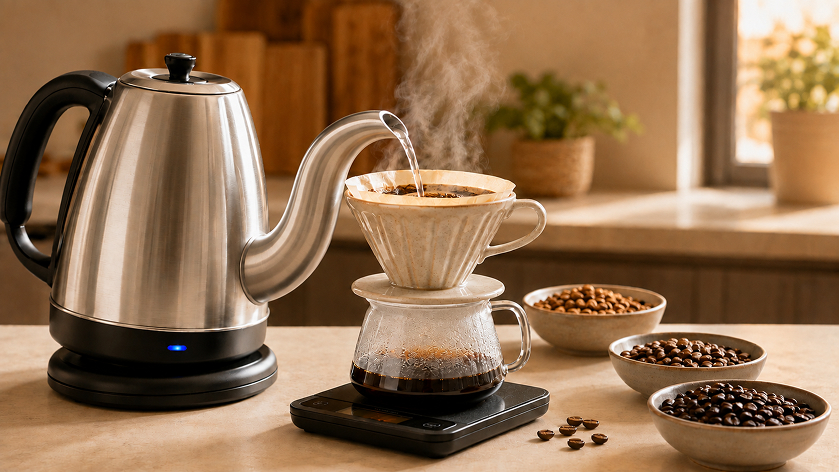
Yes, you can make excellent coffee with an electric kettle. The kettle isn’t a compromise here — it heats water fast and, on the better models, to a precise temperature, which is exactly what good coffee needs. What it doesn’t do is brew. So the real question isn’t can we make coffee in an electric kettle, it’s how to pair the kettle with the right brew method and the right water temperature.
Below are the exact numbers — temperature by roast, ratios by cup — plus three methods that cover whatever gear you have on hand.
Can You Actually Make Coffee in an Electric Kettle?
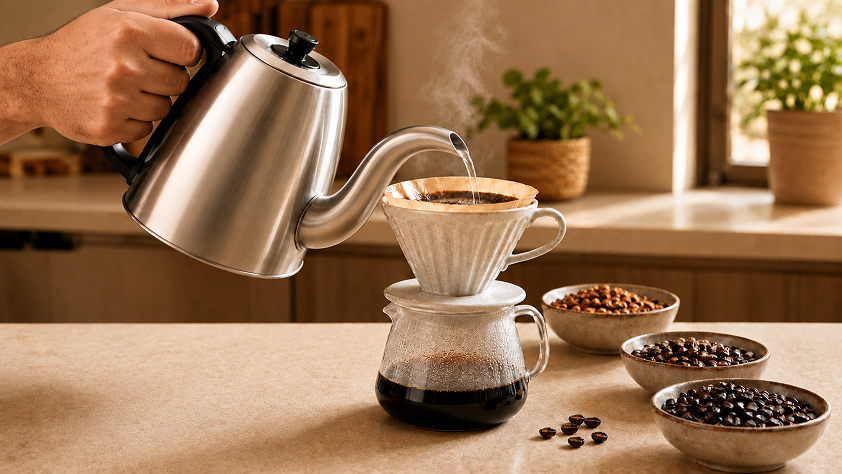
The kettle’s job is simple: get water to the correct temperature. From there you need a separate brew vessel — a pour-over dripper, a French press, or just a mug for instant. One rule matters above all: never put coffee grounds or milk directly in the kettle basin. The heating element and spout aren’t built for it. Grounds scorch onto the plate, milk boils over and leaves a film that’s miserable to clean, and both wreck the taste of the next thing you boil. Treat the kettle as a water heater, full stop.
One quick clarification, because people mix these up: an electric kettle is not a percolator or a drip coffee maker. Those cycle water through grounds automatically. A kettle just heats water — you control the brewing. That’s actually an advantage, because it means you control the variables that make coffee taste good.
What You’ll Need
- An electric kettle (variable-temperature is ideal, but a plain fixed-temp kettle works fine — more on that below)
- Ground coffee or instant coffee
- A brew vessel: pour-over dripper + paper filter, or a French press, or just a mug
- Optional but worth it: a kitchen scale, plus milk powder and sugar if you like it that way
The Right Water Temperature by Roast
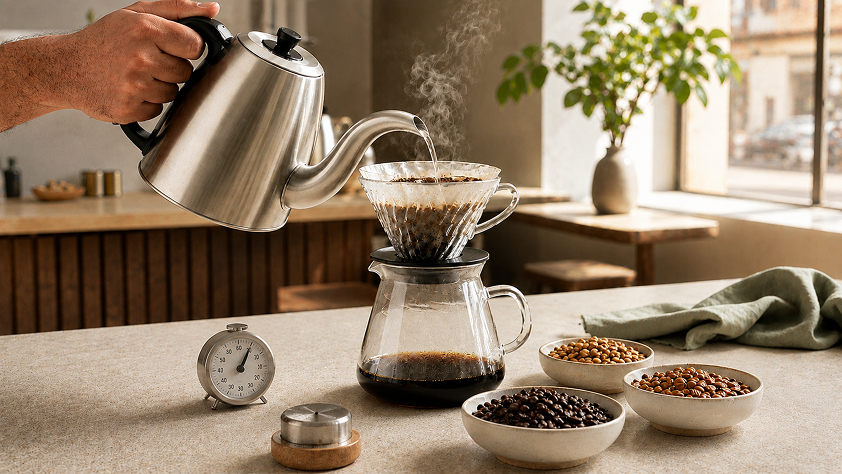
This is where nearly every other guide stops at a lazy “195–205°F” and moves on. But the right temperature depends on your roast. Darker beans are more soluble and extract faster, so they need cooler water or they turn bitter. Lighter beans are dense and need more heat to open up.
| Roast | Target temperature |
|---|---|
| Light roast | 200–205°F (93–96°C) |
| Medium roast | 195–202°F (90–94°C) |
| Dark roast | 194–200°F (90–93°C) |
| Instant / milk powder | 200–212°F (93–100°C) — near-boiling is fine |
No digital display? Count the seconds. Water boils at 212°F (100°C), then cools as it sits. A rough field guide once your kettle clicks off: about 30–45 seconds off the boil ≈ 205°F, and 1 minute off the boil ≈ 195°F. Lift the lid to speed cooling. It’s not lab-grade, but it’s more than close enough, and it’s the single trick the budget-kettle majority never gets told.
Method 1: Pour-Over Coffee With an Electric Kettle
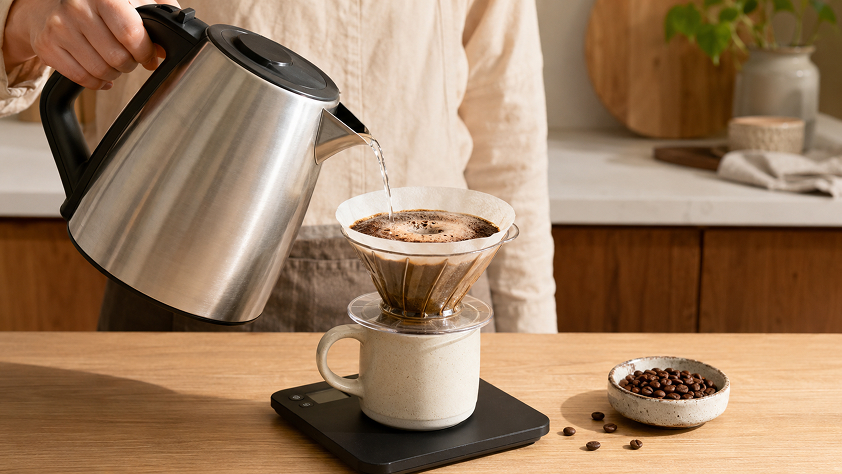
Pour-over gives you the cleanest, most flavorful cup, and it’s the method that rewards your kettle’s temperature control.
- Heat water to your roast’s target temp.
- Rinse the paper filter with a little hot water — it removes the papery taste and warms the mug.
- Add a medium-fine grind, about the texture of table salt.
- Bloom: pour just enough water to wet the grounds and wait 30–45 seconds. Fresh coffee will puff up as it releases CO2.
- Pour the rest slowly, in small circles, keeping the grounds submerged but not flooded.
Use a ratio of 1:15 to 1:17 — that’s roughly 1 gram of coffee per 15–17 grams (ml) of water, or about 2 tablespoons per 6 oz cup. A scale makes this repeatable; a tablespoon gets you close.
No gooseneck spout? Most kitchen kettles have a wide spout that dumps too fast. Fix it by pouring in short bursts rather than one continuous stream, holding the kettle higher for a thinner flow, and pausing between pours. You don’t need a $60 gooseneck to make a good cup — you need patience and a slower hand.
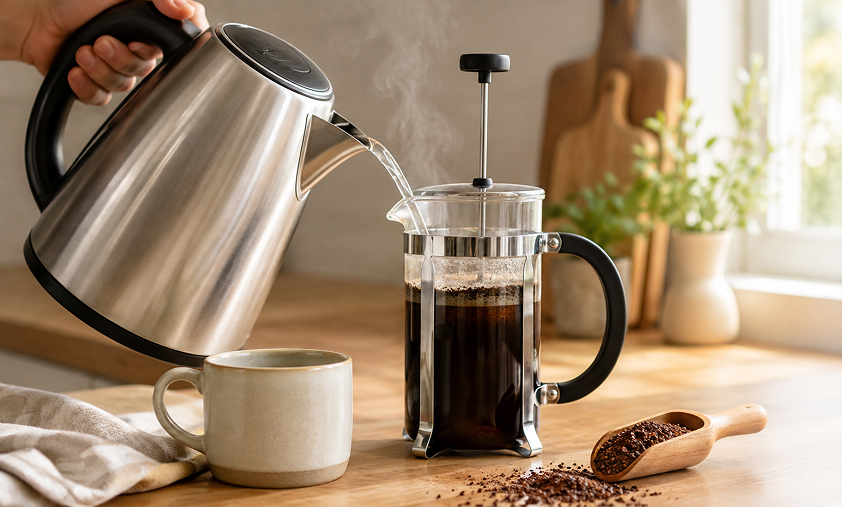
Method 2: French Press Coffee Using Kettle-Boiled Water
French press is the most forgiving method, and it’s perfect if your kettle has no temperature settings at all.
- Add a coarse grind (like breadcrumbs) to the press — about 1:15, or 2 tbsp per 8 oz.
- Pour water straight from the kettle, just off the boil.
- Stir once, cap with the plunger up, and steep 4 minutes.
- Press down slowly and pour immediately so it doesn’t keep extracting.
Because the grind is coarse and the steep is timed, boiling-hot water works fine here — the immersion evens everything out. This is why French press is the easiest way to use an electric kettle for coffee when you don’t want to fuss over degrees.

Method 3: Instant Coffee (With or Without Milk Powder)
Instant is the fastest route, and it’s where huge numbers of searchers actually land — especially for milk coffee. Near-boiling water straight from the kettle is exactly right.
For a black coffee: 1–2 tsp of instant per 6–8 oz mug, add hot water, stir. Done.
For milk coffee with milk powder, order of operations matters or you’ll get clumps:
- Put the milk powder in first with a splash of hot water and stir to a smooth paste.
- Add the instant coffee.
- Top up with the rest of the hot water.
- Add sugar last and stir.
Dissolving the powder before flooding it is the whole trick. If you like it rich and frothy — a milk-tea-style coffee — use less water and whisk hard, the same principle we cover in our guide to boiling milk in an electric kettle (short version: heat milk gently in a separate pan, not the kettle basin).
Making Coffee in a Chefman Electric Kettle Specifically
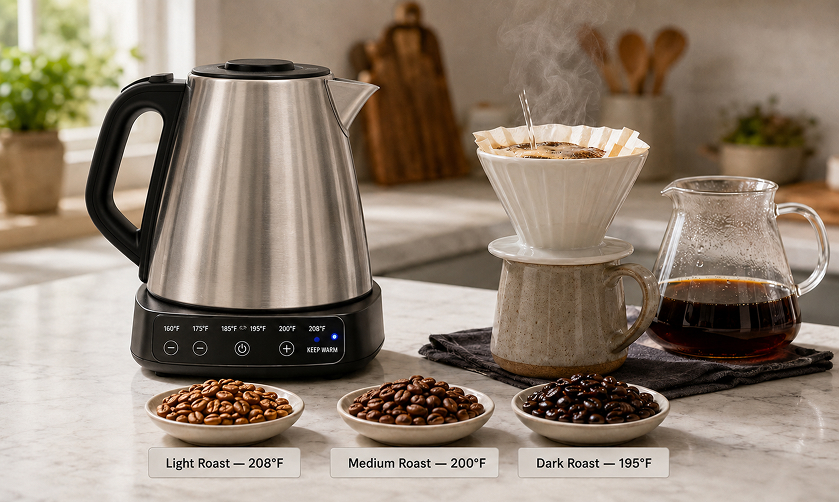
People ask how to make coffee in a Chefman electric kettle as if it needs its own instructions. It doesn’t — but Chefman’s variable-temp models do have a genuinely useful feature the spun articles never mention: preset temperature buttons. Map them to your roast:
- The ~208°F “French Press” or highest non-boil preset → light roasts
- The ~200°F “Pour Over” preset → medium roasts
- A ~195°F preset → dark roasts
Use the keep-warm function to hold your temperature during the bloom so the water doesn’t drop while you wait. And that’s it — the method is identical on any variable-temp kettle, whether it’s a Chefman, Cuisinart, or Cosori. Chefman isn’t special; it’s just popular. If yours is a basic on/off Chefman, use the count-the-seconds trick above.
No Filter, No French Press? Cowboy and Camping Kettle Coffee
Stuck with just a kettle and a mug — camping, hotel room, office? You can still do it.
- Put coarse grounds directly in the mug (1 heaping tbsp per cup).
- Pour in hot water and stir.
- Wait 4 minutes, then let the grounds settle to the bottom for another 2.
- Sip carefully off the top, or pour through a paper towel, clean cloth, or fine strainer.
This is old-school “cowboy coffee,” and it’s perfectly drinkable. Just don’t stir at the end, and stop before you reach the sludge.
Coffee-to-Water Ratio Cheat Sheet
| Water | Ground coffee | Strength |
|---|---|---|
| 6 oz (177 ml) | 2 tbsp | Standard |
| 8 oz (237 ml) | 2.5 tbsp | Standard |
| 12 oz (355 ml) | 3.5–4 tbsp | Standard |
| Any cup | 1–2 tsp instant | Adjust to taste |
Want it stronger? Add coffee, not time — longer contact just adds bitterness.
Troubleshooting Common Problems
- Bitter coffee: water too hot or over-extracted. Drop the temperature 3–5°F, grind coarser, or shorten the steep.
- Weak, watery coffee: not enough grounds or water too cool. Bump the ratio and make sure you’re hitting temp.
- Grounds in the cup: filter tore or you skipped one. Grind a touch coarser and strain again.
- Off, metallic, or chalky taste: that’s usually your kettle, not your coffee. Limescale changes water chemistry. Our kettle troubleshooting guide and a regular descale fix it — and if you’ve ever wondered whether water boiled in an electric kettle is safe, the short answer is yes, provided you keep it clean.
If you’re still deciding on a machine, the temperature-control feature we lean on throughout is worth paying for — see our electric kettle buying guide for which models actually deliver it.
Frequently Asked Questions
Can you put coffee grounds directly in an electric kettle?
No. Grounds will scorch onto the heating element, clog the spout, and taint every future boil, and most kettles have no way to strain them out. Always brew in a separate vessel — a dripper, French press, or mug — and use the kettle only to heat the water.
Can you make coffee in an electric tea kettle?
Yes. A tea kettle and a coffee kettle heat water the same way; the only real difference is that dedicated coffee kettles often have a gooseneck spout for a slow, controlled pour-over stream. Any electric tea kettle works — you just pour more carefully or use a French press instead.
Is it safe to boil coffee grounds in a kettle?
It’s safe to drink, but it’s hard on the kettle and usually tastes over-extracted and bitter. If you have no filter, put grounds in a mug and pour hot water over them rather than boiling them inside the kettle itself, then let the grounds settle before sipping.
Do you need a gooseneck kettle for good pour-over?
No. A gooseneck gives you a slower, more precise stream, but you can make excellent pour-over with a standard kettle by pouring in short bursts, holding it higher for a thinner flow, and pausing between pours to keep the grounds evenly saturated.
What temperature should the water be for pour-over coffee?
Aim for 195–205°F (90–96°C), tuned to your roast: about 200–205°F for light, 195–202°F for medium, and 194–200°F for dark. No thermometer? Let boiling water sit roughly 30–45 seconds for about 205°F, or a full minute for around 195°F.
Can you make instant coffee and milk coffee in an electric kettle?
Yes, and it’s the fastest method. Use near-boiling water straight from the kettle. For milk coffee, dissolve the milk powder into a smooth paste first, then add the coffee, then the rest of the hot water, then sugar — that order prevents clumping.
Leave a Reply