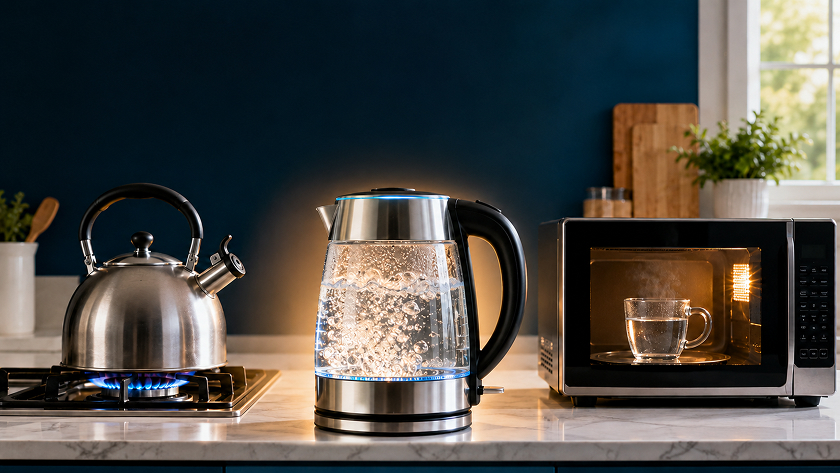
Short version: for boiling water day in and day out, an electric kettle wins on speed, running cost and safety. A stovetop kettle earns its place when there’s no outlet or you want something that lasts decades, and the microwave is a backup, not a habit. Below we show the actual numbers so you can check them against your own utility bill.
Quick Verdict: Which One Should You Actually Use?
Most comparison articles end on “it depends on your priorities.” That’s a cop-out. Here’s the decisive version.
| Method | Best for | One-line verdict |
|---|---|---|
| Electric kettle | Daily hot drinks, apartments, dorms | Fastest and cheapest to run — the default choice for most people. |
| Gas stovetop | Outages, gas-only kitchens, big batches | Slower and less efficient, but works with no electricity. |
| Electric coil stovetop | You already own one | The slowest and priciest option — skip if you can. |
| Induction cooktop | Modern kitchens, boiling in a pot | Nearly as efficient as a kettle; great if you already cook on it. |
| Microwave | A single mug in a pinch | Uneven, risky for more than one cup — emergency use only. |
If you’re deciding which is better, an electric kettle or a stove kettle, and you have a working outlet, stop reading here and get the electric one. The rest of this page is for anyone who wants to see why, and the edge cases where the stovetop actually wins.
Speed: Does an Electric Kettle Boil Water Faster?
Yes, and it isn’t close. The reason is physics, not marketing. An electric kettle’s heating element sits in direct contact with the water (or right beneath a metal base plate), so almost all the heat goes straight into the liquid. A pot on a burner has to be heated first, and a lot of that energy escapes as hot air curling around the sides.
Rough times to bring 1 litre from cold to boiling:
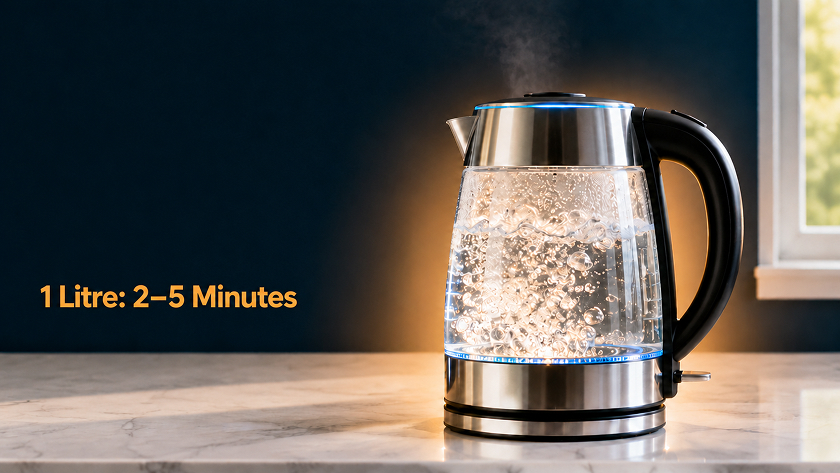
- Electric kettle (1,500–3,000 W): 2–5 minutes
- Induction cooktop: 3–5 minutes
- Gas stovetop: 8–10 minutes
- Electric coil stovetop: 10–12 minutes (worst heat transfer of the bunch)
- Microwave: ~2–3 minutes for one mug, but it scales badly
So is an electric kettle faster than a stove? For everyday quantities, comfortably, often twice as fast as gas and nearly three times faster than a coil burner. The higher the wattage, the quicker it boils; if you’re curious how that translates to your setup, see our guide on how many watts an electric kettle uses.
Energy Efficiency: What Uses More Energy, an Electric Kettle or a Stove?
Efficiency here means: of all the energy the appliance draws, how much actually ends up in the water? The gap is the whole story.
| Method | Approx. efficiency | Why |
|---|---|---|
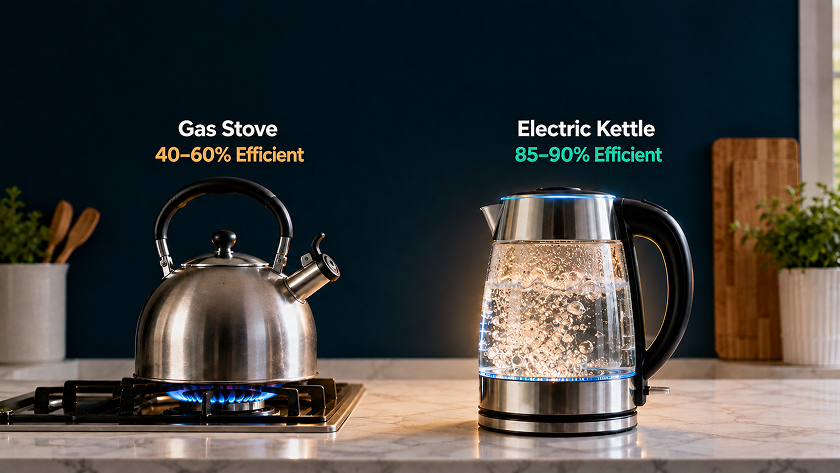
| Electric kettle | 85–90% | Element touches the water; insulated body traps heat |
| Induction cooktop | 75–85% | Heats the pot directly via magnetism, little wasted |
| Electric coil stovetop | 70–75% | Heat has to cross an air gap and the pot base |
| Microwave | 50–65% | Conversion and container losses; uneven heating |
| Gas stovetop | 40–60% | Flame spills around the pot; most heat escapes as ambient warmth |
That answers a few of the most-searched questions at once. What is more efficient, a stovetop kettle or an electric kettle? The electric kettle, by a wide margin. Is an electric kettle more energy efficient than gas? Almost double, because an open flame is one of the leakiest ways to heat anything. And which is more energy efficient, an electric kettle or a stovetop of any kind, the kettle wins every matchup except a close race with induction.
One caveat that keeps things honest: gas and electricity are priced very differently per unit of energy, so “more efficient” doesn’t automatically mean “cheaper.” That’s the next section.
Cost Comparison: Which Is Cheaper, an Electric Kettle or Stovetop?
Let’s put real money on it. Assumptions, stated openly so you can scale them: electricity at $0.16/kWh, natural gas at $1.50/therm, and boiling 1 litre of water (which needs roughly 0.093 kWh of energy delivered into the water). We divide that by each method’s efficiency to get real consumption.
| Method | Cost per litre boiled | Cost per year (2 boils/day) |
|---|---|---|
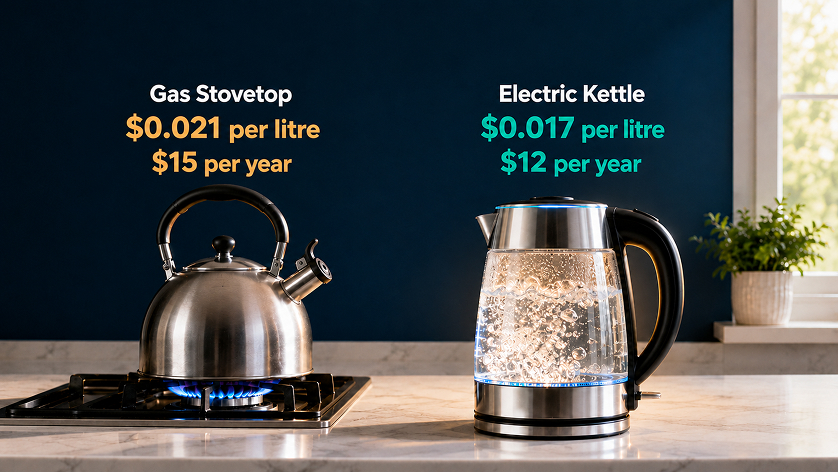
| Electric kettle | ~$0.017 | ~$12 |
| Induction cooktop | ~$0.019 | ~$14 |
| Gas stovetop | ~$0.021 | ~$15 |
| Microwave | ~$0.026 | ~$19 |
| Electric coil stovetop | ~$0.028 | ~$20 |
Two things jump out. First, is it cheaper to use an electric kettle or gas? The electric kettle is slightly cheaper per boil despite gas being a cheaper fuel, its efficiency makes up the difference. Second, the differences are small in absolute dollars. Nobody is getting rich switching kettles; you’re saving pocket change per year, not hundreds.
Where cost really matters is upfront price versus payback. A basic stovetop kettle runs $15–$40. An electric kettle runs $20–$150 depending on features. If you spend $40 more on the electric model, the ~$8/year running-cost savings over a coil stovetop takes about five years to pay back, and roughly never versus gas. So don’t buy an electric kettle to “save money” on energy. Buy it because it’s faster, safer, and more convenient. For a fuller breakdown of running costs, see how many watts an electric kettle uses and what it costs to run.
When the Stovetop Kettle Actually Wins
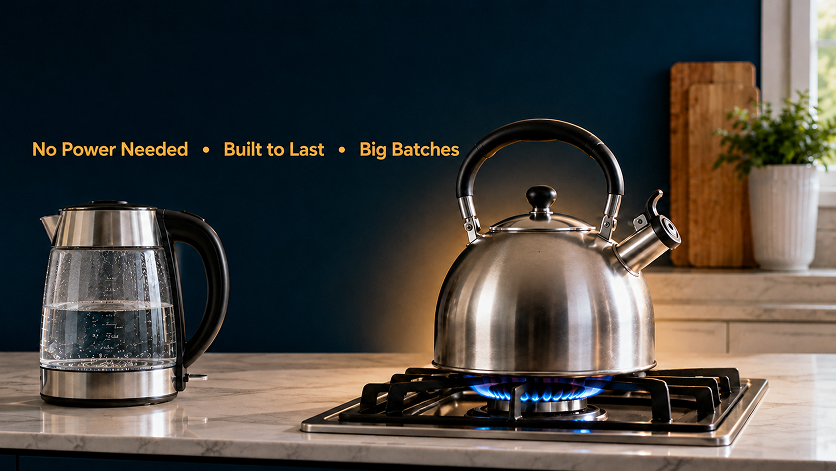
A good stovetop kettle isn’t obsolete. It’s the better tool in specific situations:
- No outlet, no problem. Camping, RVs, boats, cabins, gas-only kitchens, and, crucially, power outages. A gas stovetop kettle boils water when the electric one is a paperweight.
- Durability. There’s no heating element to burn out and no electronics to fail. A stainless steel stovetop kettle can last decades; electric kettles typically last 3–5 years of daily use.
- Big batches. If you’re boiling several litres for canning or a crowd, a large pot on a strong gas burner can out-muscle a 1.7L kettle.
- The ritual. Some people simply prefer the whistle and the look. That’s a real reason, just not a numbers one.
Note that an induction cooktop needs an induction-compatible kettle (magnetic base). If you have induction, boiling in a suitable kettle or pot is nearly as efficient as a plug-in electric kettle.
When the Electric Kettle Actually Wins (Most of the Time)
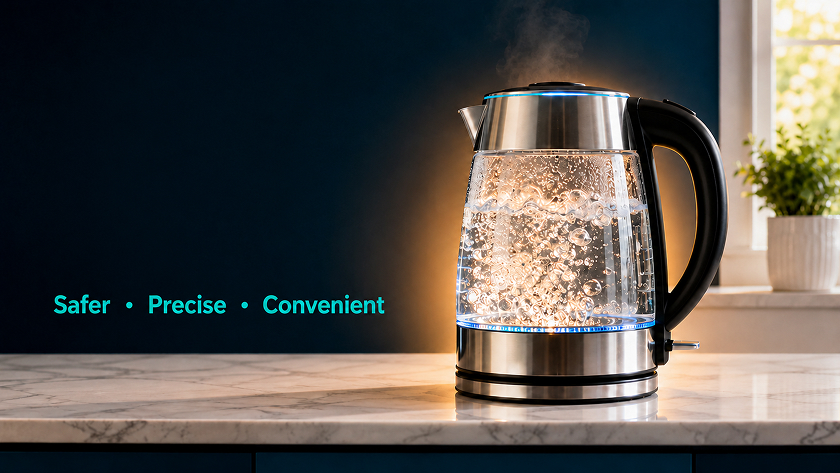
For a typical household, this is the everyday winner, and the reasons go beyond speed:
- Safety. Auto shut-off and boil-dry protection mean it won’t run dry or scorch if you forget it. There’s no open flame and no hot burner left glowing. That’s a genuine reason electric kettles are welcome in dorms and small apartments where stovetops or open flames may be restricted.
- Precision. Variable-temperature models let you hit 175°F for green tea, 195°F for pour-over coffee, or a safe temperature for baby formula, something a stovetop can only guess at.
- Convenience. Fill, click, walk away. If you make hot drinks multiple times a day, the time saved adds up fast.
Worried about what actually comes out of it? We cover that in whether water boiled in an electric kettle is safe, and if you’re new to one, our first-time guide to using an electric kettle walks through the basics. Curious how the direct-contact element works? Here’s how an electric kettle works, in plain English.
What About the Microwave?
Searchers keep asking is an electric kettle better than a microwave, and for boiling water, yes. A microwave can heat a single mug in a couple of minutes, but it heats unevenly (hot spots and cold spots), it can’t handle more than a cup or two efficiently, and it carries a real superheating risk: water can pass its boiling point without visibly bubbling, then erupt when disturbed. Always drop in a wooden stir stick or teaspoon first if you must microwave water.
Verdict on the microwave: fine as an occasional backup for one mug, poor as a daily method. It loses to the kettle on speed at any volume above a single cup, and on taste for tea and coffee where even heating matters.
Is a Stovetop or Electric Kettle Better? Final Answer
So, which is better, an electric kettle or a stove top? For the vast majority of people, the electric kettle is the better everyday choice: it’s the fastest, the most energy efficient, cheaper per boil than gas or coil, and safer thanks to auto shut-off. That’s the honest reason to use an electric kettle, not the tiny energy savings, but the speed and peace of mind.
The stovetop kettle wins in exactly three scenarios: no electricity (camping, outages, gas-only kitchens), you want an appliance that lasts 20+ years, or you’re boiling large batches. The microwave stays on the bench.
Rule of thumb: if you have an outlet and make hot drinks daily, buy electric. If you need water where there’s no power, keep a stovetop kettle for backup.
Decided electric is right for you? The next step is picking the right model, wattage, capacity, material, and temperature control all matter. Our complete guide to where to buy an electric kettle walks you through choosing one that’s genuinely worth it.
Frequently Asked Questions
Is a stovetop kettle better than electric?
Only in specific cases. A stovetop kettle wins when there’s no electricity, camping, RVs, or power outages, and it tends to last far longer since there’s no heating element to fail. For everyday use with a working outlet, an electric kettle is faster, more energy efficient, and safer.
What is more efficient, a stovetop kettle or an electric kettle?
The electric kettle. It converts roughly 85–90% of its energy into heating the water because the element is in direct contact with it. A gas stovetop manages only about 40–60%, and an electric coil burner around 70–75%, because heat escapes around the pot.
Is an electric kettle faster than a stove?
Yes, usually by a wide margin. An electric kettle boils 1 litre in about 2–5 minutes, versus 8–10 minutes on gas and 10–12 minutes on an electric coil burner. Direct-contact heating simply transfers energy to water far more efficiently than an open flame or radiant burner.
Which is cheaper, an electric kettle or a stovetop?
Per boil, the electric kettle edges it out, roughly $0.017 per litre versus about $0.021 for gas and $0.028 for an electric coil at typical rates. The savings are small (only a few dollars a year), so choose electric for speed and safety rather than to cut your energy bill.
Is a microwave faster than a kettle?
For a single mug, a microwave is roughly comparable, but it loses badly beyond one cup, heats unevenly, and risks superheating (water erupting without bubbling). An electric kettle is faster and safer for any real quantity, so keep the microwave as a backup only.
Does an electric kettle use more electricity than a stove?
No. An electric kettle draws a lot of power (1,500–3,000 W) but only for a short burst, and it wastes very little of it. An electric stovetop runs longer and loses more heat to the air, so it actually uses more electricity to boil the same amount of water.
Leave a Reply