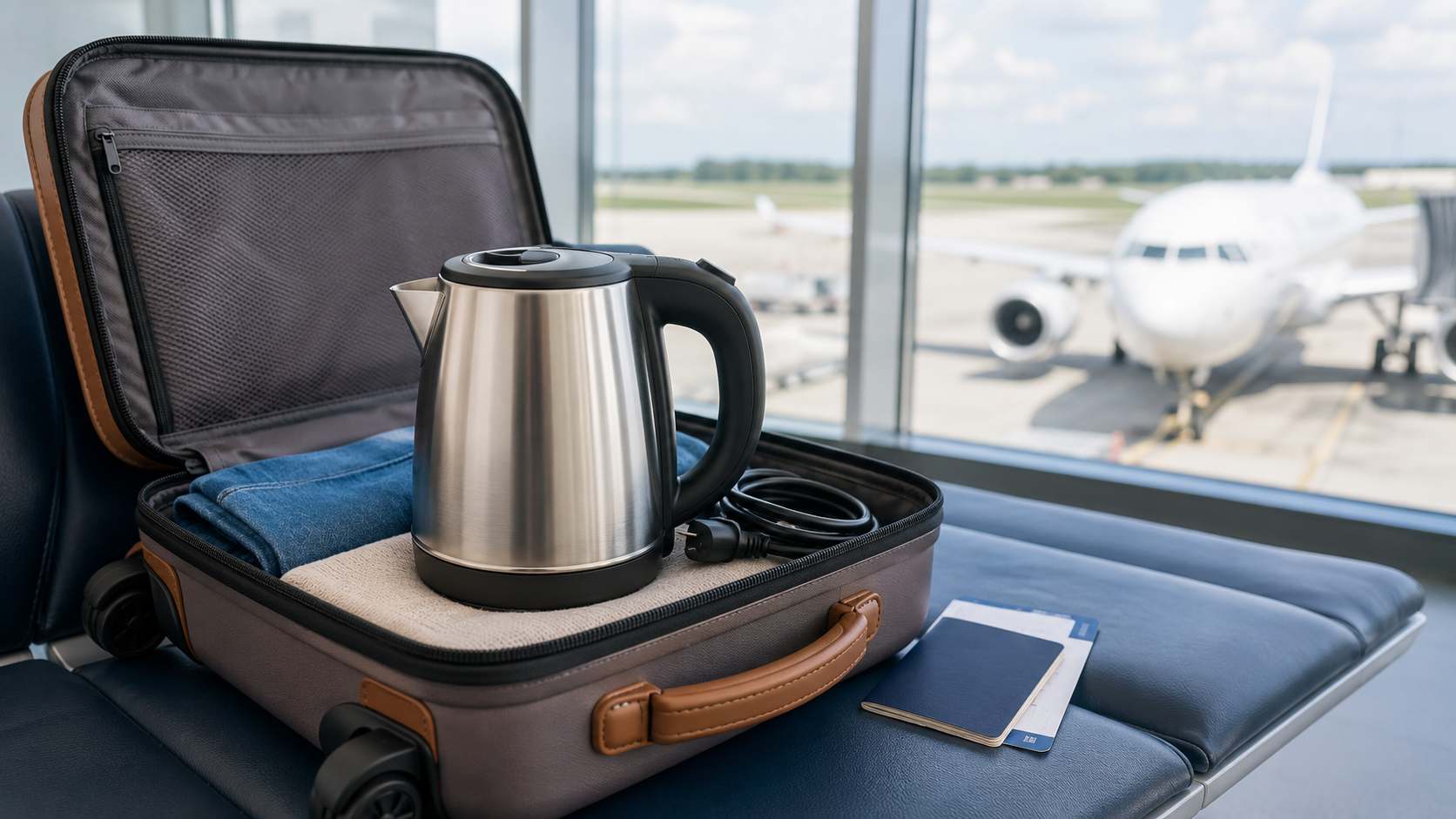
Short version: a standard corded electric kettle is allowed in flight. It goes in checked baggage almost everywhere, and most airlines let you carry it in the cabin too, as long as it’s empty of water. The confusion only starts with battery-powered travel kettles, in-flight use, and a few Indian carriers that quietly prefer you check it in. Here’s every answer in one scroll.
Quick Answer: Is an Electric Kettle Allowed in Flight?
An electric kettle is treated as a small appliance, not a weapon or a chemical, so the object itself is rarely the problem. What matters is whether it has a lithium battery, and whether the airline wants it in the cabin or the hold. Use this table as your fast reference.
| Kettle type | Carry-on | Checked bag | Use during flight |
|---|---|---|---|
| Corded (plug-in) kettle | Usually yes, empty and dry | Yes | No |
| Battery/cordless travel kettle (≤100Wh) | Yes, battery in cabin | Battery not allowed loose in hold | No |
| Battery kettle (100–160Wh) | Airline approval needed | No | No |
| Battery kettle (>160Wh) | Banned | Banned | No |
If you own an ordinary corded kettle, you’re in the clear. Empty it, dry it, and pack it. The rest of this guide is for the edge cases that trip people up.
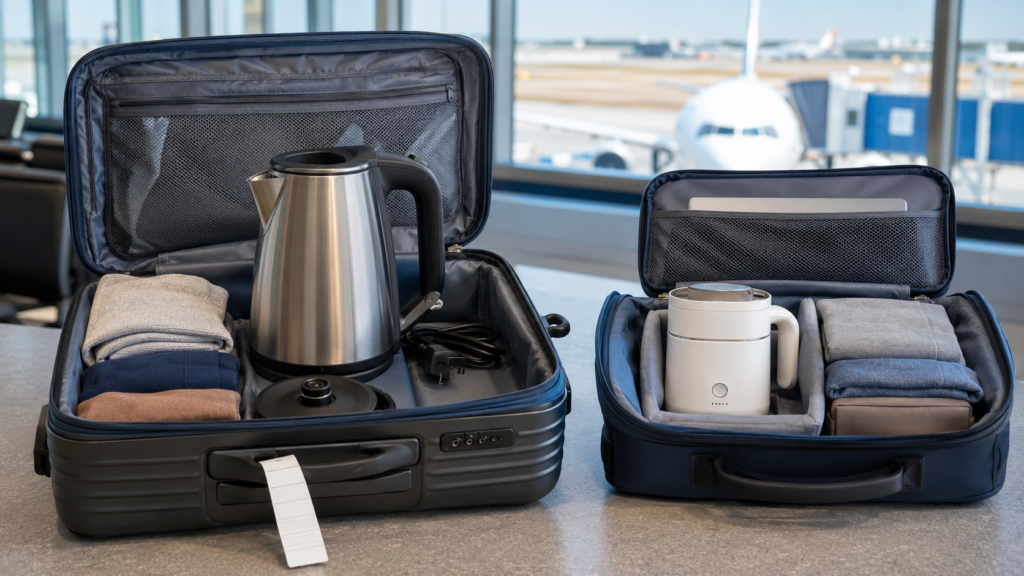
Checked Baggage vs. Carry-On: What’s the Real Difference?
There are actually two separate rules at play, and mixing them up is the number-one reason people get contradictory answers online.
The appliance rule. A corded kettle has no battery and no fuel, so it carries no thermal or fire risk when it’s switched off and empty. Security officers just want to see that it’s dry inside — a kettle full of water reads as liquid and can be flagged. Empty it before you reach the checkpoint and it’s simply a metal-and-plastic object.
The battery rule. Cordless travel kettles run on lithium-ion cells, and lithium batteries follow strict watt-hour (Wh) limits set by aviation regulators worldwide: under 100Wh is fine in the cabin, 100–160Wh needs airline approval, and anything over 160Wh is banned outright. Crucially, spare and built-in lithium batteries must travel in the cabin, never in checked baggage, because a fire in the hold can’t be reached. So a battery kettle is one of the rare items that is often safer to carry on than to check — the opposite of a corded one.
Why do airlines still hesitate over corded kettles? It’s the exposed heating element and the small chance of accidental activation in a packed bag, not the material. That’s why some carriers push them into checked luggage even though nothing about them is technically prohibited.
TSA and US Domestic and International Flight Rules
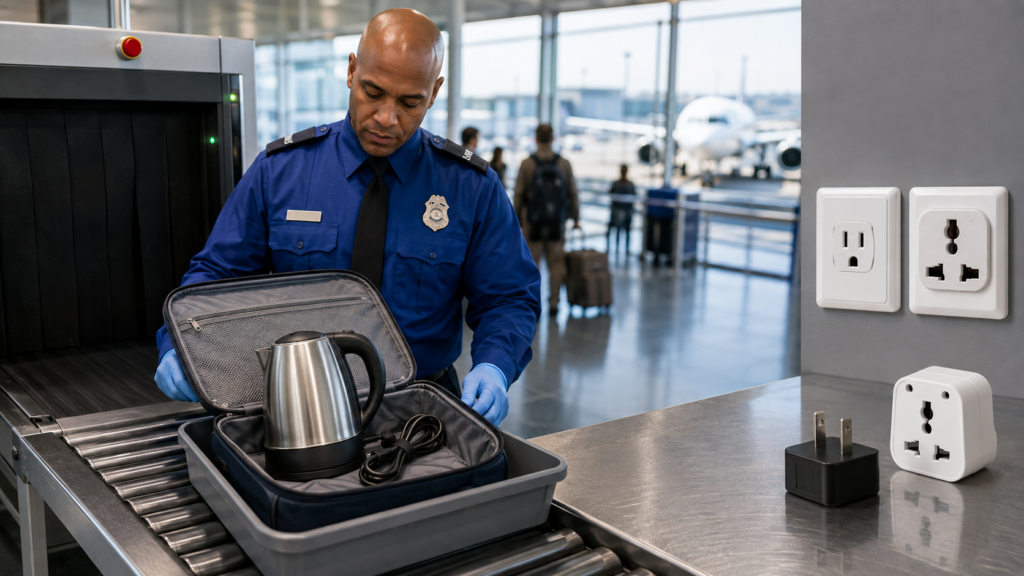
The TSA’s official guidance on tea kettles is refreshingly blunt: they’re allowed in both carry-on and checked bags, with the standard note that the final decision at the checkpoint rests with the security officer. In practice, a corded kettle sails through US screening without issue.
Two caveats. First, officer discretion is real — if a kettle’s dense metal base or coiled cord looks odd on the X-ray, expect a bag check. Second, on international routes the deciding factor shifts from the airline to battery watt-hours and to what you’ll do with the kettle at your destination. A 120V US kettle won’t work on a 220–240V outlet abroad without a voltage mismatch, and vice versa, so the practical question of “will this even function here” matters as much as the security one. If you want to understand why voltage and power draw matter, our guide on how many watts an electric kettle uses explains the numbers.
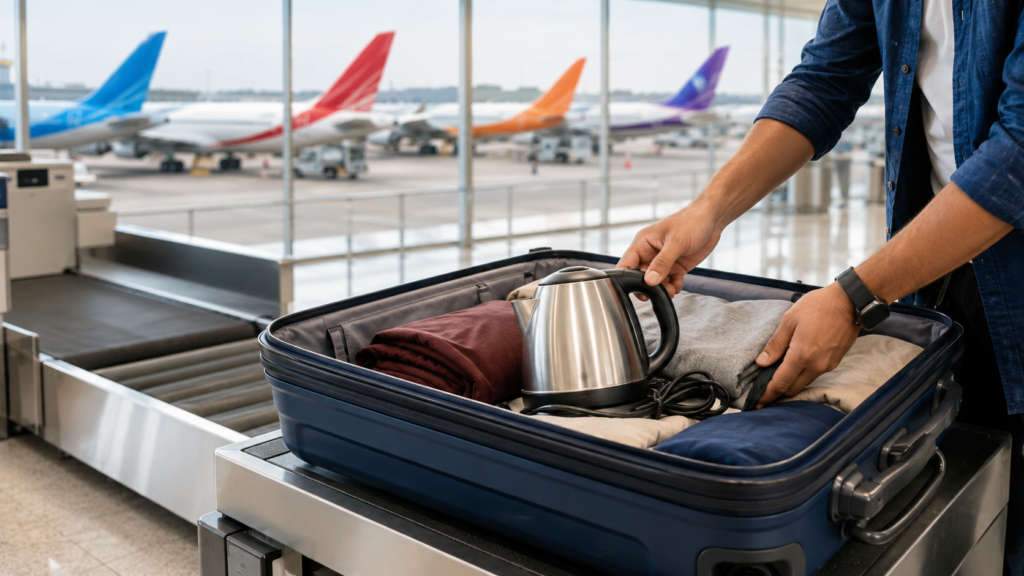
Is Electric Kettle Allowed in Flight in India? IndiGo, Air India, Air India Express and Akasa Air
India’s carriers are where the internet goes quiet, so here’s the consolidated view. India’s DGCA follows the same global dangerous-goods framework as everyone else: the kettle appliance is permitted, and lithium batteries follow the standard Wh limits. The variation is in each airline’s cabin preference.
| Airline | Checked baggage | Cabin baggage | Notes |
|---|---|---|---|
| IndiGo | Allowed | Check-in preferred | IndiGo’s own customer support has advised passengers to place electric kettles in check-in luggage rather than carry them in the cabin. |
| Air India | Allowed | Allowed if empty | Covered under general small-appliance/dangerous-goods policy; the airline doesn’t single kettles out. Checked bag is the safe choice. |
| Air India Express | Allowed | Allowed if empty | Same restricted-baggage framework as the parent airline; keep it empty and be ready to explain it. |
| Akasa Air | Allowed | Allowed if empty | Falls under standard personal-electronics/appliance rules; no specific kettle ban published. |
Bottom line for an Indian domestic flyer: if you want zero friction, put the kettle in your checked bag. Every major carrier allows it there without argument, and it sidesteps the cabin gray area entirely. This holds whether you’re on an IndiGo domestic hop or a longer Air India route.
Domestic vs. International Flights: What Changes
On domestic flights, especially within India, the airline’s own cabin-baggage preference is the deciding factor — hence the “check it in” trend above. On international flights, the airline preference still applies, but the harder limit becomes the lithium battery Wh threshold enforced by TSA, EASA and their equivalents. A corded kettle crosses borders freely; a cordless one over 160Wh will be stopped at the gate regardless of which country you’re in. Kettles with sealed, non-removable batteries get extra scrutiny at international checkpoints because staff can’t verify the rating — keep the manual or a photo of the Wh label handy.
Is an Electric Water Heater or Immersion Rod Allowed in Flight?
This is a different query with a stricter answer. Immersion water heaters — those bare-coil rods you drop into a cup — are treated more cautiously than enclosed kettles because the heating element is exposed and easy to activate by accident. They’re generally fine in checked baggage, wrapped and protected, but many travelers report cabin pushback. If you rely on hot water on the road, a proper enclosed travel kettle is the smarter thing to pack. And whatever you carry, know the signs of a failing element — our piece on fixing an electric kettle that stops working covers what heating-element damage looks like.
Can You Use an Electric Kettle During the Flight?
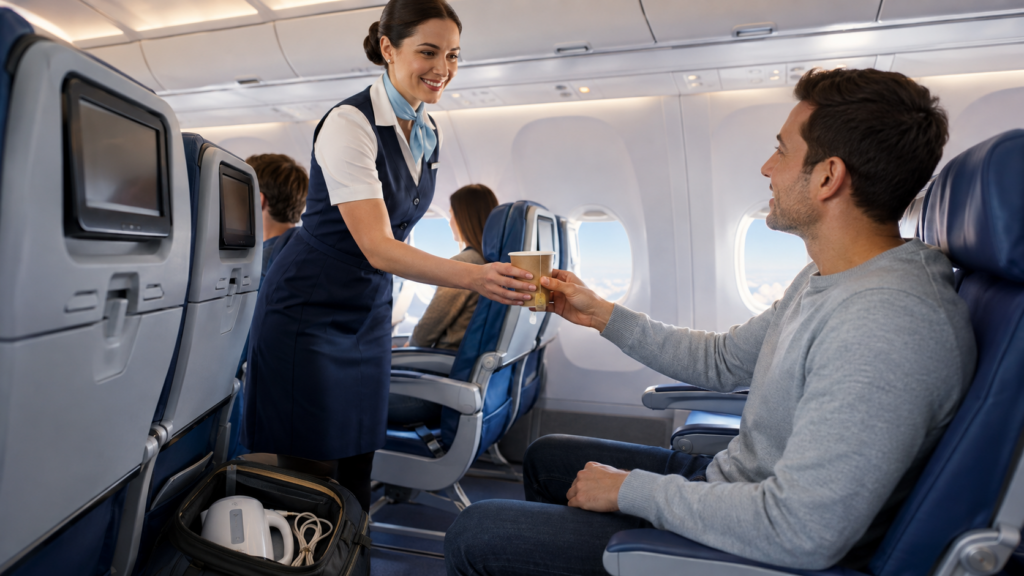
No. Personal heating appliances cannot be plugged in or operated onboard any commercial aircraft. There’s no compatible outlet at your seat, and cabin crew treat any passenger-supplied heating device as a fire risk. Trying to run one will get it confiscated at best. The simple workaround: ask the crew for hot water — they’ll happily fill a cup for tea or coffee. If you’re planning your first proper cup on arrival, our guide to making coffee with an electric kettle has ratios worth bookmarking.
How to Pack Your Electric Kettle for Flying: A Checklist
- Empty and fully dry it. No water inside — residual liquid gets flagged at security and can leak in the hold.
- Wrap the cord loosely around the base and secure it so it can’t snag or press a switch.
- Remove loose parts. Pack the lid, filter and any detachable base separately so nothing cracks under pressure.
- Cushion it. Wrap the kettle in clothing whether it’s going in checked or carry-on; the shell and heating plate are the fragile parts.
- Keep proof of the battery rating if it’s a cordless model — a photo of the Wh label or the manual settles any gate-side question fast.
- Be ready to explain it. If asked at check-in, say it’s an empty appliance; a screenshot of the airline’s policy ends the conversation.
While you have it open, it’s a good moment to check the inside — a kettle that’s been in storage can hide rust or mold you don’t want steeping in your first cup abroad.
Can We Use an Electric Kettle in a Train?
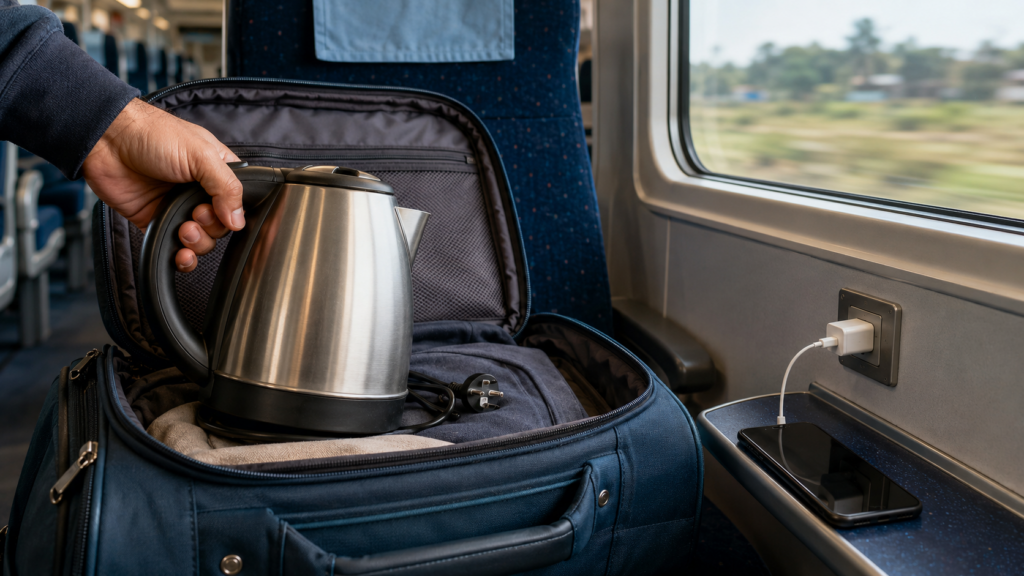
Carrying a kettle as luggage on a train is generally fine — IRCTC and most rail operators treat it as ordinary personal baggage. Using one onboard is the restricted part. Standard coaches don’t have suitable high-draw sockets, and plugging a 1,000W+ appliance into a charging point isn’t permitted; it can trip the circuit or trigger a safety response. The exception is premium and AC coaches fitted with 230V sockets, but even there, unauthorized appliance use is discouraged. Treat train sockets as phone chargers, not kettle outlets.
How to Use an Electric Kettle in a Car
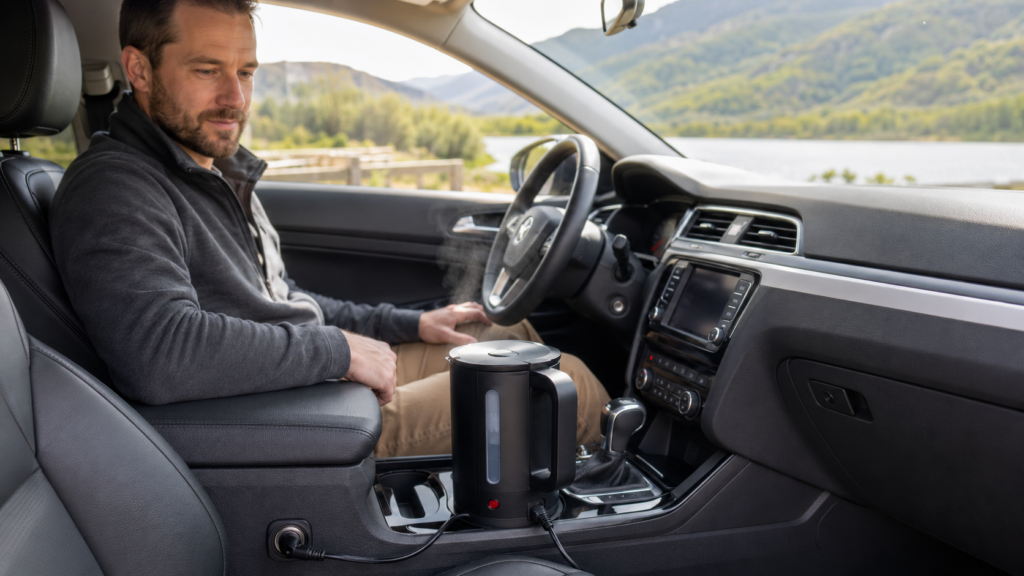
Here’s the good news for road-trippers: car kettles exist specifically for this. A 12V (or 24V for trucks) car kettle plugs into the cigarette-lighter or accessory socket and draws low enough power to run safely off the vehicle. None of the flight restrictions apply — it’s the ideal way to get hot water on a drive when a mains kettle would be useless. Two safety basics: never leave it boiling unattended, and choose a model with boil-dry protection, since 12V kettles heat slowly and it’s easy to forget one’s running. For the trade-offs between kettle types, our electric kettle vs stove vs microwave comparison is worth a look before you buy a travel unit.
The Bottom Line
Is an electric kettle allowed in flight? For a normal corded kettle, yes — check it in and you’ll never have a problem, and most airlines allow it in the cabin empty too. Battery kettles follow lithium Wh limits and belong in the cabin, not the hold. In India, default to checked baggage across IndiGo, Air India, Air India Express and Akasa. And for hot water on the move, a 12V car kettle beats fighting airline and train rules every time.
Frequently Asked Questions
Is an electric kettle allowed in flight on IndiGo?
Yes. IndiGo allows an electric kettle, but the airline’s customer support has advised passengers to pack it in check-in luggage rather than carry it in the cabin. Keep it empty and dry.
Is an electric kettle allowed in flight with Air India or Air India Express?
Yes. Both carriers permit a corded electric kettle under their general dangerous-goods and small-appliance rules. It’s allowed in checked baggage, and in the cabin if empty. Checked baggage is the friction-free option.
Is an electric kettle allowed in domestic and international flights?
Yes to both. On domestic flights the airline’s cabin preference decides where it goes; on international flights the lithium battery watt-hour limit (under 100Wh safe, over 160Wh banned) is the deciding factor for cordless models. Corded kettles travel freely either way.
Can I carry an electric kettle in check-in luggage?
Yes, this is the safest choice everywhere. A corded kettle has no battery risk, so it’s unrestricted in checked baggage. Only cordless kettles with lithium batteries must stay in the cabin instead.
Is an electric water heater or immersion rod allowed in flight?
Generally yes in checked baggage, wrapped and protected, but immersion rods face more cabin scrutiny than kettles because the heating coil is exposed. Pack them in the hold to avoid delays.
Can I use an electric kettle during the flight?
No. Personal heating appliances cannot be plugged in or operated onboard any commercial aircraft for fire-safety reasons, and there’s no compatible outlet at your seat. Ask cabin crew for hot water instead.
Leave a Reply