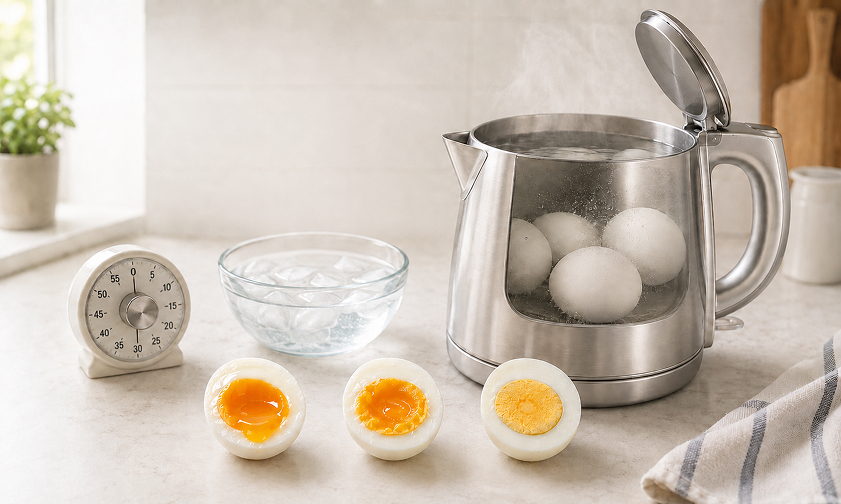
Yes, you can boil eggs in an electric kettle, and it works better than most people expect. But nearly every guide online treats all kettles the same, and that’s why readers report cracked shells, undercooked yolks, and a lingering egg smell in their morning tea. The method changes depending on whether you own a basic water-only kettle or a multipurpose one with an egg rack — and the timing only works if you start the clock at the right moment.
Here’s the complete method, the exact times, and the one safety rule that actually matters.

Can We Boil Eggs in an Electric Kettle? The Honest Answer
Yes — with one caveat. The safety of boiling eggs comes down to your kettle’s heating element, not the eggs themselves.
- Concealed or flat-plate element (most modern kettles): Safe. The heating element sits under a stainless steel base, so the eggs never touch it. This covers the vast majority of Prestige, Havells, Philips, and similar models sold today.
- Exposed heating coil (older or budget kettles): Risky. If an egg cracks and leaks onto a bare coil, you get baked-on residue that’s hard to clean and can shorten the element’s life. We’d skip it on these.
Not sure which you have? Look inside. If you see a visible metal coil sitting in the water, it’s exposed. If the bottom is a smooth flat disc, the element is concealed. If you want the full breakdown of how the element sits inside the appliance, our guide on how an electric kettle works explains it plainly.
Is it safe to boil eggs in an electric kettle? For a concealed-element kettle, yes — it’s as safe as boiling on a stove. The real risks are cracked shells making a mess and residue if you don’t clean up afterward, not danger to you.
A quick word on warranties: many manuals say “for boiling water only.” That’s standard liability language, not a warning that eggs will destroy your kettle. In practice, boiling eggs occasionally in a concealed-element kettle is fine. If your kettle is under warranty and you’re worried, know that the manufacturer could point to that clause — but the actual mechanical risk to a flat-plate kettle is minimal.

Two Methods: Basic Kettle vs. Multipurpose Kettle With an Egg Rack
Before you cook, figure out which kettle you own. This is the step every other guide skips.
Method 1: Basic Water-Only Kettle
This is the standard glass or stainless kettle most people have. The eggs go directly into the water:
- Take the eggs out of the fridge 10–15 minutes early so they warm to room temperature — cold eggs hitting hot metal are the number one cause of cracking.
- Lower each egg in gently with a spoon. Keep them in a single layer so they cook evenly.
- Cover the eggs with cold water by 1–2 cm above the shells.
- Close the lid, switch on, and let the kettle run to its automatic shut-off.
Method 2: Multipurpose Kettle With an Egg Rack or Steamer Tray
Many multipurpose kettles — Agaro, Pigeon-style, and similar models — ship with a small perforated egg rack or steamer basket. This changes the method entirely: the eggs sit above a shallow layer of water and cook by steam, not submersion.
- Add just enough water to cover the base — usually 1 to 1.5 cm, or follow the marked line if your kettle has one.
- Place the egg rack in and set the eggs in the slots.
- Close the lid and switch on. Steam-boiling is gentler, so shells crack less often and peeling is easier.
Brand note: Prestige and Havells kettles are usually basic water-only models, so use Method 1. Agaro and many Pigeon multipurpose kettles include the rack — check the box; if yours came with a tray, use Method 2. When in doubt, Method 1 works for any concealed-element kettle.
How Long to Boil Eggs in an Electric Kettle: The Exact Timing Chart
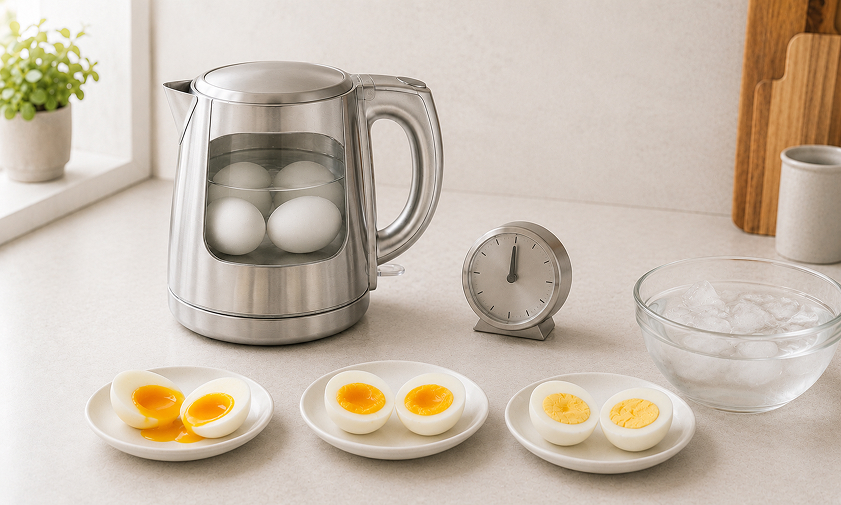
Here’s the single most important rule, and the one nobody states clearly: start the timer the moment the kettle clicks off — not when you switch it on. The eggs finish cooking in the residual heat of the water after shut-off. Time it from the boil, and you’ll get inconsistent results every time.
So the sequence is: kettle boils, kettle auto-shuts-off, then you start counting while the eggs rest in the hot water with the lid closed.
| Result | Rest time after shut-off | What you get |
|---|---|---|
| Soft-boiled | 6 minutes | Runny yolk, set white — for dipping |
| Medium / jammy | 8 minutes | Creamy, custardy center |
| Hard-boiled | 10–12 minutes | Fully set yolk, firm white |
So how many minutes to boil an egg in an electric kettle? Count from shut-off: 6 for soft, 8 for medium, and 10–12 for a proper hard boil. If your kettle is on the smaller side (0.5L travel models) and cools fast, add a minute.
Adjustments that matter:
- Large or extra-large eggs: add 1 minute to each time above.
- Straight from the fridge: add 1–2 minutes, though room-temp eggs give you more reliable, crack-free results.
- High altitude (above ~1,500 m / 5,000 ft): water boils cooler, so add 2–3 minutes to the hard-boil range.
How to Hard Boil Eggs in an Electric Kettle
To make hard-boiled eggs specifically: use Method 1, bring to a full auto shut-off, and leave the eggs in the hot water for a full 12 minutes for large eggs. Don’t lift the lid to check — you’ll release the heat that’s doing the cooking. When the 12 minutes are up, move straight to the ice bath below.
Cooling and Peeling
The instant your timer ends, transfer the eggs into a bowl of ice water and leave them for 3 minutes. This does two things: it stops the cooking so your yolk doesn’t turn chalky or go grey around the edge, and it contracts the egg slightly from the shell so peeling is far easier.
To peel, crack the egg all over and roll it gently on the counter, then peel under a thin stream of running water. The water slips under the membrane and lifts the shell off in bigger pieces.
Is the Water Still Safe to Drink or Use for Tea Afterward?
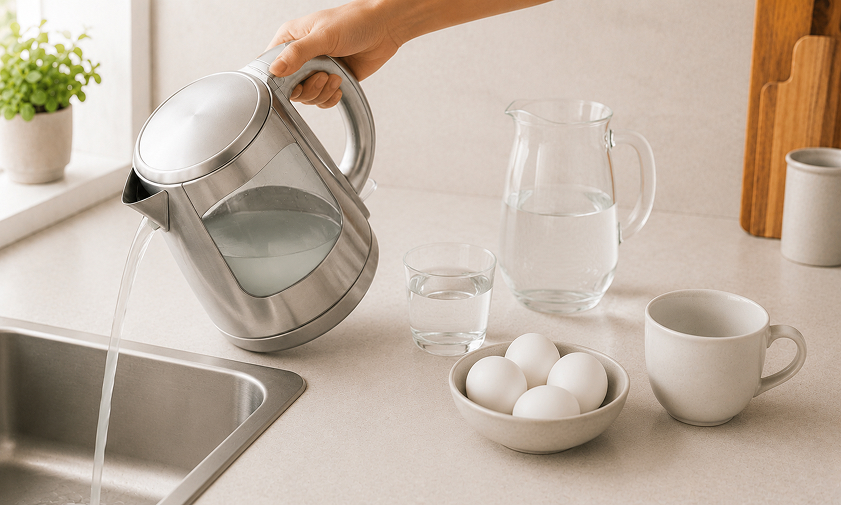
This is the question that stops people from trying the method at all. The short answer: the water is technically safe, but we wouldn’t use it for tea or coffee right after.
Egg shells can carry surface bacteria and leave a faint sulfur trace in the water and on the kettle wall. It won’t hurt you, but it can taint the flavor of your next brew. Our recommendation: tip out the egg water, then run one plain boil-and-discard cycle with fresh water before you make anything you’ll drink. That flushes out any residue and smell.
If you want the deeper explanation of what’s actually in your boiled water, we cover it in is water boiled in an electric kettle safe.
Troubleshooting: Cracked Eggs and Cleanup
Why Eggs Crack — and How to Stop It
Three causes account for nearly every cracked egg:
- Temperature shock: cold eggs meeting hot metal. Fix: room-temp eggs, added to cold water before heating.
- Overcrowding: eggs knocking against each other during the boil. Fix: single layer, a little space between them.
- Exposed-coil contact: an egg resting directly on a bare heating element. Fix: use the egg rack, or don’t boil eggs in an exposed-coil kettle at all.
A pinch of salt in the water won’t stop cracks, but it does help the whites set faster if a shell does split, which limits the mess.
Cleaning Egg Residue and Smell
If an egg cracks, you may get a thin film or a lingering smell. Empty the kettle, wipe the interior with a cloth, then boil a solution of water with a tablespoon of white vinegar (or a squeeze of lemon), let it sit 10 minutes, and rinse. That clears both the film and the odor. For a stubborn smell, repeat once. For a full descaling and deep-clean walkthrough, follow our complete guide on using your electric kettle the right way, which covers routine care so residue never builds up.
And if your kettle stops heating properly after heavy use, that’s usually scale or the element — not the eggs. Our symptom-by-symptom repair guide walks through the fixes.
Frequently Asked Questions
Can you put raw eggs directly in an electric kettle?
Yes, in a basic concealed-element kettle. Lower them in gently with a spoon, cover with cold water, and let the kettle run to auto shut-off. If your kettle has an exposed heating coil, use an egg rack or avoid the method entirely.
Do you start timing before or after the kettle switches off?
After. Start the clock the moment the kettle clicks off, then let the eggs rest in the hot water — 6 minutes for soft, 8 for medium, and 10–12 for hard-boiled. Timing from when you switch it on gives inconsistent results.
How long do you boil eggs in an electric kettle for hard boiled?
Leave large eggs in the hot water for 10–12 minutes after the kettle shuts off, using 12 minutes for a fully firm yolk. Add a minute for extra-large or fridge-cold eggs, then move straight to an ice bath.
Can you boil more than one egg at a time in a kettle?
Yes. A standard 1.5L kettle comfortably holds 4–6 eggs in a single layer. Keep them from stacking or knocking together so they cook evenly and crack less.
Is it safe to make tea in the same kettle after boiling eggs?
The water is safe, but egg shells can leave a faint sulfur trace. Tip out the egg water and run one plain boil-and-discard cycle with fresh water before brewing tea or coffee.
Do multipurpose kettles need an egg rack to boil eggs?
If your kettle came with a rack or steamer tray (common on Agaro and Pigeon models), use it — the eggs steam-cook above shallow water and crack less. Basic kettles don’t need one; the eggs go straight into the water.
Leave a Reply